Lesson 06 — Independent Health Management: Sleep, Movement, Nutrition
Learners build the first half of an independent health plan: sleep, movement, and nutrition. They learn evidence-based ranges (teenagers about 8–10 hours of sleep; regular movement that includes aerobic and muscle-strengthening activity; varied eating), and they fit those ranges to their own body, pace, and life through self-observation — treating guidance as ranges, never rigid rules, and never grading any body.
Objectives
Objectives
- D03.S4.12.01 Manage their own health independently, integrating sleep, movement, nutrition, mental health, and medical care.
Essential question
Now that no one is telling me when to sleep, move, and eat, how do I tend these three things myself — in a way that fits my body, my pace, and my life?
Key vocabulary
Materials
Standard materials
- Three-pillar plan sheet · 1 per learner Three columns — sleep, movement, nutrition — each with a "what I know (range)" line, a "what my body tells me" line, and a "my small step" line
- Health & care journal · 1 per learner The unit-long notebook for plans and portfolio artifacts
Low-tech / no-cost
- Paper and any writing tool A hand-drawn three-column sheet works identically
- One's own body and a clock or daylight Self-observation needs nothing beyond noticing how you feel after sleeping, moving, and eating
Enriched / lab & device
- A sleep/movement tracking app or simple log · optional For learners who want to log patterns over a few days; always optional, never required
Works in different contexts
- large-group Model the three-pillar worked example whole-class, then learners fill their own sheet in pairs
- multi-age Younger learners name one sleep, one movement, and one nutrition habit they already have; older learners also set a measurable small step
- self-directed A learner builds the three-pillar sheet alone and writes the small step for each pillar
- level-grouped A ready group also distinguishes a *range* (what evidence says) from a *rule* (a rigid target that ignores bodies)
- outdoor-only Use daylight, the body's own tiredness, and real foods to set each pillar, naming one movement possible outdoors
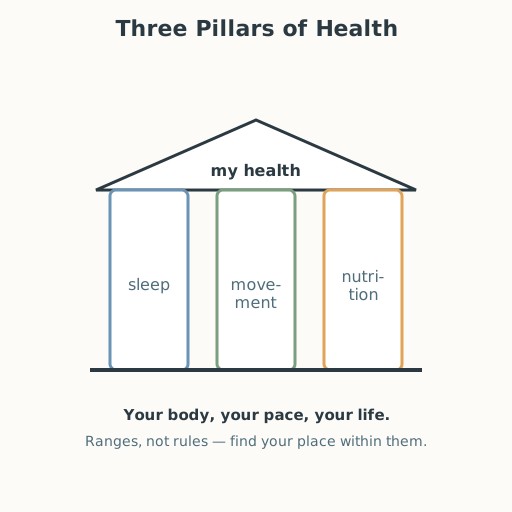
Lesson 6 — Independent Health Management: Sleep, Movement, Nutrition
Summary
Learners build the first half of an independent health plan: sleep, movement, and nutrition. They learn evidence-based ranges (teenagers about 8–10 hours of sleep; regular movement that includes aerobic and muscle-strengthening activity; varied eating), and they fit those ranges to their own body, pace, and life through self-observation — treating guidance as ranges, never rigid rules, and never grading any body.
Objectives
- Manage their own health independently, integrating sleep, movement, nutrition, mental health, and medical care — beginning with the first three. (D03.S4.12.01)
Connection
Leaving home, you become the person who decides when you sleep, how you move, and what you eat. Independence is not doing whatever feels good in the moment; it is tending these three things like a garden you now own. The good news is that you already know more than you think — your body has been telling you what works. Today you learn to listen to it, with a little science to guide you.
Materials
- Three-pillar plan sheet
- Health & care journal
- Low-tech: paper and any writing tool; one’s own body and a clock or daylight
- Enriched: an optional sleep/movement log
Preparation
- Copy or draw the three-column sheet (sleep / movement / nutrition, each with “what I know,” “what my body tells me,” “my small step”).
- Retrieval: from Grade 8 (D03.S4.08.02), a personal self-care routine covering sleep, hygiene, movement, and connection; from Grade 10 (D03.S2.10.01), a safe and sustainable movement plan. Today we make the plan independently ours.
- Prepare the worked example (one pillar filled in) to model first (S-011).
Facilitator note
This lesson is written to the learner (“you”). The idea to land: independent health management means tending sleep, movement, and nutrition yourself — guided by evidence-based ranges, adapted by self-observation, and free of rigid rules or any judgment of a body. Teach one filled-in pillar as a worked example, then let learners complete their own (S-011). Lead with dignity: a learner with a disability, an illness, an eating-disorder history, or a life that makes “8 hours” impossible must never be graded on the targets. Ranges describe tendencies, not verdicts; the goal is tending, not scoring.
The ethics lens: we treat a person’s body and habits with the respect we owe a person — describing, not prescribing shame. The egalitarianism lens: the same ranges serve every body, but every body meets them differently — a person who uses a wheelchair moves differently, a person with insomnia sleeps differently — and none is worth less. The global lens: sleep, movement, and eating look different across cultures and climates — a midday rest in one place, a dawn run in another, a shared late meal elsewhere — and all can be healthy. The technology lens: trackers and apps can help you notice patterns, but they can also turn health into a scoreboard that feeds anxiety; use them as a mirror, never as a judge. The environment lens: where you live shapes how you can move and sleep — a walkable neighborhood, a safe green space, a quiet room — and the plan must fit the place. Preview: Lesson 7 adds mental health and medical care; Lesson 8 weaves all five into one lifelong plan.
Procedure
- Recall (5 min). From Grade 8: name one self-care routine you built for sleep, hygiene, movement, or connection. Today we make those routines ours to run, not just to follow.
- Meet the idea (8 min). Write it down: independent health management is tending your own wellbeing with knowledge and attention — starting with three pillars: sleep, movement, nutrition. The science gives you ranges; your own body and life tell you where within them you belong.
- Worked example — the ranges (15 min). Model each range and note it is a range, not a rule: sleep — teenagers about 8–10 hours a night (S-050); movement — regular activity that includes both aerobic and muscle-strengthening work, done at your own capacity (S-069); nutrition — varied eating across food groups, with water as the everyday drink (S-038, S-049). For each, write what the evidence says (a range) on your sheet.
- Name the move — range, not rule (8 min). A range says “most people in this group thrive around here”; a rule says “everyone must.” Your job is to find your place in the range by self-observation: notice how you actually feel after sleeping, moving, and eating. Write one thing your body has already told you about each pillar.
- Guided practice (15 min). With a partner, complete your three-pillar sheet — a range, a body-signal, and a small step for each. Exchange and check each other: is each small step small enough to actually take, and kind rather than punishing? Say — or write, sign, gesture, or use AAC to show — your one smallest step and when you will try it.
- Write it (5 min). In your journal, write your three small steps as a single sentence of intent: I will ____, ____, and ____ this week, and I will notice how I feel.
- Close (2 min). Say — or write, sign, gesture, or use AAC to express — the difference between a range to find yourself in and a rule to obey.
Differentiation
- Support: Use the sheet pre-filled with the three ranges; the learner adds only one body signal and one small step rather than all three.
- Extension: For one pillar, distinguish what is a measurable fact (a sleep range, an activity guideline) from what is a personal value (how much to prioritize each), and note where the two could conflict and how you would resolve it.
- Number access (dyscalculia): The ranges (8–10 hours) are read as “about this much, more or less,” never computed; provide the three-column sheet pre-printed with the ranges already written, and allow every step to be expressed in words, drawings, or gesture with no arithmetic at all.
- Communication access: Every spoken step — saying, naming, reading aloud, discussing, or closing — can be done in writing, sign, gesture, or AAC instead. Learners who are non-speaking, d/Deaf, hard-of-hearing, or who use AAC complete every task in their preferred mode; no step requires producing or hearing sound.
Assessment
- Formative (peer + self): Can the learner state each range as a range, name a body signal for each pillar, and set one kind, small step for each?
- Portfolio artifact (unit): The completed three-pillar sheet plus the sentence of intent, opened in the health & care journal.
Home connection
At home, notice — without judgment — how you felt after one night’s sleep, one bout of movement, and one meal. Write one sentence for each: what helped, and one thing you might do the same or differently next time.
Resources
- On worked examples and guided practice for a new concept: Kirschner, Sweller & Clark (2006) (S-011).
- On sleep duration for teenagers: AASM — Recommended Amount of Sleep (S-050).
- On physical activity guidance: WHO — Physical activity fact sheet (S-069).
- On a healthy, varied diet and water: WHO — Healthy diet (S-038); WHO — Drinking-water (S-049).