Lesson 10 — Emergency Response: Basic Skills
Learners learn basic emergency response: check the scene and the person, call the local emergency number, and care with the few skills an untrained responder can safely give — the recovery position for an unresponsive breathing person, direct pressure for severe bleeding, cooling for burns, and help for choking. They learn that calling for help and knowing one's limits are themselves first-aid, and that deeper skills are best learned hands-on from a certified instructor. The framing empowers without inducing anxiety.
Objectives
Objectives
- D03.S4.12.02 Explain how to care for the health and safety of others, including basic emergency response and caregiving, and when to step in.
Essential question
In the first minutes of an emergency, what three moves — check, call, care — can I make, and how do I know my own limits?
Key vocabulary
Materials
Standard materials
- Check-call-care card · 1 per learner A wallet-size card with the three steps, the learner's local emergency number written in, and one line per common emergency
- Health & care journal · 1 per learner The unit-long notebook for reflection and the emergency-response plan artifact
Low-tech / no-cost
- Paper and any writing tool A hand-drawn three-step card works identically
- One's own voice and hands The core skills — checking, calling, pressing, cooling — need no device beyond a person
Enriched / lab & device
- A certified first-aid instructor or a CPR manikin · 1 session, if available Hands-on practice of recovery position and CPR with a trained instructor (S-082, S-313); never practiced on a peer
Works in different contexts
- large-group Model check-call-care whole-class, then pairs rehearse the steps aloud (never practicing thrusts or CPR on a peer)
- multi-age Younger learners learn check-call-care and the local number; older learners also rehearse the recovery-position and pressure steps
- self-directed A learner writes the check-call-care card, fills in their local number, and reviews the one-line steps for each emergency
- level-grouped A ready group also discusses the limits of an untrained responder and when professional help must take over
- outdoor-only Practice scene-safety and calling for help in a real outdoor setting, naming local hazards before approaching
Lesson 10 — Emergency Response: Basic Skills
Summary
Learners learn basic emergency response: check the scene and the person, call the local emergency number, and care with the few skills an untrained responder can safely give — the recovery position for an unresponsive breathing person, direct pressure for severe bleeding, cooling for burns, and help for choking. They learn that calling for help and knowing one’s limits are themselves first-aid, and that deeper skills are best learned hands-on from a certified instructor. The framing empowers without inducing anxiety.
Objectives
- Explain how to care for the health and safety of others, including basic emergency response and when to step in. (D03.S4.12.02)
Connection
In a crisis, the first minutes matter, and the most important first-aider is often the nearest ordinary person — you. Most of the time, an emergency does not call for a hero; it calls for three calm moves anyone can learn: check, call, care. Knowing them turns panic into a plan, and the plan is the same in a city, a village, a field, or a boat.
Materials
- “Check, call, care” card
- Health & care journal
- Low-tech: paper and any writing tool; one’s own voice and hands
- Enriched: a certified first-aid instructor or CPR manikin (optional)
Preparation
- Copy or draw the three-step card, leaving a blank for the learner’s local emergency number.
- Retrieval: from Grade 5 (D03.S4.05.01), calling for help and what information to give; from Grade 7 (D03.S4.07.01), first aid for bleeding, burns, and choking. Today we make the response adult-level: check, call, care, and know your limits.
- Prepare the worked example (the check-call-care sequence) to model first (S-011).
Facilitator note
This lesson is written to the learner (“you”). The idea to land: emergency response is three calm moves — check the scene and person, call the emergency number, care within your limits — and calling for help and knowing your limits are themselves first aid. Teach the sequence explicitly as a worked example, then let learners rehearse the safe parts (S-011). Keep it empowering, never frightening: the message is you can do this, not danger is everywhere. Two safety rules are non-negotiable: learners never practice thrusts or CPR on a peer, and hands-on skills are learned from a certified instructor, not from this lesson alone (S-082, S-313). Emergency numbers are region-specific — 112, 999, 911, 000, and local numbers differ — so the card always carries the learner’s own local number, filled in locally (S-195).
The ethics lens: an emergency is a moment where another person’s life may depend on you — the ethical core is act to help, and do no further harm, which is exactly why we learn limits. The egalitarianism lens: first aid belongs to everyone, not to professionals — the nearest person, of any background, is the one who can begin help. The global lens: emergency numbers and services differ worldwide, and the basic moves are international — the IFRC’s guidelines are taught across more than 190 countries (S-082). The technology lens: a phone can summon help in seconds and guide an untrained responder, but it cannot replace the person who checks and cares. The environment lens: scene safety is environmental awareness — check for traffic, fire, water, or unstable ground before you approach. Preview: this closes the unit; the capstone portfolio gathers the lifelong plan, the caregiving circle, and this card.
Procedure
- Recall (5 min). From Grade 7: name one first-aid step for a cut, a burn, or choking. Today we organize everything into one adult-level sequence: check, call, care.
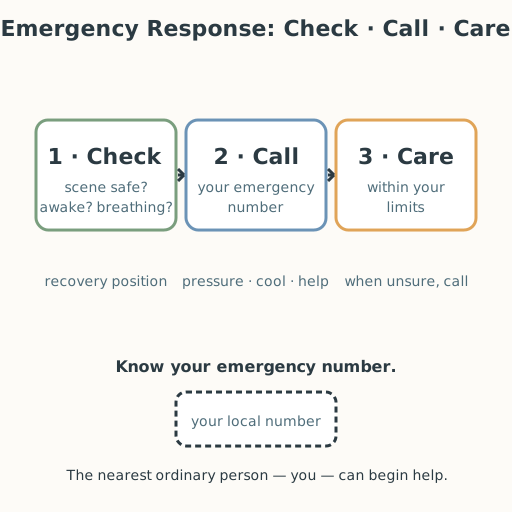
- Meet the idea (8 min). Write it down: in any emergency, three moves, in order. Check — is the scene safe, and is the person awake and breathing? Call — your local emergency number, and say where you are and what is wrong. Care — do the few things you are able to do, within your limits.
- Worked example — the sequence (15 min). Model each move. Check: look for danger (traffic, fire, water) before you approach; then check the person — awake? breathing? Call: the emergency number (fill in yours on the card, S-195); give the location and the problem, and do not hang up until told. Care: if the person is unresponsive but breathing, place them in the recovery position (on their side, airway open); if they are not breathing, begin CPR if you are trained and get help fast; for severe bleeding, press firmly with a clean cloth; for a burn, cool under cool running water (never ice); for choking, call for help and give back blows/thrusts only if trained (S-313, S-082, S-121). Write the one-line version on your card.
- Name the move — know your limits (8 min). First aid is doing what you can and getting more help. If you are unsure, the single most important care is calling for help. Write that on the card: “When unsure, call.”
- Guided practice (12 min). With a partner, rehearse the safe parts aloud: read a scenario, then say — or write, sign, gesture, or use AAC to show — your check (what danger), your call (the number and what you would say), and your care (the one step you would do). Never practice thrusts or CPR on a peer. Exchange cards and check that the local number is filled in.
- Write your card (5 min). Complete your wallet card: the three steps, your local number, and one line each for unresponsive, bleeding, burn, and choking. Keep it — or a photo of it — where you would find it in a real emergency.
- Close (2 min). Say — or write, sign, gesture, or use AAC to express — why “check, call, care” matters more than being a hero.
Differentiation
- Support: Use the card pre-filled with the three steps and the local number; the learner adds one “care” line for a single emergency rather than all four.
- Extension: State the limits of an untrained responder for each emergency, and write what a certified course (such as a Red Cross/Red Crescent first-aid course) would add (S-082).
- Number access (dyscalculia): The local emergency number is copied, never computed, and may be stored as a picture, a saved contact, or a written note; all timing and dosage-like figures (how long to cool a burn, compression details) are offloaded to the pre-printed card or a partner, and no arithmetic is required anywhere in the lesson.
- Motor access / low-mobility: Every physical skill — the recovery position, direct pressure, cooling a burn, and back blows/thrusts — can be shown without the learner physically performing it: describe the steps aloud or in writing, sequence picture cards, direct a partner or instructor to act (“roll them onto their side, airway open”), or place a doll, rolled blanket, or manikin into position. The assessment asks for knowledge of each move (what to do, when, and why) — never for physical performance — so a learner who uses a wheelchair, has low muscle tone, or limited mobility meets the objective fully by explaining and directing, exactly as a responder who can act does.
- Sensory access (low vision / blind): “Check” is not only visual. A learner who is blind or has low vision checks the scene by listening, calling out and asking others, and feeling carefully (e.g., the warmth of a surface) — or works with a sighted partner who describes what they see. What is assessed is knowing what to check for and why, not the visual act of looking.
- Communication access: Every spoken step — saying, naming, reading aloud, rehearsing, or closing — can be done in writing, sign, gesture, or AAC instead. Learners who are non-speaking, d/Deaf, hard-of-hearing, or who use AAC complete every task in their preferred mode; no step requires producing or hearing sound. Note: some emergency calls are made by text or relay in many places; learners should learn the option that works for them.
Assessment
- Formative (peer + self): Can the learner state the three moves in order, give the one-line care step for each common emergency, fill in their local number, and say what to do when unsure?
- Portfolio artifact (unit): The completed “check, call, care” card, opened in the health & care journal as the S4.12.02 capstone.
Home connection
At home, learn or confirm your local emergency number together, and agree on one place (a phone contact, a card on a wall) where everyone in the household could find it fast. Write one sentence recording the number and the place.
Resources
- On worked examples and guided practice for a new concept: Kirschner, Sweller & Clark (2006) (S-011).
- On first-aid steps (bleeding, burns, choking): IFRC Global First Aid Reference Centre (S-313); IFRC First aid guidelines (S-082).
- On burns: WHO — Burns fact sheet (S-121).
- On emergency numbers being region-specific: ITU Recommendation E.161.1 (S-195).