Lesson 09 — Caring for Others: Caregiving and When to Step In
Learners explore caregiving — helping others with daily life (a sick friend, a sibling, a child, an elder, a person with a disability) — with dignity, consent, and respect for autonomy. They build a circle of supports (daily help, listening, safety, professional help), learn to "help with, not instead of," and name the moments to step in: immediate danger, a child being harmed, or a need bigger than one person can meet. The framing is empowering — you can already do this — never anxiety-inducing.
Objectives
Objectives
- D03.S4.12.02 Explain how to care for the health and safety of others, including basic emergency response and caregiving, and when to step in.
Essential question
How do I care for someone else's health and safety with dignity and consent — and how do I know the moment to step in or get more help than I can give?
Key vocabulary
Materials
Standard materials
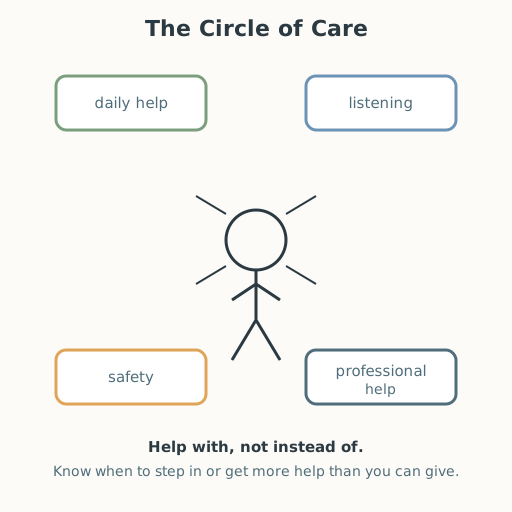
- Caregiving-circle sheet · 1 per learner A person at center with rings outward — daily help, listening, safety, professional help — each with a "help with" and a "step in" line
- Health & care journal · 1 per learner The unit-long notebook for reflections and portfolio artifacts
Low-tech / no-cost
- Paper and any writing tool A hand-drawn circle of supports works identically
- A remembered moment of helping One time the learner helped someone — a sick friend, a younger child, an elder — named or described, no device needed
Enriched / lab & device
- A short account of a caregiver or support worker · 1 per class A respectful story of caring for a child, an elder, or a person with a disability, to ground the skill
Works in different contexts
- large-group Model the worked example whole-class, then pairs build their circle and discuss "when to step in" scenarios
- multi-age Younger learners name one way they already help and one adult they would tell; older learners also weigh dignity, consent, and when to escalate
- self-directed A learner builds the caregiving circle alone and writes the "when to step in" rules in their own words
- level-grouped A ready group also works a "help with, not instead of" dilemma and names where dignity and safety pull in different directions
- outdoor-only Practice noticing a need and offering help in the real place — a fall, a heat day, a lost child — and naming who to tell
Lesson 9 — Caring for Others: Caregiving and When to Step In
Summary
Learners explore caregiving — helping others with daily life (a sick friend, a sibling, a child, an elder, a person with a disability) — with dignity, consent, and respect for autonomy. They build a circle of supports (daily help, listening, safety, professional help), learn to “help with, not instead of,” and name the moments to step in: immediate danger, a child being harmed, or a need bigger than one person can meet. The framing is empowering — you can already do this — never anxiety-inducing.
Objectives
- Explain how to care for the health and safety of others, including caregiving and when to step in. (D03.S4.12.02)
Connection
Caring for others is something you already do — you have helped a friend who was sick or sad, watched a younger child, sat with someone who was hurting. Caregiving makes that a skill: how to help without taking over, and how to know the moment to get more help than you can give. Being able to care for another person is one of the most useful things a human can be.
Materials
- Caregiving-circle sheet
- Health & care journal
- Low-tech: paper and any writing tool; a remembered moment of helping
- Enriched: a short account of a caregiver or support worker
Preparation
- Copy or draw the caregiving circle (person at center; rings: daily help / listening / safety / professional help; each with “help with” and “step in”).
- Retrieval: from Grade 5 (D03.S4.05.01), responding in an emergency and calling for help; from Grade 8 (D03.S1.08.02), healthy ways to help a body return to calm. Today we broaden from “help in a crisis” to “care for a person over time.”
- Prepare the worked example (one ring filled in) to model first (S-011).
Facilitator note
This lesson is written to the learner (“you”). The idea to land: caregiving means helping another person’s health and safety with dignity, consent, and respect for their autonomy — “help with, not instead of” — and knowing when to step in or get more help than you can give. Teach one ring as a worked example, then let learners build their own circle (S-011). Keep it empowering and normal: learners already help people; we are naming and refining that. On the “safeguarding” moments, stay calm and clear, and always point to the adult/professional path — never leave a learner feeling they must carry a heavy secret alone (S-051).
The ethics lens: care respects the person — their dignity, their choices, their right to be heard and to say no; consent and autonomy are the floor of good care (S-060). The egalitarianism lens: people who need care — children, elders, people with disabilities — are not “burdens”; they are people whose dignity is equal to anyone’s, and caring for them is honoring that equality. The global lens: caregiving is done everywhere, in families and communities, in many arrangements — multigenerational households, mutual aid, formal care-workers — and no one arrangement is “correct.” The technology lens: tools from phones to monitoring devices can support care and summon help, but they can never replace a human who notices and stays. The environment lens: a safe, accessible environment is itself a form of care — and many people’s need for care is shaped by the places they must live in. Preview: Lesson 10 adds the crisis skills — emergency response — that caregiving sometimes requires.
Procedure
- Recall (5 min). Think of one time you helped someone who was sick, sad, or in need. Name — or write, sign, gesture, or use AAC to show — what you did and what made it help.
- Meet the idea (8 min). Write it down: caregiving is helping another person with their health and daily life — over hours, days, or longer. Its first rule is dignity: help with, not instead of. The person stays the author of their own life; you support.
- Worked example — the circle of supports (15 min). Model the four rings. Daily help — food, comfort, medicine as needed; Listening — being present, not fixing; Safety — noticing danger and acting; Professional help — knowing when a trained person is needed. For each ring, write one thing you would do (help with) and one sign that you should do more (step in).
- Name the move — when to step in (8 min). You step in — or get help — when there is immediate danger, when a child is being harmed (tell a trusted adult, and keep telling until the child is safe, S-051), or when the need is bigger than you (a health worker, an emergency number). Write those three triggers in your own words.
- Guided practice (15 min). With a partner, work two short scenarios: (a) a friend is deeply sad for weeks and says they will manage alone; (b) a younger child near you seems hurt and afraid of going home. For each, decide: help with, or step in? Say — or write, sign, gesture, or use AAC to show — your choice and your reason.
- Write your circle (5 min). In your journal, draw your own caregiving circle with one “help with” and one “step in” per ring. Add the line: I help with, not instead of.
- Close (2 min). Say — or write, sign, gesture, or use AAC to express — the difference between helping someone and taking over someone.
Differentiation
- Support: Use the circle pre-filled with the worked example; the learner adds one “help with” and one “step in” to a single ring rather than all four.
- Extension: Work the “help with, not instead of” dilemma — a person who wants to do something risky for themselves — and write where dignity and safety pull in different directions and how you would weigh them.
- Number access (dyscalculia): This lesson requires no arithmetic; the four rings are handled by the pre-printed circle, and every ring may be completed in words, drawings, or gesture with no numerals at all.
- Communication access: Every spoken step — saying, naming, reading aloud, discussing, or closing — can be done in writing, sign, gesture, or AAC instead. Learners who are non-speaking, d/Deaf, hard-of-hearing, or who use AAC complete every task in their preferred mode; no step requires producing or hearing sound.
Assessment
- Formative (peer + self): Can the learner name the four rings, state “help with, not instead of,” and give the three “step in” triggers with a reason?
- Portfolio artifact (unit): The completed caregiving circle with the three triggers and the “help with, not instead of” line, opened in the journal.
Home connection
At home, notice one small way you already help someone (or someone helps you), and name it without judgment. Write one sentence about what makes that help respectful rather than taking over.
Resources
- On worked examples and guided practice for a new concept: Kirschner, Sweller & Clark (2006) (S-011).
- On dignity, autonomy, and the right to be heard: UN Convention on the Rights of the Child (S-060).
- On safeguarding children (believe, don’t promise secrecy, report): WHO — Preventing violence against children (S-051).
- On recognizing distress and supporting wellbeing: WHO — Mental health (S-504); WHO — Mental health of adolescents (S-311).
- On caring for older people with dignity: WHO — Ageing and health (S-505).