Lesson 01 — Reasoning Through a Real Moral Dilemma
Learners meet a real, complex moral dilemma with no clean answer — a composite whistleblower case drawn from many documented situations — and learn a reasoning frame for thinking it through: name the dilemma, list the options, trace who is affected and how, and ask about consequences, duties, and the kind of person each choice makes. They practice on a second dilemma and name what stays unsettled, learning that a dilemma is reasoned, not solved, and that the conclusion is never prescribed.
Objectives
Objectives
- D09.S1.12.01 Reason through a complex, real-world moral dilemma with no clean answer, weighing multiple frameworks and consequences, and defend a nuanced position.
Essential question
When every choice leaves something important undone, how do I reason through a real moral dilemma with no clean answer — without pretending one choice is simply "right"?
Key vocabulary
Materials
Standard materials
- Dilemma reasoning sheet · 1 per learner One page with the reasoning frame: name the dilemma, list the options, who is affected and how, the values at stake, the consequences, the duties, the character — and a bottom box for 'what stays unsettled'
- Capstone ethics & civic journal · 1 per learner
Low-tech / no-cost
- A short written dilemma (two paragraphs) Hand-copied or read aloud; the composite whistleblower case, or a local dilemma the learners recognize
- Scratch paper To draw the reasoning frame by hand
Enriched / lab & device
- Two documented, anonymized whistleblower case summaries · 1 per pair Real cases, names and identifying detail removed, to compare across contexts
Works in different contexts
- large-group Model the reasoning frame whole-class on the worked example, then pairs each reason through a second dilemma and report one step
- multi-age Younger learners name the people affected and what they would feel; older learners run the full frame and name what stays unsettled
- self-directed A learner works the frame on the composite case, then on one dilemma from their own life, and writes what stays unsettled
- level-grouped A ready group also names which values directly conflict with each other in the dilemma
- outdoor-only Use a dilemma the group actually faces in their place (a shared resource, a boundary, a promise) and reason it aloud in a circle
Lesson 1 — Reasoning Through a Real Moral Dilemma
Summary
Learners meet a real, complex moral dilemma with no clean answer — a composite whistleblower case drawn from many documented situations — and learn a reasoning frame for thinking it through: name the dilemma, list the options, trace who is affected and how, and ask about consequences, duties, and the kind of person each choice makes. They practice on a second dilemma and name what stays unsettled, learning that a dilemma is reasoned, not solved, and that the conclusion is never prescribed.
Objectives
- Reason through a complex, real-world moral dilemma with no clean answer, weighing multiple frameworks and consequences, and defend a nuanced position. (D09.S1.12.01)
Connection
Most hard choices are not between right and wrong but between two things that both matter. You find out a friend has done something harmful — telling the truth hurts them, staying silent lets the harm continue. You learn that the work that feeds your family is quietly damaging the river everyone drinks from. In a city, a village, or a household, the same shape appears: every option leaves something important undone. A real dilemma has no clean answer. The question is not “which choice is obviously right” but “which reasons and which costs can I stand behind, and what will I do about the harm I cannot avoid?”
Materials
- Dilemma reasoning sheet
- Capstone ethics & civic journal
- Low-tech: a short written dilemma; scratch paper
- Enriched: two documented, anonymized whistleblower case summaries
Preparation
- Copy or draw the reasoning sheet; prepare the composite whistleblower case (clearly labeled as a composite of many real, anonymized situations), or a local dilemma learners recognize.
- Retrieval: from Grade 11 (D09.S1.11.01), how structures shape the choices people can make; from Grades 6–9, moral dilemmas and multiple frameworks. Today we add the method: a frame for reasoning, not a verdict.
- Prepare the worked example to model first (S-011).
Facilitator note
This lesson is written to the learner (“you”). The idea to land: a real moral dilemma has no clean answer, and the mature response is to reason it through — name the dilemma, list the options, trace who is affected and how, and ask about consequences, duties, and character — then say honestly what stays unsettled. The frame is a tool, not a verdict machine; the conclusion is the learner’s own, never the lesson’s. Teach the frame explicitly with a worked example (S-011), then let learners apply it — the reasoning, not the answer, is the learning. Do not supply a “correct” resolution to any dilemma; hold the question open (inquiry over creed).
The ethics lens: this is the heart of the strand — reasoning about what is right when the right thing is genuinely unclear; three questions recur across traditions: what happens (consequences), what is owed (duties), and who am I becoming (character) (S-456, S-457, S-458). The egalitarianism lens: in every dilemma, ask who benefits and who is harmed, and whose voice is least heard — a dilemma looks different from the position of the person with least power to choose. The global lens: the shape of a dilemma (loyalty vs. honesty, obedience vs. conscience, promise vs. harm) recurs across cultures and times, but what counts as a live option differs with a person’s position — the frame is universal, the content is local. The technology lens: the whistleblower case is a technology-shaped dilemma — leaked documents, surveillance, and instant spread change what “speaking out” costs; reasoning must notice the tool, not just the choice. The environment lens: many of the most painful real dilemmas are about land, water, and shared resources, where the harm falls on people and places with the least power to refuse it. Preview: Lesson 2 weighs the three frameworks against each other and turns the frame into a defended position.
Procedure
- Recall (5 min). From earlier grades, what makes a choice a dilemma — two things that matter pulling in opposite directions? Today we meet a dilemma with no clean answer, and a frame for reasoning it through.
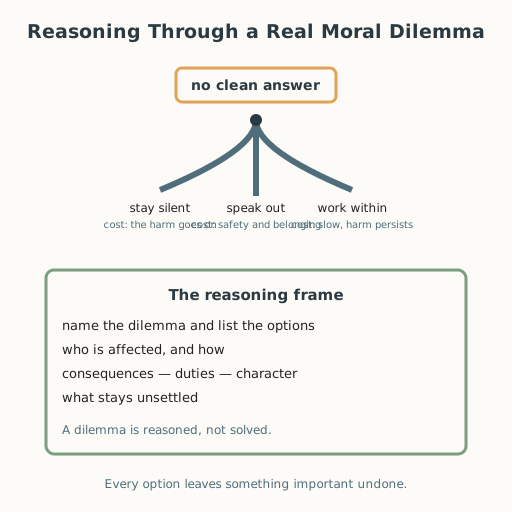
- Meet the frame (8 min). Write it: a moral dilemma is a choice where every option leaves something important undone. A reasoning frame is a set of questions that keeps you honest as you think: name the dilemma; list the options; who is affected and how; what values are at stake; what are the consequences; what is owed (duties); what kind of person does each choice make? Three questions stand behind the frame — consequences, duties, and character (S-456, S-457, S-458).
- Worked example — the composite whistleblower (15 min). Read the case: a person inside a large organization discovers it is quietly causing real harm — covering up unsafe water, overcharging the poorest, or hiding a danger. They can stay silent (protecting their job, their family, their friends), speak out publicly (exposing the harm, but risking their work and the people around them), or work from within (trying to fix it, but slowly, while the harm continues). Work the frame aloud on the sheet: who is affected by each option? what is gained and lost in each? what is owed to whom? what kind of person does each choice build? Write your answers.
- Practice on a second dilemma (15 min). Choose a second dilemma — one from the lesson’s list or one from your own life (a friend’s secret, a family loyalty, a boss asking you to hide a mistake). Run the same frame. Do not try to “solve” it; try to see it clearly.
- Name what stays unsettled (8 min). In the bottom box, write what the frame could not settle for you — which value had to give, which harm you could not avoid. A good reasoner names this out loud.
- Close (4 min). Say — or write, sign, gesture, or use AAC to express — one thing the reasoning frame changed about how you see a hard choice.
Differentiation
- Support: Use a sheet pre-filled with the composite case’s options and affected people; the learner underlines who is affected in each option and answers with a starter (“If I stay silent, the people harmed are…; if I speak out, the people harmed are…”).
- Extension: Name the exact value that conflicts with another in your dilemma (for example, honesty vs. loyalty) and write one sentence on which you would lean toward and why — without pretending the other value stops mattering.
- Number access (dyscalculia): This lesson requires no arithmetic. All names, options, and steps are words; nothing must be counted, ordered, or computed. The sheet is pre-printed, and every step can be spoken, written, signed, or gestured.
- Communication access: Every spoken step — naming, reading aloud, discussing, or closing — can be done in writing, sign, gesture, or AAC instead. Learners who are non-speaking, d/Deaf, hard-of-hearing, or who use AAC complete every task in their preferred mode; no step requires producing or hearing sound. The dilemma text may be provided in print, braille, or audio description.
Assessment
- Formative (peer + self): Can the learner run the frame on a real dilemma — naming the options, who is affected, the consequences, duties, and character — and say honestly what stays unsettled, rather than asserting a clean answer?
- Portfolio artifact (unit): The completed reasoning sheet, opened in the capstone ethics & civic journal — the strand’s first “moral reasoning” artifact.
Home connection
Bring one dilemma from home or the neighborhood — a choice someone is facing with no clean answer — and run just the first two questions of the frame on it (name it; list the options). Write two lines in your journal.
Resources
- On worked examples and guided practice: Kirschner, Sweller & Clark (2006) (S-011).
- On the three recurring questions (consequences, duties, character): Stanford Encyclopedia of Philosophy — Consequentialism (S-456), Deontological Ethics (S-457), Virtue Ethics (S-458).