Lesson 02 — Weighing Frameworks and Defending a Nuanced Position
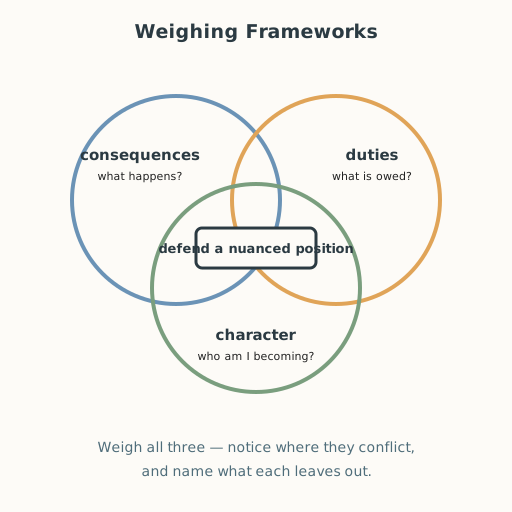
Learners weigh three ethical frameworks — consequentialism (what happens), deontology (what is owed), and virtue ethics (who I become) — against each other, seeing that these lenses appear across world traditions, not only in one. They apply all three to a dilemma, notice where the lenses agree and where they conflict, and write a defended, nuanced position that credits more than one framework and names what each leaves out — reasoning toward a position, never asserting a slogan.
Objectives
Objectives
- D09.S1.12.01 Reason through a complex, real-world moral dilemma with no clean answer, weighing multiple frameworks and consequences, and defend a nuanced position.
Essential question
When consequences, duties, and character pull in different directions, how do I weigh the frameworks against each other and defend a nuanced position — rather than a slogan?
Key vocabulary
Materials
Standard materials
- Frameworks weighing sheet · 1 per learner Three columns — consequences, duties, character — each with space for what that lens sees in the dilemma, and a bottom row for the learner's defended, nuanced position
- Capstone ethics & civic journal · 1 per learner
Low-tech / no-cost
- Three short framework cards One card each for consequences, duties, and character, hand-written with one guiding question each
- Scratch paper To draw the weighing sheet by hand
Enriched / lab & device
- Short excerpts from three ethical traditions · 1 per pair One consequentialist, one duty-based, one virtue-based passage, to see each lens in its own voice
Works in different contexts
- large-group Weigh the three lenses whole-class on the worked example, then pairs each weigh a different dilemma and defend one position aloud
- multi-age Younger learners say what each lens would *ask*; older learners write the defended, nuanced position
- self-directed A learner runs all three lenses on one dilemma, then writes a defended position that names where the lenses conflict
- level-grouped A ready group also names where two lenses directly contradict each other and argues which should carry more weight, and why
- outdoor-only Take the three framework cards and a local dilemma, and weigh them in a circle — each person speaks from one lens
Lesson 2 — Weighing Frameworks and Defending a Nuanced Position
Summary
Learners weigh three ethical frameworks — consequentialism (what happens), deontology (what is owed), and virtue ethics (who I become) — against each other, seeing that these lenses appear across world traditions, not only in one. They apply all three to a dilemma, notice where the lenses agree and where they conflict, and write a defended, nuanced position that credits more than one framework and names what each leaves out — reasoning toward a position, never asserting a slogan.
Objectives
- Reason through a complex, real-world moral dilemma with no clean answer, weighing multiple frameworks and consequences, and defend a nuanced position. (D09.S1.12.01)
Connection
The same hard choice can look different depending on the question you ask. “What will cause the least harm?” points one way; “what do I owe, no matter what?” points another; “what kind of person am I becoming?” points a third. A person deciding whether to tell a difficult truth, keep a promise, or break a rule is living all three at once. Weighing frameworks means holding more than one question at the same time — and refusing to flatten a hard choice into a one-line slogan.
Materials
- Frameworks weighing sheet
- Capstone ethics & civic journal
- Low-tech: three framework cards; scratch paper
- Enriched: short excerpts from three ethical traditions
Preparation
- Copy or draw the weighing sheet; prepare three framework cards (one guiding question each).
- Retrieval: from Lesson 1, the reasoning frame and the three recurring questions. Today we weigh the questions against each other and defend a position.
- Prepare the worked example to model first (S-011).
Facilitator note
This lesson is written to the learner (“you”). The idea to land: the three lenses — consequences, duties, and character — are not competitors to rank; they are questions to weigh together. A nuanced position is one that reasons with more than one lens, credits what the others see, and names what it cannot fully settle. The lenses appear across world traditions — they are not the property of one culture — and none is offered as the correct answer. Teach the weighing explicitly (S-011); the defense is the learning. Do not rank the frameworks for the learner; a position is the learner’s own, defended with reasons.
The ethics lens: consequentialism judges by results (S-456, S-386); deontology by duty and respect for persons (S-457, S-387); virtue ethics by the kind of person an act builds (S-458). The global lens is essential here: consequentialist reasoning is as old as Chinese Mohism’s inclusive care (S-466) and Buddhist concern to reduce suffering for all beings (S-467); duty-based reasoning runs through Confucian role ethics (S-468) and Hindu and Buddhist accounts of dharma (S-469). Holding these side by side models that ethics is a shared human work, not one tradition’s invention. The egalitarianism lens: ask which lens is easiest to speak from power — a “consequences” calculation can quietly discount the people who are hardest to see, which is why the duty lens insists every person counts, and why the virtue lens asks who a habit of overlooking them turns you into. The technology lens: new tools sharpen old dilemmas — a data platform can calculate consequences at a scale no single conscience can check, so weighing frameworks is also a guard against letting a machine settle a question that needs all three lenses. The environment lens: environmental choices are exactly where consequences (for future people, for other species), duties (to a river, a forest, a generation not yet born), and character (a habit of care or of waste) must be weighed together, because no single lens is enough. Preview: Lesson 3 turns inward — how the learner’s own values formed.
Procedure
- Recall (5 min). From Lesson 1, the three recurring questions: consequences, duties, character. Today we name them as frameworks and weigh them against each other.
- Meet the three frameworks (10 min). Write them. Consequentialism judges an act by its results — what happens to everyone affected (S-456). Deontology judges by duty — what is owed regardless of results, treating persons as ends, never merely as means (S-457). Virtue ethics judges by character — what kind of person the act builds, practiced until it becomes habit (S-458). Note: these are questions, not verdicts, and they appear across traditions (S-466, S-467, S-468, S-469).
- Worked example — one dilemma, three lenses (15 min). Return to the composite whistleblower case from Lesson 1. Run each lens on it: what would the consequences lens notice? the duty lens? the virtue lens? Write each on your sheet. Mark where two lenses agree and where they conflict.
- Write a nuanced position (15 min). Write a defended position: a claim, supported by the strongest reasons from more than one lens, crediting what the other lens adds, and naming what your position still cannot settle. Do not assert a slogan; argue a position.
- Share and check (8 min). With a partner, read your position. Ask: does it use more than one lens, credit the other side, and name what stays unsettled? Give one specific suggestion.
- Close (2 min). Say — or write, sign, gesture, or use AAC to express — one thing weighing three frameworks adds that a single framework misses.
Differentiation
- Support: Use the sheet pre-filled with one line per lens on the case; the learner circles where the lenses conflict, then writes the position with a starter (“Weighing consequences and duty together, I lean toward…, because…, though I cannot settle…”).
- Extension: Name a place where two lenses directly contradict each other and argue, in a paragraph, which should carry more weight in this dilemma and why — without pretending the other lens stops mattering.
- Number access (dyscalculia): This lesson requires no arithmetic. The three frameworks, the case, and the position are all in words; nothing must be counted, computed, or ordered. The sheet is pre-printed, and the whole weighing can be done in speech, writing, sign, or gesture.
- Communication access: Every spoken step — naming, reading aloud, discussing, sharing, or closing — can be done in writing, sign, gesture, or AAC instead. Learners who are non-speaking, d/Deaf, hard-of-hearing, or who use AAC complete every task in their preferred mode; no step requires producing or hearing sound. Excerpts may be provided in print, braille, or audio description.
Assessment
- Formative (peer + self): Can the learner weigh consequences, duties, and character on one dilemma, name where they conflict, and defend a nuanced position that credits more than one lens and states what stays unsettled (in speech, writing, sign, or AAC)?
- Portfolio artifact (unit): The completed weighing sheet with the defended position, added to the capstone ethics & civic journal.
Home connection
Take one current dilemma in the news or your neighborhood and ask it three questions out loud to someone at home: what would happen, what is owed, and what kind of person does each choice make? Write one line on where the three answers pull apart.
Resources
- On worked examples and guided practice: Kirschner, Sweller & Clark (2006) (S-011).
- On the three frameworks: Stanford Encyclopedia of Philosophy — Consequentialism (S-456), Deontological Ethics (S-457), Virtue Ethics (S-458).
- On the same lenses appearing across traditions: SEP — Mohism (S-466); SEP — Ethics in Indian and Tibetan Buddhism (S-467); SEP — Confucius (S-468); Britannica — dharma (S-469).