Lesson 05 — Weighing a Contested Question of Justice and Rights
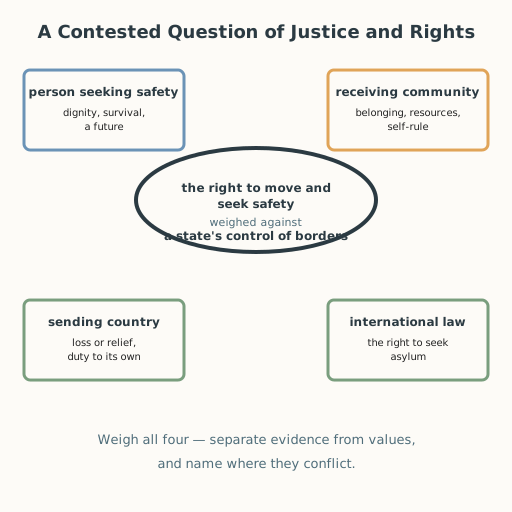
Learners weigh a real, contested question of justice and rights — the right to move and seek safety, weighed against a state's control of its borders — locally and globally. They map four perspectives (the person seeking safety, the receiving community, the sending country, and international law), name the value each appeals to, and separate evidence about displacement from values about what should happen. No single verdict is asserted; the question is weighed, and the conflicts are named honestly.
Objectives
Objectives
- D09.S2.12.01 Weigh a real, contested question of justice and rights, locally and globally, and defend a reasoned position that accounts for multiple perspectives.
Essential question
When a question of justice and rights is genuinely contested — the right to move and seek safety, weighed against a state's control of its borders — how do I weigh the competing claims locally and globally, without pretending there is one easy verdict?
Key vocabulary
Materials
Standard materials
- Contested-justice weighing sheet · 1 per learner A four-quadrant organizer — the person seeking safety, the receiving community, the sending country, and international law — with a center space for the contested question and a bottom row for 'what each perspective adds and where they conflict'
- Capstone ethics & civic journal · 1 per learner
Low-tech / no-cost
- Four short perspective cards One card each for the person fleeing, the receiving community, the sending country, and international law, hand-written in plain language
- Scratch paper To draw the weighing sheet by hand
Enriched / lab & device
- Two short primary sources · 1 per pair A passage from the Universal Declaration (Articles 13–14) and a first-person account of seeking refuge
Works in different contexts
- large-group Map the four perspectives whole-class on a wall, then small groups each weigh the question and report one conflict and one shared ground
- multi-age Younger learners name who is affected and what each fears; older learners weigh the claims and name the conflict
- self-directed A learner weighs the four perspectives, lists what each adds, and writes where they conflict and where they overlap
- level-grouped A ready group also separates *evidence* (what displacement data shows) from *values* (what should be done about it)
- outdoor-only Use a local contested question of land, water, or movement, and have each perspective spoken from a different place in a circle
Lesson 5 — Weighing a Contested Question of Justice and Rights
Summary
Learners weigh a real, contested question of justice and rights — the right to move and seek safety, weighed against a state’s control of its borders — locally and globally. They map four perspectives (the person seeking safety, the receiving community, the sending country, and international law), name the value each appeals to, and separate evidence about displacement from values about what should happen. No single verdict is asserted; the question is weighed, and the conflicts are named honestly.
Objectives
- Weigh a real, contested question of justice and rights, locally and globally, and defend a reasoned position that accounts for multiple perspectives. (D09.S2.12.01)
Connection
Almost every community faces the same tension in some form: people need to move — for safety, for work, for a future — and the places they arrive already have people, rules, and scarce resources. One voice says every person deserves safety and a chance; another says a community must be able to decide who comes in. Both speak for something real. A contested question of justice is not solved by declaring one side wrong; it is weighed, so the real conflict — between dignity and belonging, between openness and self-rule — can be seen and argued honestly.
Materials
- Contested-justice weighing sheet
- Capstone ethics & civic journal
- Low-tech: four perspective cards; scratch paper
- Enriched: two short primary sources
Preparation
- Copy or draw the weighing sheet; prepare four perspective cards in plain language.
- Retrieval: from Lessons 1–2, weighing and holding a question open; from Grade 11 (D09.S2.11.01), justice, power, and law. Today we weigh a contested question of rights across perspectives.
- Prepare the evidence side carefully: displacement is large and global, driven mainly by conflict and persecution (S-493); migration has been part of human life throughout history (S-086).
Facilitator note
This lesson is written to the learner (“you”). The idea to land: a contested question of justice and rights — here, the right to move and seek safety weighed against a state’s control of its borders — is weighed, not settled; the work is to map the perspectives (the person seeking safety, the receiving community, the sending country, international law), name the value each appeals to, and separate evidence about displacement from values about what should be done. No single verdict is asserted. Hold the facts accurately: the Universal Declaration affirms a right to seek and enjoy asylum (Articles 13–14) (S-149); forced displacement is large and global, driven mainly by conflict and persecution, with climate a growing driver (S-493); people have always moved (S-086). Present every perspective as genuine; the learner weighs and judges.
The ethics lens: the question is a genuine clash of duties — a duty to the stranger in danger and a duty to one’s own community — and ethical reasoning means holding both, not choosing the easier one to dismiss. The egalitarianism lens: ask who has the power to be heard in this debate and whose voice is loudest or quietest; a state speaks with institutions behind it, a person fleeing often speaks with none — weighing fairly means noticing that imbalance (S-275). The global lens: the right to move and seek asylum is framed in global documents (S-149), yet the African Charter adds duties and peoples’ rights to the picture (S-465), showing the idea of rights is amended and extended across traditions, not simply accepted. The technology lens: how movement is governed is now mediated by technology — borders tracked by data, identity by documents and databases — and who is included or excluded is partly decided by systems, not only by people. The environment lens: some movement is driven by a changing climate — drought, flood, lost harvests — which makes the question one about shared responsibility for a shared Earth, not only about borders (S-493). Preview: Lesson 6 asks the learner to defend a reasoned position across these perspectives.
Procedure
- Recall (5 min). From Lessons 1–2, how we weigh and hold a question open. Today we aim that skill at a contested question of justice and rights.
- Name the contested question (8 min). Write it: people need to move and seek safety; states claim the right to control their borders. Both are claims about justice and rights. A contested question is one where reasonable people, appealing to real values, disagree.
- Meet the four perspectives (15 min). Read the four cards: the person seeking safety (dignity, survival, a future); the receiving community (belonging, resources, self-rule); the sending country (loss of people, or relief of pressure, or duty to its own); and international law (the right to seek asylum, S-149; the duty of states to their own people). On your sheet, write what each perspective adds and the value it appeals to.
- Separate evidence from values (10 min). Mark each claim as evidence (what the data show: displacement is large and driven mainly by conflict and persecution, S-493; people have always moved, S-086) or value (what should be done about it). They are different, and honest weighing keeps them distinct.
- Name the conflicts (10 min). In the bottom row, write where the perspectives conflict directly and where they overlap (for example: everyone prefers safety; they disagree about whose duty it is to provide it).
- Close (2 min). Say — or write, sign, gesture, or use AAC to express — one thing weighing four perspectives adds that picking one side does not.
Differentiation
- Support: Use a sheet with the four perspectives pre-summarized; the learner underlines the value each appeals to, then answers with a starter (“The person seeking safety appeals to…; the receiving community appeals to…”).
- Extension: Name the strongest point made by the perspective you are least inclined to agree with, and write why it is genuinely strong — without surrendering your own position.
- Number access (dyscalculia): Any figures about displacement are offloaded to a pre-printed organizer and read aloud; nothing must be computed, ordered, or compared numerically. The whole weighing can be done in words, spoken, written, or signed, with no numerals required.
- Communication access: Every spoken step — naming, reading aloud, discussing, or closing — can be done in writing, sign, gesture, or AAC instead. Learners who are non-speaking, d/Deaf, hard-of-hearing, or who use AAC complete every task in their preferred mode; no step requires producing or hearing sound. Cards may be provided in print, braille, or audio description.
Assessment
- Formative (peer + self): Can the learner weigh a contested question of justice and rights by mapping the perspectives, naming the value each appeals to, separating evidence from values, and stating where they conflict — without asserting one easy verdict?
- Portfolio artifact (unit): The completed weighing sheet, opened in the capstone ethics & civic journal — the strand’s “contested justice” artifact.
Home connection
Ask someone at home how your own community has weighed “who may come in” or “who belongs” — at a border, a neighborhood, a school, or a family. Write two lines: what they appealed to, and what you noticed.
Resources
- On the right to seek asylum: UN — Universal Declaration of Human Rights, Articles 13–14 (S-149).
- On forced displacement: UNHCR — Global Trends (S-493). On migration as a human constant: IOM — Who is a migrant (S-086).
- On rights across traditions (duties and peoples’ rights): African Charter on Human and Peoples’ Rights (S-465). On power shaping who is heard: Lukes — Power: A Radical View (S-275).