Lesson 04 — Testing My Values in the World
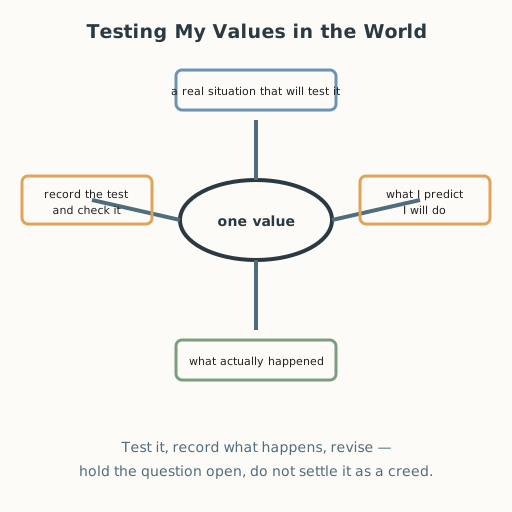
Learners turn one of their values into a testable prediction: they name a value, a real situation that will test it, what they predict they will do, and a plan to record what actually happens. They learn to treat the result as evidence to reflect on — revising or confirming the value — rather than as a settled verdict on who they are, holding the question of what they value open as it meets the world.
Objectives
Objectives
- D09.S1.12.02 Reflect on their own evolving values, how they formed, and how they will test them in the world, holding questions open rather than settling them as creed.
Essential question
How will I test my values in the real world — and hold the result as evidence to learn from, not as a settled verdict on who I am?
Key vocabulary
Materials
Standard materials
- Value-testing sheet · 1 per learner Four columns: the value, a real situation that will test it, what I predict, and what actually happened — with a final row for 'what I learned / what I will revise'
- Capstone ethics & civic journal · 1 per learner
Low-tech / no-cost
- Blank paper To draw the testing sheet by hand
- A calendar or notebook To note when and where the test will happen
Enriched / lab & device
- A short personal essay on a value tested under pressure · 1 per pair A real account of someone discovering what they believed only when it cost something
Works in different contexts
- large-group Model the test on one shared value, then each learner designs their own small test to run over the coming days
- multi-age Younger learners choose one value and one simple situation; older learners add a prediction and a plan to check it
- self-directed A learner designs a test, runs it over several days, and records what happened and what they will revise
- level-grouped A ready group also distinguishes a *value* from a *preference*, and tests only the value
- outdoor-only Test a value that involves the land or water around you (care, restraint, fairness in sharing) over the next days
Lesson 4 — Testing My Values in the World
Summary
Learners turn one of their values into a testable prediction: they name a value, a real situation that will test it, what they predict they will do, and a plan to record what actually happens. They learn to treat the result as evidence to reflect on — revising or confirming the value — rather than as a settled verdict on who they are, holding the question of what they value open as it meets the world.
Objectives
- Reflect on their own evolving values, how they formed, and how they will test them in the world, holding questions open rather than settling them as creed. (D09.S1.12.02)
Connection
A value is only a wish until it meets a cost. “I value honesty” is easy to say and easy to hold — until telling the truth costs a friendship. “I value fairness” is tested the day sharing means you get less. A value is not proven by being stated; it is tested by being spent. The test is not a pass-or-fail exam on your character. It is a way to learn what you actually believe, and to revise it honestly when the world shows you something new.
Materials
- Value-testing sheet
- Capstone ethics & civic journal
- Low-tech: blank paper; a calendar or notebook
- Enriched: a personal essay on a value tested under pressure
Preparation
- Copy or draw the testing sheet; prepare the four columns (value, situation, prediction, what happened) and a final “what I learned / what I will revise” row.
- Retrieval: from Lesson 3, the values map and one value marked “still forming.” Today we take one value and test it.
- Emphasize: the test is for learning, not for grading the self; a value that “fails” a test is information, never a verdict (mastery, not ranking).
Facilitator note
This lesson is written to the learner (“you”). The idea to land: a value is tested, not settled; the honest way to test it is to predict what you will do in a real situation, record what actually happens, and treat the gap between prediction and result as evidence to learn from — revising or confirming the value while holding the question open rather than closing it as a creed. This mirrors the scientific habit of distinguishing evidence from belief, applied to character (philosophy §5). Guard against shame: a learner who does not live up to a stated value has gained data, not a failing grade; frame every gap as information.
The ethics lens: testing a value is the move from holding an opinion to practicing a commitment — and practice, not declaration, is what virtue ethics says builds character (S-458). The egalitarianism lens: which values can be tested freely is not equal — a learner with little power may find “courage” costs more than it does for one with much; the lesson honors that a test is harder for some, not that some people are better. The global lens: the same value — hospitality, honesty, restraint — is tested in different situations in different places; a test designed in a city looks unlike one designed on a farm or a boat, and both are real. The technology lens: screens create new test-sites for old values — kindness in a comment thread, honesty about what you share, restraint with what you click (S-481, S-482); a value is tested where you actually live, and part of that life is digital. The environment lens: some of the clearest tests are about care for shared things — water, food, a shared space — where restraint and fairness become concrete, daily, and observable. Preview: Lesson 5 turns from the self to a contested question of justice and rights.
Procedure
- Recall (5 min). From Lesson 3, your values map. Choose one value — ideally one you marked “still forming” or “chosen.” Today we test it.
- Write the prediction (10 min). On your sheet, name the value. Then name a real situation in the coming days that will test it — a moment, not a hypothetical. Write what you predict you will do and why.
- Plan the record (8 min). Decide how you will record what actually happens: a note that evening, a checkmark in a calendar, a voice memo, a drawing. A test without a record is only a guess.
- Run it (over the coming days). Between now and the next lesson, let the situation happen. Do not force it; notice what you actually did.
- Read the evidence (10 min, next session). When the moment has come and gone, write what actually happened in the fourth column. Compare it with your prediction. Where they match, the value is being practiced; where they differ, you have learned something real.
- Revise or confirm (10 min). Write in the final row: what the test taught you, and whether you will confirm the value, revise it, or hold it open a little longer. A question still open is a value still being lived (S-001).
- Close (4 min). Say — or write, sign, gesture, or use AAC to express — one thing testing a value taught you that saying it could not.
Differentiation
- Support: Choose a small, low-stakes test (one honest moment, one act of care) with a pre-printed record prompt; the learner fills in “I predicted… / it happened…” with a starter.
- Extension: Test two values in the same situation and write where they pull against each other, and which one held under the actual cost.
- Number access (dyscalculia): This lesson requires no arithmetic. The sheet is a four-column organizer in words; nothing must be counted, computed, or ordered. Recording can be a checkmark, a drawing, a voice memo, or a single word — no numerals required.
- Communication access: Every spoken step — naming, reading aloud, discussing, or closing — can be done in writing, sign, gesture, or AAC instead. Learners who are non-speaking, d/Deaf, hard-of-hearing, or who use AAC complete every task in their preferred mode; no step requires producing or hearing sound.
Assessment
- Formative (self + peer): Can the learner design a real, recordable test of one value, compare prediction with what actually happened, and name what they learned — revising or confirming without turning a gap into a verdict on themselves?
- Portfolio artifact (unit): The completed testing sheet, added to the capstone ethics & civic journal.
Home connection
Tell someone at home the value you are testing and the situation that will test it. Ask them to simply notice — and, at the end of the week, compare one line: what you predicted, and what happened.
Resources
- On practice building character: Stanford Encyclopedia of Philosophy — Virtue Ethics (S-458).
- On self-awareness and reflection: CASEL — Fundamentals of SEL (S-001).
- On emotion and decision-making under real conditions: Lerner et al. — Emotion and Decision Making (S-333). On digital life as a test-site: Britannica — Social media (S-481); Pariser — The Filter Bubble (S-482).