Lesson 06 — Defending a Reasoned Position Across Perspectives
Learners move from weighing to *defending*: they take a reasoned position on the contested question of movement and safety, support it with reasons and evidence, and — crucially — credit the strongest point of each perspective they do not fully share (steelmanning) while still standing. They name what their position cannot settle, learning that a defensible position is firm and honest at once, not a slogan that pretends the other side has nothing real to say.
Objectives
Objectives
- D09.S2.12.01 Weigh a real, contested question of justice and rights, locally and globally, and defend a reasoned position that accounts for multiple perspectives.
Essential question
How do I defend a reasoned position on a contested question of justice that genuinely accounts for the perspectives I do not fully share — crediting their strongest points while still taking a stand?
Key vocabulary
Materials
Standard materials
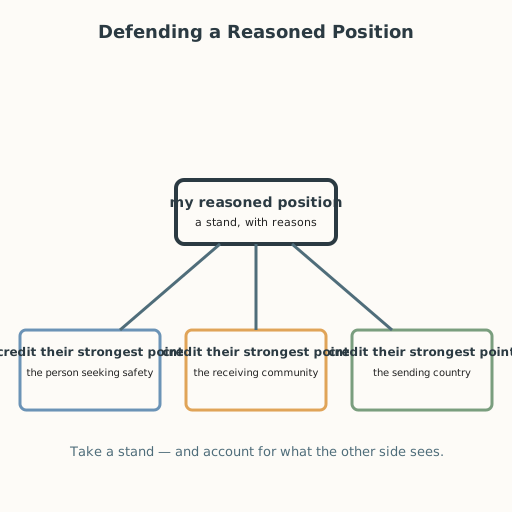
- Position-defense organizer · 1 per learner Three rows — my position and its reasons; the strongest point of each perspective I do not fully share, credited honestly; and what my position still cannot settle
- Capstone ethics & civic journal · 1 per learner
Low-tech / no-cost
- Blank paper To draw the organizer by hand
- A talking object (stone, stick) To pass in the circle so each voice is heard in turn
Enriched / lab & device
- Two opinion pieces on the same contested question · 1 per pair Two well-argued, opposing pieces to steelman before taking a stand
Works in different contexts
- large-group Pairs steelman one opposing perspective each, then a few volunteer to defend their position and receive one credited counterpoint
- multi-age Younger learners state the strongest point of someone they disagree with; older learners write the full defended position
- self-directed A learner writes the position, credits the strongest opposing point, and names what stays unsettled
- level-grouped A ready group also distinguishes *crediting* an opposing point from *adopting* it, and keeps their stand while honoring the other
- outdoor-only Hold a circle with a talking object; each person states their position, then restates the strongest point of the person before them
Lesson 6 — Defending a Reasoned Position Across Perspectives
Summary
Learners move from weighing to defending: they take a reasoned position on the contested question of movement and safety, support it with reasons and evidence, and — crucially — credit the strongest point of each perspective they do not fully share (steelmanning) while still standing. They name what their position cannot settle, learning that a defensible position is firm and honest at once, not a slogan that pretends the other side has nothing real to say.
Objectives
- Weigh a real, contested question of justice and rights, locally and globally, and defend a reasoned position that accounts for multiple perspectives. (D09.S2.12.01)
Connection
A position worth defending is not a wall; it is a stance that has looked at the other side and still stands. The person who can state their opponent’s best argument better than their opponent can is not weakening their own case — they are proving it has been tested. Defending across perspectives means taking a stand and crediting what the other side genuinely sees, then saying honestly what even your own position cannot settle. That is what separates a reasoned position from a slogan.
Materials
- Position-defense organizer
- Capstone ethics & civic journal
- Low-tech: blank paper; a talking object
- Enriched: two opposing opinion pieces
Preparation
- Copy or draw the organizer; prepare a talking object for circle work.
- Retrieval: from Lesson 5, the four perspectives and where they conflict. Today we defend a position across them.
- Model “steelmanning” explicitly (S-011): state the strongest version of the view you disagree with, then respond to that, not to a weak version of it.
Facilitator note
This lesson is written to the learner (“you”). The idea to land: defending a reasoned position across perspectives means taking a stand, supporting it with reasons and evidence, and crediting the strongest point of each perspective one does not fully share — then naming what one’s own position cannot settle. A defensible position is firm and honest at once; it is not a slogan that pretends the other side has nothing real to say. Model steelmanning (S-011); structure the deliberation so reasons, not volume, carry the day (S-349). Do not push any one position; the learner’s stand is their own, and the skill is that it accounts for the others.
The ethics lens: crediting an opponent’s strongest point is an act of intellectual honesty — a duty to truth over the comfort of a neat answer; a position that cannot survive a fair steelman is not yet well defended. The egalitarianism lens: deliberation must not simply reproduce who already has power — use structures (a talking object, turn-taking, written contributions) so the quietest and least powerful voices carry equal weight (S-238). The global lens: contested questions of rights are argued differently in different places, and a reasoned position should be able to say where it is rooted and what it assumes — not treat one place’s framing as universal (S-460). The technology lens: deliberation increasingly happens on screens, where the loudest and most extreme voices can drown reasons (S-481, S-482); steelmanning is a deliberate antidote to an algorithm that feeds you only your own side. The environment lens: on questions with an environmental dimension (who bears the cost of a changing climate, who must move because of it), a defended position must account for future people and distant places who are not in the room to argue back. Preview: Lesson 7 turns to the learner’s own responsibilities to fairness and justice.
Procedure
- Recall (5 min). From Lesson 5, the contested question and the four perspectives. Today we take a stand — and account for the rest.
- Learn to steelman (10 min). Write the move: steelmanning is stating the strongest version of a view you do not fully share, then responding to that version — not to a weak or unfair one. Practice once aloud: give the strongest point of the perspective you find hardest to agree with, in one honest sentence.
- Write your position (12 min). On the organizer, write your position and its reasons — the evidence and values that support it. A position, not a slogan: “I hold that…, because….”
- Credit the others (12 min). In the second row, write the strongest point of each perspective you do not fully share, credited honestly — “the receiving community’s strongest point is…, and it is a real one.” Note: crediting is not adopting; you can honor a point and still stand.
- Name what stays unsettled (8 min). In the final row, write what your own position cannot fully settle — the cost it accepts, the person it still cannot fully answer. A firm position that names its own limits is stronger, not weaker.
- Share and check (6 min). With a partner, read your position. Ask: does it state reasons, credit the strongest opposing point, and name what stays unsettled? Give one specific suggestion.
- Close (2 min). Say — or write, sign, gesture, or use AAC to express — one thing crediting the other side changed about your own position.
Differentiation
- Support: Use a pre-printed organizer with sentence starters for each row (“I hold that…, because…”; “the strongest point of the view I disagree with is…”; “what I still cannot settle is…”).
- Extension: Write the strongest objection to your own position from one perspective, then respond to it — and say whether the response fully succeeds or leaves a remainder.
- Number access (dyscalculia): This lesson requires no arithmetic. Any evidence is offered on a pre-printed organizer and read aloud; nothing must be counted, computed, or ordered. The whole defense can be done in words, spoken, written, or signed.
- Communication access: Every spoken step — stating, reading aloud, steelmanning, discussing, or closing — can be done in writing, sign, gesture, or AAC instead. Learners who are non-speaking, d/Deaf, hard-of-hearing, or who use AAC complete every task in their preferred mode; no step requires producing or hearing sound. Materials may be provided in print, braille, or audio description.
Assessment
- Formative (peer + self): Can the learner take a reasoned position, support it with reasons and evidence, credit the strongest point of each opposing perspective, and name what their position cannot settle (in speech, writing, sign, or AAC)?
- Portfolio artifact (unit): The completed defense organizer, added to the capstone ethics & civic journal.
Home connection
Choose a disagreement you actually have at home or with a friend. Write one sentence stating their strongest point as fairly as you can — then one sentence for your own position, crediting theirs.
Resources
- On worked examples and guided practice: Kirschner, Sweller & Clark (2006) (S-011).
- On structured deliberation of contested issues: Hess — Controversy in the Classroom (S-349); Michaels & O’Connor — Accountable Talk (S-238).
- On freedom and development across contexts: Sen — Development as Freedom (S-460). On digital debate and the filter bubble: Britannica — Social media (S-481); Pariser — The Filter Bubble (S-482).