Lesson 07 — My Responsibilities to Fairness and Justice
Learners meet the evidence that inequality and unequal access are real and measured — within and between countries, and in basics like clean water — and then reflect on what they owe to fairness and justice at four scales: self, close community, wider society, and world. They carefully separate *evidence* (inequality is real and widespread) from *value* (what I owe in response), learning that responsibility is reasoned from both, never assumed, and never a single correct list.
Objectives
Objectives
- D09.S2.12.02 Reflect on their own responsibilities to fairness and justice in their communities and in the wider world, and how they will act.
Essential question
Given that inequality and unfairness are real and measured, what — if anything — do I owe to fairness and justice in my own communities and in the wider world?
Key vocabulary
Materials
Standard materials
- Inequality evidence sheet · 1 per learner Pre-printed, with the key facts (inequality within and between countries; unequal access to basics like clean water) already written and read aloud — no arithmetic required
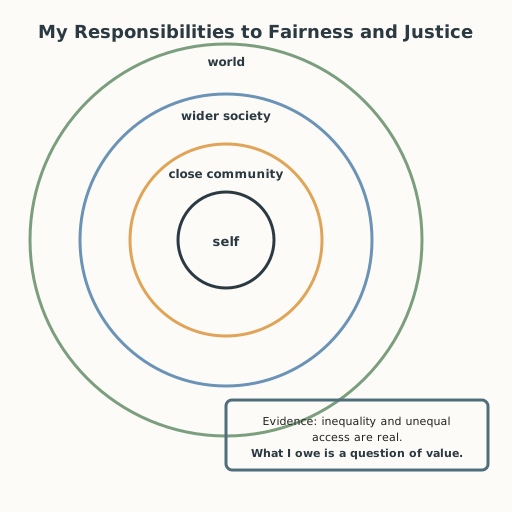
- Circles-of-responsibility sheet · 1 per learner Concentric circles — self, close community, wider society, world — with space to write a responsibility at each scale
- Capstone ethics & civic journal · 1 per learner
Low-tech / no-cost
- Two pre-written facts about unequal access Hand-copied and read aloud — for example, that many people still lack safely managed drinking water
- Chalk or sticks and open ground To draw concentric circles on the earth and stand in each ring
Enriched / lab & device
- An interactive inequality data page · 1 per pair World Inequality Report or Our World in Data, to explore one inequality the learner chooses
Works in different contexts
- large-group Read the evidence whole-class, then each learner writes responsibilities in the four circles and shares one
- multi-age Younger learners name one unfair thing they have seen and one thing they could do; older learners work all four circles with reasons
- self-directed A learner reads the evidence, writes a responsibility at each scale, and distinguishes evidence from value in their own answer
- level-grouped A ready group also distinguishes *charity* from *justice* (a gift vs. changing the rules) and reflects on which their responsibility is
- outdoor-only Draw four circles on the ground; learners stand in each ring and name a responsibility there, then step back and reflect
Lesson 7 — My Responsibilities to Fairness and Justice
Summary
Learners meet the evidence that inequality and unequal access are real and measured — within and between countries, and in basics like clean water — and then reflect on what they owe to fairness and justice at four scales: self, close community, wider society, and world. They carefully separate evidence (inequality is real and widespread) from value (what I owe in response), learning that responsibility is reasoned from both, never assumed, and never a single correct list.
Objectives
- Reflect on their own responsibilities to fairness and justice in their communities and in the wider world, and how they will act. (D09.S2.12.02)
Connection
Fairness is not only a big abstract idea; it shows up in who gets clean water, who can see a doctor, who gets heard, and who is left out. The facts are real and measured — some people are born into far more than others, and some basics are still denied to millions. The harder question is not whether unfairness exists but what it asks of me — here, in my own circle, and far away, where I will never meet the people affected. That is a question of value, and it is answered with reasons, not reflexes.
Materials
- Inequality evidence sheet
- Circles-of-responsibility sheet
- Capstone ethics & civic journal
- Low-tech: two pre-written facts; chalk or sticks and open ground
- Enriched: an interactive inequality data page
Preparation
- Copy the evidence sheet with all figures pre-printed and plan to read them aloud (number access); copy the circles-of-responsibility sheet.
- Retrieval: from Lesson 6, defending a position across perspectives. Today we turn from the contested question to the self — what I owe.
- Distinguish the two moves clearly: evidence establishes that inequality exists; value establishes what, if anything, I owe in response. Neither is skipped, and neither is smuggled into the other.
Facilitator note
This lesson is written to the learner (“you”). The idea to land: inequality and unequal access are real and measured (evidence), and what each of us owes to fairness and justice is a question of value reasoned from that evidence — at the scale of self, community, society, and world. There is no single correct list of responsibilities; the skill is to reason from evidence to a value commitment without confusing the two. Present the evidence accurately but lightly (the lesson is about responsibility, not about mastering statistics): inequality within and between countries is large and documented (S-464, S-283); unequal access to basics such as safely managed drinking water is real and widespread (S-065). Offload all numbers to the pre-printed sheet and read them aloud; never require computation.
The ethics lens: the move from “this is unfair” to “therefore I owe…” is an inference, not automatic — philosophers have long argued about whether the better-off owe the worse-off anything, and the lesson holds that question open rather than decreeing an answer (S-388, S-459). The egalitarianism lens: the heart of the strand — who benefits and who is left out — is here made personal: my responsibility is partly shaped by where I stand in the unequal order, which is why the answer differs honestly from one learner to another. The global lens: justice is argued differently across traditions — some center equal treatment, some need, some capability and freedom (S-388, S-459, S-460) — and a learner’s answer may draw on any of them, or on none, as long as it is reasoned. The technology lens: technology can widen or narrow the gaps — digital access is itself now an inequality (S-006, S-283) — so part of a responsibility to justice is asking who a new tool leaves out. The environment lens: unequal access to clean water and a safe environment is among the starkest injustices, and the people who did least to cause environmental harm often bear the most of it (S-065, S-005). Preview: Lesson 8 turns these responsibilities into concrete actions.
Procedure
- Recall (5 min). From Lesson 6, a defended position and what it cannot settle. Today the question turns inward: what do I owe?
- Meet the evidence (10 min). Read the evidence sheet aloud together. Notice what it shows: inequality within and between countries is real and large (S-464, S-283); unequal access to basics like clean water is real and widespread (S-065). These are facts — what is. They do not, by themselves, tell you what to do.
- Name the value question (5 min). Write the move: evidence tells us the world is unequal; value answers “what do I owe in response?” The two are different, and honest reasoning keeps them different (S-388, S-459, S-460).
- Work the four circles (20 min). On the circles sheet, write one responsibility you actually accept at each scale — self (a habit of fairness), close community (something in your school, neighborhood, or family), wider society (a rule, a vote, a voice), and world (a far-away fairness you care about). For each, write one reason.
- Check the reasoning (10 min). With a partner, ask of each responsibility: is this a real thing I could do, and is my reason a reason — not just a feeling? Give one specific suggestion.
- Close (5 min). Say — or write, sign, gesture, or use AAC to express — one responsibility you now hold that you had not named before.
Differentiation
- Support: Use a circles sheet with example responsibilities printed at each ring; the learner circles two they accept and adds one of their own, with a starter reason (“I owe this because…”).
- Extension: Distinguish charity (a one-way gift that leaves the power where it was) from justice (changing the rule or the structure), and write which of your responsibilities is which, and why (S-345).
- Number access (dyscalculia): All figures are offloaded to the pre-printed evidence sheet and read aloud; nothing must be computed, compared numerically, or ordered. The circles are spatial, not numerical; the whole reflection can be done in words, spoken, written, or signed.
- Communication access: Every spoken step — reading aloud, naming, discussing, or closing — can be done in writing, sign, gesture, or AAC instead. Learners who are non-speaking, d/Deaf, hard-of-hearing, or who use AAC complete every task in their preferred mode; no step requires producing or hearing sound. The evidence sheet may be provided in print, braille, or audio description.
Assessment
- Formative (peer + self): Can the learner name a responsibility to fairness and justice at each scale with a reason, and distinguish the evidence that inequality is real from the value of what they owe (in speech, writing, sign, or AAC)?
- Portfolio artifact (unit): The completed circles-of-responsibility sheet, added to the capstone ethics & civic journal.
Home connection
Ask someone at home: “What is one thing you think we owe to people who have less than us?” Write their answer and your own — one line each, with one reason each.
Resources
- On inequality as measured: World Inequality Lab — World Inequality Report (S-464); UNDP — Human Development Reports (S-283); Our World in Data (S-006).
- On unequal access to clean water: WHO/UNICEF JMP — WASH (S-065).
- On theories of justice and what is owed: Stanford Encyclopedia of Philosophy — Distributive Justice (S-388); Rawls — A Theory of Justice (S-459); Sen — Development as Freedom (S-460). On charity vs. solidarity: Spade — Mutual Aid (S-345).