Lesson 08 — How I Will Act
Learners turn a responsibility they accepted in Lesson 7 into a concrete, doable action: they name the responsibility, choose one specific action, list allies and resources, name the honest limits (time, power, risk), and set a check-back date for accountability. They learn that agency — the real capacity to act — grows when it is shared, and that a commitment with named limits is stronger, not weaker, than a vague promise.
Objectives
Objectives
- D09.S2.12.02 Reflect on their own responsibilities to fairness and justice in their communities and in the wider world, and how they will act.
Essential question
How do I turn a responsibility I accept into a concrete, doable action — with allies, resources, and honest limits — so that fairness and justice become something I do, not just something I believe?
Key vocabulary
Materials
Standard materials
- Responsibility-to-action sheet · 1 per learner A flow: name the responsibility, choose one concrete action, list allies and resources, name the honest limits, and set a check-back date
- Capstone ethics & civic journal · 1 per learner
Low-tech / no-cost
- Blank paper To draw the flow by hand
- A local community contact list Names or groups nearby who already work on the chosen issue
Enriched / lab & device
- A searchable directory of local groups · 1 per pair To find real allies and resources for the chosen action
Works in different contexts
- large-group Model the flow on one shared responsibility, then each learner drafts their own action and pairs check feasibility
- multi-age Younger learners choose one small doable action; older learners add allies, resources, limits, and a check-back date
- self-directed A learner drafts the action, lists allies and limits, and commits to a check-back date they will honor
- level-grouped A ready group also anticipates one obstacle and one way to work around it — without dropping the commitment
- outdoor-only Choose an action tied to a shared place or resource, and plan it with the people who actually use that place
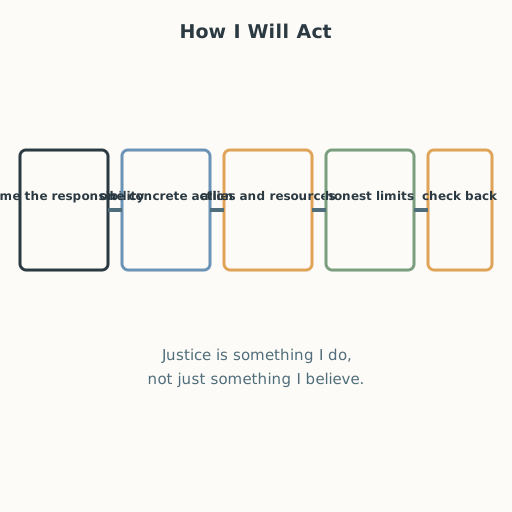
Lesson 8 — How I Will Act
Summary
Learners turn a responsibility they accepted in Lesson 7 into a concrete, doable action: they name the responsibility, choose one specific action, list allies and resources, name the honest limits (time, power, risk), and set a check-back date for accountability. They learn that agency — the real capacity to act — grows when it is shared, and that a commitment with named limits is stronger, not weaker, than a vague promise.
Objectives
- Reflect on their own responsibilities to fairness and justice in their communities and in the wider world, and how they will act. (D09.S2.12.02)
Connection
“I care about fairness” becomes real only when it becomes a verb. The gap between caring and acting is usually not a lack of feeling but a lack of shape: no specific action, no allies, no sense of what it will cost. A commitment that names a single doable thing, the people who will do it with you, and the honest limits of what you can manage is one you can actually keep. Justice, like any craft, is practiced — and practice needs a plan.
Materials
- Responsibility-to-action sheet
- Capstone ethics & civic journal
- Low-tech: blank paper; a local community contact list
- Enriched: a searchable directory of local groups
Preparation
- Copy or draw the flow sheet; gather a short list of local groups that already act on common issues (a food share, a cleanup, a mutual-aid circle, a student council).
- Retrieval: from Lesson 7, one responsibility at each scale. Today we choose one and make it concrete.
- Frame limits as honesty, not failure: naming what you cannot do protects the commitment you do make.
Facilitator note
This lesson is written to the learner (“you”). The idea to land: a responsibility becomes real when it becomes an action — name the responsibility, choose one specific, doable action, list allies and resources, name the honest limits, and set a check-back date. Agency grows when it is shared, and a commitment with named limits is stronger than a vague promise. This is the strand’s “how I will act” move, and it pairs the value (what I owe) with agency (what I can actually do). Do not grade learners on the size of their action; a small, real, kept commitment is worth more than a grand, abandoned one.
The ethics lens: a responsibility without an action is a good intention, and ethics is about what we do — the move from “I ought” to “I will” is where the strand’s reasoning becomes practice. The egalitarianism lens: agency is not equal — a learner with money, time, and safety can do more than one without, so the lesson never ranks actions by size; it asks only that the action be real and the limits be named honestly (S-460). The global lens: acting for fairness looks different everywhere — a mutual-aid tradition like harambee, gotong royong, or mink’a is one way humans have always turned shared responsibility into shared work (S-164); a learner’s action can be local and still join an old, worldwide pattern. The technology lens: an action can use tools — a shared document, a group chat, a petition — but the tool is not the action; the lesson keeps the doing first and the technology in service of it. The environment lens: many of the most doable actions of fairness are also acts of care for a shared place — cleaning a common space, sharing water, protecting a green corner — where justice and stewardship meet. Preview: Lesson 9 scales up — researching an issue, building coalitions, and listening.
Procedure
- Recall (5 min). From Lesson 7, your circles of responsibility. Choose one responsibility you actually accept — the one you are most willing to act on now.
- Name one concrete action (12 min). Turn it into a single, doable action. Make it specific: not “help the poor” but “join the weekend food-share at the market” or “help run the school fairness club.” Write it as a verb with a where and a when.
- List allies and resources (10 min). Write who will do it with you and what you will need. Agency grows when it is shared (S-147); a lone promise is harder to keep than a shared one. Include groups already doing the work.
- Name the honest limits (8 min). Write what you honestly cannot do — the time, the power, the risk. Naming a limit protects the part you can keep; it is honesty, not failure.
- Set the check-back (8 min). Write a date — one to two weeks out — when you will look back at whether you did it, what got in the way, and what to adjust. A commitment is kept by checking, not by hoping.
- Pair-check (8 min). With a partner, read your plan. Ask: is the action specific and doable? are the allies real? are the limits honest? is there a check-back date? Give one specific suggestion.
- Close (4 min). Say — or write, sign, gesture, or use AAC to express — one thing you will actually do this week.
Differentiation
- Support: Use a flow sheet with the five boxes and starters (“I will… by…, with…; I cannot…; I will check back on…”); the learner fills one line per box.
- Extension: Anticipate one concrete obstacle, write how you will work around it without dropping the commitment, and name the ally who can help with that specific obstacle.
- Number access (dyscalculia): This lesson requires no arithmetic. Dates are chosen from a calendar and can be circled rather than computed; nothing must be counted, ordered, or calculated. The flow is a word organizer, doable in speech, writing, sign, or gesture.
- Communication access: Every spoken step — naming, reading aloud, discussing, or closing — can be done in writing, sign, gesture, or AAC instead. Learners who are non-speaking, d/Deaf, hard-of-hearing, or who use AAC complete every task in their preferred mode; no step requires producing or hearing sound.
Assessment
- Formative (peer + self): Can the learner turn a responsibility into a specific, doable action with allies, resources, honest limits, and a check-back date (in speech, writing, sign, or AAC)?
- Portfolio artifact (unit): The completed action plan, added to the capstone ethics & civic journal.
Home connection
Tell someone at home your one action and your check-back date, and ask them to ask you about it on that day. Accountability is a gift, not a test.
Resources
- On shared agency and cooperative work: Slavin — Cooperative Learning (S-147); Sen — Development as Freedom (S-460).
- On mutual-aid traditions as a worldwide pattern: Communal-work traditions — harambee, gotong royong, mink’a (S-164). On solidarity vs. charity: Spade — Mutual Aid (S-345).