Lesson 09 — Researching, Building Coalitions, Listening
Learners practice the first habits of an engaged citizen — researching an issue honestly, building a coalition across difference, and listening to people they do not already agree with. They study a real coalition (the Chipko movement of the 1970s, where villagers, especially women, joined across difference to protect the forests their communities depended on), then begin their own issue research with a source-check habit, learning that coalitions are built by listening, not by sameness.
Objectives
Objectives
- D09.S3.12.01 Practice the habits of an engaged citizen by researching an issue, building coalitions, listening across disagreement, and acting collectively toward a fairer common life.
Essential question
How do I practice the first habits of an engaged citizen — researching an issue honestly, building a coalition across difference, and listening to people I do not already agree with?
Key vocabulary
Materials
Standard materials
- Coalition case sheet · 1 per learner One real coalition (e.g., the Chipko movement) mapped: the issue, who joined and why, how they listened across difference, and what they won or struggled with
- Issue-research sheet · 1 per learner Three columns — what I know, what I need to find out, where I will look (with a source-check reminder)
- Capstone ethics & civic journal · 1 per learner
Low-tech / no-cost
- One written account of a local issue A news clipping, a notice, or a hand-written description from a neighbor
- Scratch paper To draw the research sheet by hand
Enriched / lab & device
- A small set of primary and secondary sources on one issue · 1 per pair To practice sourcing and corroboration
Works in different contexts
- large-group Study the coalition case whole-class, then small groups each research a different facet of a shared issue and report back
- multi-age Younger learners name who joined the coalition and why; older learners map listening and research the issue
- self-directed A learner studies the case, then researches an issue of their own and records sources
- level-grouped A ready group also audits a source for who is speaking and who benefits, and checks a claim against a second source
- outdoor-only Research a live local issue by walking the place and asking the people it affects, then record what you heard and from whom
Lesson 9 — Researching, Building Coalitions, Listening
Summary
Learners practice the first habits of an engaged citizen — researching an issue honestly, building a coalition across difference, and listening to people they do not already agree with. They study a real coalition (the Chipko movement of the 1970s, where villagers, especially women, joined across difference to protect the forests their communities depended on), then begin their own issue research with a source-check habit, learning that coalitions are built by listening, not by sameness.
Objectives
- Practice the habits of an engaged citizen by researching an issue, building coalitions, listening across disagreement, and acting collectively toward a fairer common life. (D09.S3.12.01)
Connection
A single person acting alone can do a little; many people acting together can change a rule, a street, or a forest. But coalitions do not begin with agreement — they begin with listening: people who differ on much agree on one thing that matters to all of them, and build from that. Before any of that, someone had to find out the facts. Research, coalition, and listening are the three first habits of anyone who wants a fairer common life — and they are skills, learnable by practice.
Materials
- Coalition case sheet
- Issue-research sheet
- Capstone ethics & civic journal
- Low-tech: one written account of a local issue; scratch paper
- Enriched: primary and secondary sources on one issue
Preparation
- Copy the coalition case sheet (the Chipko movement) and the research sheet.
- Retrieval: from Lessons 5–6, weighing perspectives and listening to the other side; from Grade 11 (D09.S3.11.02), solidarity across difference. Today we practice the habits.
- Prepare the Chipko case accurately: in the 1970s in the Himalayan region of India, villagers — especially women — embraced trees to stop them being felled, protecting forests their communities depended on, in a nonviolent movement inspired by Gandhi (S-328).
Facilitator note
This lesson is written to the learner (“you”). The idea to land: the habits of an engaged citizen are concrete skills — research an issue honestly (check sources), build a coalition across difference (people agree on one shared thing, not on everything), and listen across disagreement (hear the other side’s real reasons). Coalitions are built by listening, not by sameness. Teach the source-check explicitly (S-011); the Chipko case is the worked example (S-328). Do not turn the case into a script every learner must copy; it is one real instance of a worldwide pattern (also suffrage coalitions S-327, the Salt March S-390).
The ethics lens: research and listening are ethical acts — an engaged citizen owes others the accuracy of checking a claim and the respect of hearing their reasons before answering. The egalitarianism lens: coalitions work only when they are not built on sameness of power — the Chipko movement drew its strength from women and villagers who had been left out of decisions about their own forests; a coalition that centers the least heard is the one that holds (S-328). The global lens: the pattern recurs worldwide — people who differ on much joining on one shared thing (suffrage coalitions, S-327; the Salt March, S-390) — and each coalition is weighed in its own terms, not flattened into one template. The technology lens: research today is shaped by tools — search, feeds, and social platforms can surface one side and bury the other, so a source-check (who is speaking, who benefits, what does a second source say) is now a basic civic skill (S-278, S-217, S-481). The environment lens: the Chipko case is an environmental justice case — the forest was a commons the community depended on, and its defense was also defense of a shared, life-giving place (S-328, S-416). Preview: Lesson 10 turns the habits into a designed collective action.
Procedure
- Recall (5 min). From Lessons 5–6, listening to perspectives we do not share. Today we add two more habits — research and coalition — and practice all three.
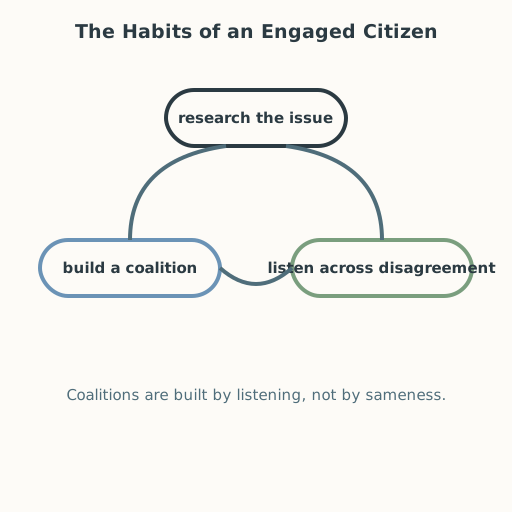
- Meet the three habits (8 min). Write them: research (find out the facts, and check who is telling you and what a second source says); coalition (people who differ on much joining on one shared thing); listening (hearing the other side’s real reasons before answering).
- Worked example — the Chipko movement (15 min). Read the case: in the 1970s in the Himalayan region of India, villagers — especially women — embraced trees to stop them being felled, protecting forests their communities depended on, in a nonviolent movement inspired by Gandhi (S-328). Map it on your sheet: what was the issue? who joined and why? how did they listen across difference? what did they win, and what did they struggle with?
- Begin your own research (17 min). Choose an issue you care about — local or global. On the research sheet, write: what I know, what I need to find out, and where I will look. For each place you look, note who is speaking and who benefits, and plan to check the claim against a second source (S-278, S-217).
- Share one finding (8 min). With a partner, share one thing you learned from the case about listening, and one thing your research still needs to find out. Give one specific suggestion.
- Close (2 min). Say — or write, sign, gesture, or use AAC to express — one habit you will practice first.
Differentiation
- Support: Use a case sheet with the Chipko map partly filled in; the learner underlines who joined and why, then answers with a starter (“The coalition held together because…”).
- Extension: Audit one source on your issue for who is speaking and who benefits, and write one sentence on what a second, different source would add or correct.
- Number access (dyscalculia): This lesson requires no arithmetic. Any dates (the 1970s) are pre-printed and read aloud; nothing must be counted, computed, or ordered. The research sheet is a word organizer, doable in speech, writing, sign, or gesture.
- Communication access: Every spoken step — naming, reading aloud, discussing, sharing, or closing — can be done in writing, sign, gesture, or AAC instead. Learners who are non-speaking, d/Deaf, hard-of-hearing, or who use AAC complete every task in their preferred mode; no step requires producing or hearing sound. The case may be provided in print, braille, or audio description.
Assessment
- Formative (peer + self): Can the learner map a real coalition (who joined, why, how they listened), and begin researching an issue with a source-check habit (in speech, writing, sign, or AAC)?
- Portfolio artifact (unit): The coalition map and the begun research sheet, opened in the capstone ethics & civic journal.
Home connection
Ask someone at home about one time people in your community joined together despite their differences to get something done. Write two lines: the shared thing they agreed on, and how they listened.
Resources
- On the Chipko movement: Encyclopaedia Britannica — Chipko movement (S-328).
- On the recurring pattern of coalitions: Britannica — Woman suffrage (S-327); Britannica — Salt March (S-390).
- On checking sources: Center for News Literacy (S-278); UNESCO — Media and Information Literacy (S-217); Britannica — Social media (S-481). On cooperative structures: Slavin — Cooperative Learning (S-147); Ostrom — Governing the Commons (S-416).