Lesson 01 — Who I Am in Full: An Integrated Self
Learners open the closing week by gathering themselves into one whole. They retrieve the integrated-self work of the year and test its three threads — who I am, what I value, how I will act — across the contexts of their own life, watching how the same through-line holds together. They write a short "who I am in full" statement and celebrate it as the self they hand to adult life.
Objectives
Objectives
- D01.S2.12.01 Articulate an integrated sense of who they are, what they value, and how they will act, holding together across contexts.
Essential question
Who am I — in full — as I gather every part of myself, across every context, into one integrated self I can hand to adult life?
Key vocabulary
Materials
Standard materials
- Integrated-self map · 1 per learner A page with a center figure and four labeled context rooms — family, friends, community, online — plus three thread lines (who I am, what I value, how I will act) and a closing line: 'this is the one me who shows up everywhere'
- Capstone journal · 1 per learner The year-long notebook, now gathering its closing artifacts
Low-tech / no-cost
- Paper and pencil To draw the map and write the whole-self statement by hand
- Voice and body (or pen, screen, or hands) To share one line aloud, in writing, or in sign — no printed sheet needed
Enriched / lab & device
- One plain-language page on narrative identity · 1 per pair A short page on the life story as an evolving, self-authored whole (McAdams), to frame the map as a living draft, not a verdict
Works in different contexts
- large-group Fill the map individually, then a quiet gallery walk of the whole-self lines, followed by a closing circle where each learner shares one line they will keep — spoken, written, or signed
- multi-age Younger learners name "who I am" and "what I value" in two rooms; older learners complete all three threads and all four rooms plus the closing line
- self-directed A learner completes the map and the whole-self statement alone, then reads the closing line aloud or silently (or signs/types it) to themselves as a promise
- level-grouped A ready group also writes one sentence on where their through-line strains and how they keep it unbroken — the honest stress-test
- outdoor-only Four marked stations for the four contexts; walk to each and name one way the same you shows up there, then return to center for the closing line
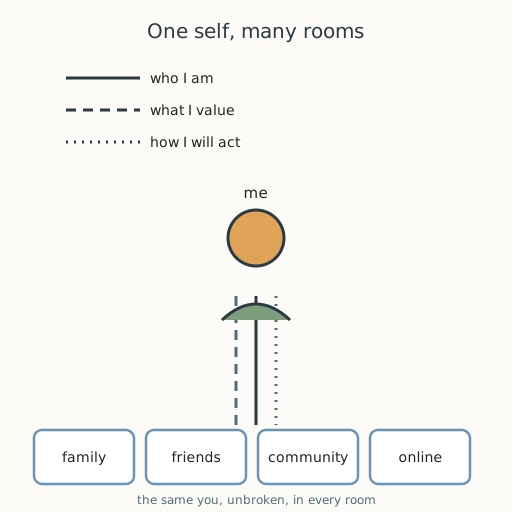
Lesson 1 — Who I Am in Full: An Integrated Self
Summary
Learners open the closing week by gathering themselves into one whole. They retrieve the integrated-self work of the year and test its three threads — who I am, what I value, and how I will act — across the contexts of their own life, watching how the same through-line holds together. They write a short “who I am in full” statement and celebrate it as the self they hand to adult life.
Objectives
- Articulate an integrated sense of who they are, what they value, and how they will act, holding together across contexts. (D01.S2.12.01)
Connection
You are not a different person in every room, and yet different parts of you come out in different places — the you at the family table, the you with friends, the you in community work, the you online. The question this week asks is not “which one is the real me?” but is there one me running through all of them, and can I say who that is? A woven cloth holds together because the threads run the whole length; the same is true of a person.
Materials
- Integrated-self map
- Capstone journal
- Paper and pencil (low-tech); voice, body, pen, screen, or hands (low-tech)
- Narrative-identity page (enriched)
Preparation
- Copy or draw the integrated-self map (center figure + four context rooms + three thread lines + closing line).
- Retrieval: from the unit’s earlier work, the integrated-self statement’s three threads — who I am, what I value, how I will act — and the “one self across contexts” idea (D01.S2.12.01). Today they are gathered and tested across four named contexts.
- Prepare a model map (worked example first: Kirschner, Sweller & Clark, S-011), and hold the whole explicitly as a living draft, never a verdict — identity develops across the whole lifespan (Erikson, S-155), and an “I don’t know this part yet” is welcome in any room.
Facilitator note
This lesson is written to the learner (“you”). The idea to land: an integrated self is one through-line — who I am, what I value, how I will act — that stays recognizably the same across every context, and it is celebrated, not graded. This is the opening move of a closing week, so there is no new heavy content; the lesson consolidates what the year already built and turns it into a handoff. Model once, then let each learner gather their own (S-011); the gathering is retrieval across the whole year, which is the science-of- learning payoff of spacing (Dunlosky et al., S-039).
The ethics lens: “how I will act” makes the integrated self an ethical commitment, not only self-description. The egalitarianism lens: every self is a whole honored as it is — no map is better than another, and no learner’s identity is measured against a template or a ranking. The global lens: the lesson refuses any single model of what a person is. The written map with rooms is one culture’s shape for this passage — a self drawn from inside, in a Western idiom — but many traditions name personhood relationally: Ubuntu (umuntu ngumuntu ngabantu, “a person is a person through other persons,” S-508), a Southern African ethic, holds that one becomes a person with and through others, not alone, and other traditions root the self in kin, roles, or land. The passage itself is also marked differently — a naming, a song, a vow, or a pilgrimage. None is the default; learners may adapt the form, or the model, to their own life. The technology lens: “online” is one of the real rooms where a self shows up now, and the lesson asks whether the same through-line holds there or gets distorted — without moralizing about being online. The environment lens: the whole self is also a body in a place, in relationship with land, water, and the living world; the closing week gathers that belonging too (it returns in full in Lesson 3).
Safeguarding: the map may include anything a learner chooses to include; nothing is required about trauma, family, or a marginalized identity. A learner may complete the map privately, share only one line, or leave a room blank with “still becoming” — a complete and honored answer.
Procedure
- Recall the year (8 min). Without opening your journal, write the three threads of your integrated self from memory: who I am, what I value, how I will act. Then open your journal and check what you recalled and what you missed (retrieval: S-039).
- Meet the map (6 min). Look at the model map (S-011). It has one center figure and four rooms — family, friends, community, online — and it asks one question in every room: is the same me here?
- Fill the rooms (14 min). For each of the four rooms, write one real, specific way the three threads show up: something true of who you are, something you value, and something you actually do there. Leave any room blank and write “still becoming” if that is honest.
- Name the through-line (10 min). Look across your four rooms. Write the one line that runs through all of them — the part that does not change from room to room — and one line on where it strains, and how you keep it unbroken.
- Write who you are in full (10 min). In your journal, compose a short statement — no more than five lines — beginning: “I am one person, in every room: ___”. End it with what you hand to adult life.
- Celebrate (7 min). In a circle or with a partner, share one line of your statement — spoken, written, or signed. Receive others’ lines (by ear, eye, or hand) without ranking them; notice what the room repeats.
Differentiation
- Support: Fill two rooms and write a two-line “who I am in full” statement; share one line — spoken, written, or signed.
- Extension: Distill the statement to a single sentence you could say from memory, and test whether it still holds in a future context you expect to enter as an adult.
- Communication access: Every step — recalling, filling rooms, naming the through-line, sharing, or celebrating — can be done in writing, sign, gesture, typing, or AAC instead of speech. Learners who are non-speaking, d/Deaf, hard-of-hearing, or who use AAC complete every task in their preferred mode; no step requires hearing or producing sound. A learner who is blind or has low vision completes the map through spoken description, dictation, or a tactile organizer rather than a printed sheet.
- Number access (dyscalculia): No arithmetic is required. “Four rooms” and “three threads” are simple counts that the map already structures with labeled boxes, so no learner needs to hold numbers in mind to complete the task.
Assessment
- Summative + portfolio (unit): The completed integrated-self map and the “who I am in full” statement, filed as closing capstone artifacts — assessed for specificity and honesty (does one through-line actually hold across the rooms?), never for agreement with any template.
- Self + peer: Did the learner name real, specific threads in more than one room and state the through-line in their own words? Shared without ranking.
Home connection
Read your “who I am in full” statement (or one chosen line) to someone at home, and ask them to name one way they have seen the same you in different rooms. Write one sentence on what you heard.
Resources
- On identity as a lifelong, developing process: Erikson, Childhood and Society (S-155).
- On the life story as an evolving, self-authored whole: McAdams, The Psychology of Life Stories (S-404).
- On relational personhood — becoming a person with and through others, not alone: Ubuntu, umuntu ngumuntu ngabantu (S-508).
- On worked examples and guided practice: Kirschner, Sweller & Clark (2006) (S-011); on spaced retrieval across the year: Dunlosky et al. (2013) (S-039).