Lesson 08 — My Family and My People
Learners name the people who care for them — family and the wider circle of "my people" — and see that belonging to people is part of who they are.
Objectives
Objectives
- D01.S2.K.02 Name the groups to which they belong (family, class, community).
Essential question
Who are my people?
Key vocabulary
Materials
Standard materials
- Paper and crayons · per learner
- A "My people" house or circle outline · 1 per learner A big circle or house shape with room to draw people inside
Low-tech / no-cost
- Voice and body Tell about your people aloud; no paper needed
- A stick or finger in sand or soil Draw the people who care for you as simple stick figures in the dirt
Enriched / lab & device
- A family photo or drawing from home (optional) · per learner Learners bring or draw a picture of their people to share
- A tablet with a drawing app · 1 per pair Draw a "my people" circle digitally
Works in different contexts
- large-group Learners take turns naming one person who cares for them; the group listens and names how people care (feed, hold, teach, play)
- self-directed A learner draws the people who care for them in the circle, then tells a grown-up one thing those people do together
- outdoor-only Find a plant or tree that grows with others near it, and talk about how people also grow best with others around them
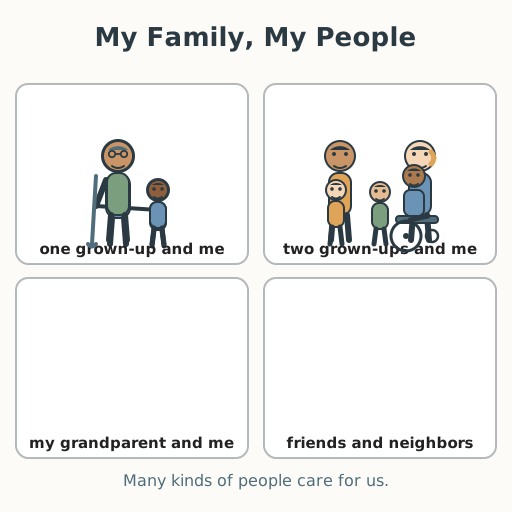
Lesson 8 — My Family and My People
Summary
Learners name the people they belong to — the grown-ups and others who care for them, whether they share a home or a wider circle. They draw their people and celebrate the care that holds them.
Objectives
- Name the groups to which they belong (family, class, community). (D01.S2.K.02)
Connection
Think of the people who take care of you — the ones who feed you, hold you, teach you, and play with you. They might be parents, grandparents, aunties and uncles, older siblings, or neighbors. These are your people, and you belong to them just as they belong to you.
Materials
- Paper and crayons
- A “My people” circle or house outline for each learner
Preparation
- Draw or print a big circle or house shape for each learner.
- Think of one example to model: a person who cares for you.
Facilitator note
This lesson is written to the learner (“you”) so it works in a classroom and for a self-directed learner. As facilitator, use the wide word “people” so every family shape is honored — one caregiver, two, grandparents, guardians, a chosen family, or a community that raises a child. Do not assume a single household form. Invite sharing about care, not about who lives where.
Procedure
- Gather (5 min). Think of one person who takes care of you. What do they do?
- Who cares, and how (10 min). People care in many ways: they feed you, hold you when you cry, teach you things, and play with you. Can you name a person for each kind of care? They are your people.
- Draw my people (15 min). In your circle or house, draw the people who care for you. They do not all have to live in one home — everyone who cares belongs in your circle.
- Share one (10 min). Tell a partner one thing your people do together — a meal, a story, a game, a walk.
- Close (5 min). Remember: you belong to your people, and they belong to you.
Differentiation
- Support: Offer a sentence starter: “One person who cares for me is ___.”
- Extension: Invite learners to add a wider circle around the first — people beyond home, like neighbors or caregivers — and name them.
Assessment
- Formative (observation): Can the learner name at least one group of people they belong to?
- Artifact (portfolio): The “My people” drawing.
Resources
- CASEL SEL Framework (foundational competencies): https://casel.org/fundamentals-of-sel/
Home connection
Ask your people to tell you a story about when you were little. Bring one thing you learned back to share with the class.