Lesson 09 — My Marks Tell a Story
Learners discover that the marks they make can carry meaning — just like the writing systems of the world — and invent their own marks to stand for ideas and feelings.
Objectives
Objectives
- D04.S3.K.01 Draw, dictate, or write marks to express an idea and tell what they mean.
Essential question
How can my marks carry a meaning that others can see?
Key vocabulary
Materials
Standard materials
- Paper and drawing tools · per learner Crayons, pencils, charcoal, or chalk
- Examples of marks that carry meaning · 1 set Simple pictograms, symbols, and early writing marks from around the world (sun, water, home, arrow)
Low-tech / no-cost
- A stick and a patch of soil or sand Learners draw marks in the ground — the oldest writing surface there is
- A finger and a dusty or foggy surface Marks can be made anywhere with just a hand
Enriched / lab & device
- A set of world writing-system cards · 1 set Show a mark from several scripts (a Chinese character, an Arabic letter, a Maya glyph, an Adinkra symbol) to show that marks carry meaning everywhere
- A tablet drawing app · 1 per pair Learners draw marks and record their voice explaining each one
Works in different contexts
- large-group Draw one learner's mark very large for all to see; the group guesses its meaning before the owner explains
- self-directed A learner draws several marks, then explains each one's meaning to a grown-up or into a recording
- outdoor-only Draw marks in soil or sand with a stick; walk around and guess each other's marks' meanings
Lesson 9 — My Marks Tell a Story
Summary
Learners discover that marks can carry meaning — the same idea that powers every writing system on Earth — and invent their own marks to stand for ideas, objects, and feelings.
Objectives
- Draw, dictate, or write marks to express an idea and tell what they mean. (D04.S3.K.01)
Connection
Long before you could write letters or characters, you could make marks — lines, dots, swirls. A mark can stand for an idea, a feeling, or a whole story. The marks you make are already writing, because they carry meaning from you to someone else.
Materials
- Paper and drawing tools (crayons, pencils, charcoal, or chalk)
- Examples of marks that carry meaning — pictograms and symbols (optional)
Preparation
- Gather paper and drawing tools.
- Collect or draw a few examples of marks that carry meaning from around the world.
Facilitator note
This lesson is written to the learner (“you”) so it works in a classroom and for a self-directed learner. The deep idea is egalitarian and global: writing began as marks that carry meaning, and every writing system — from pictograms to alphabets to character scripts — is a beautiful, equal achievement. No mark is “scribble” that should be corrected; every mark a child makes with intent is writing. Ask learners what their marks mean rather than what they “should” mean.
Procedure
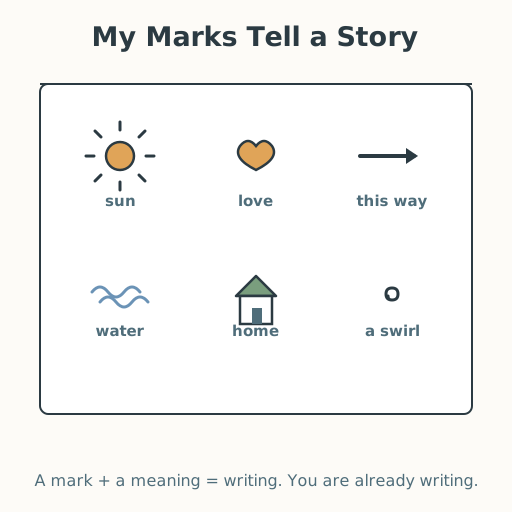
- Gather (5 min). Can a picture say a word? Think of a sun, a heart, an arrow. What do they mean?
- See marks that mean something (10 min). Look at marks from around the world: a picture of water, a symbol for home, a mark from an old writing system. Every one of them carries meaning. Your marks can too.
- Make your own marks (15 min). Draw three marks. Make one stand for a thing, one for an idea, and one for a feeling. Let the marks look however you like — lines, dots, swirls, shapes.
- Tell what they mean (10 min). Show a partner your marks. Can they guess what each one means? Then tell them. The meaning you give your mark is the meaning it has.
- Close (5 min). Remember: marks carry meaning. When you draw a mark and tell what it means, you are writing — the same way people everywhere have always written.
Differentiation
- Support: Offer one mark to copy and a simple meaning (a circle for the sun); let the learner trace and explain it.
- Extension: Invite learners to build a small “mark dictionary” — several marks with their meanings drawn beside them — and teach it to a friend.
Assessment
- Formative (observation): Can the learner make a mark and explain its meaning?
- Artifact (portfolio): The learner’s three marks, kept with a dictated caption of what each means.
Home connection
At home, make up a family mark for something you all love — a park, a food, a pet — and draw it together. Teach your mark to someone new.