Lesson 10 — Drawing and Telling My Idea
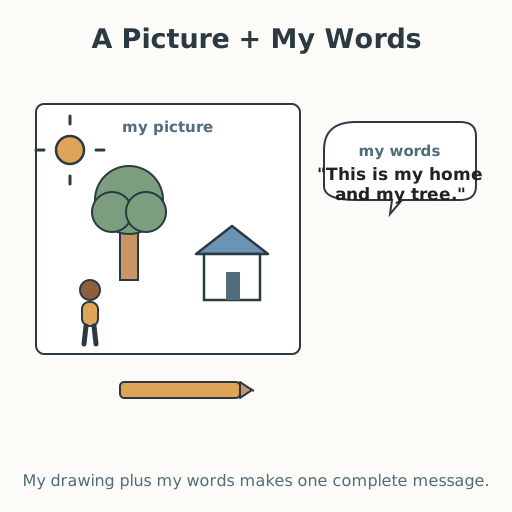
Learners draw an idea and then tell what it means, practicing the earliest form of composition: a picture plus spoken words that together carry a complete message.
Objectives
Objectives
- D04.S3.K.01 Draw, dictate, or write marks to express an idea and tell what they mean.
Essential question
How do I draw an idea and tell what it means?
Key vocabulary
Materials
Standard materials
- Paper and drawing tools · per learner Crayons, pencils, or chalk
- A scribe (facilitator or older peer) · as available Someone to write down the learner's dictated words beside their drawing
Low-tech / no-cost
- A surface and a drawing tool Soil and a stick, or paper and a single pencil, are enough
- Voice The telling itself is the writing; a grown-up remembers or writes the words later
Enriched / lab & device
- A tablet with a drawing app and a voice recorder · 1 per pair Learners draw, then record themselves telling what it means
Works in different contexts
- large-group After drawing, each learner holds up their picture while the group guesses, then the learner tells the meaning in their own words
- self-directed A learner draws an idea and dictates or records their explanation, then reads it back
- outdoor-only Draw an idea from nature — a favorite tree, a cloud shape, a bug — then tell a partner what it is and why it matters
Lesson 10 — Drawing and Telling My Idea
Summary
Learners draw an idea and then tell someone what it means — a picture plus spoken words. They learn that a drawing and its telling together make a complete message, the root of all writing.
Objectives
- Draw, dictate, or write marks to express an idea and tell what they mean. (D04.S3.K.01)
Connection
Sometimes a picture says what words are still learning to say. When you draw an idea and then tell someone what it means, you are sharing your thinking. Your drawing plus your words make one complete message — and that is how writing begins for everyone.
Materials
- Paper and drawing tools
- A scribe (a facilitator or older peer) to write dictated words (optional)
Preparation
- Set out paper and drawing tools.
- Arrange a quiet way for each learner to tell their idea to someone who can listen.
Facilitator note
This lesson is written to the learner (“you”) so it works in a classroom and for a self-directed learner. “Dictate” means the child speaks and an adult or older peer writes the words down. The drawing is the child’s own; the scribe writes exactly what the child says, in the child’s language, without correcting or “improving” it. This is a cornerstone of emergent writing: children compose long before they can spell, and their spoken words are real authorship.
Procedure
- Gather (5 min). Think of an idea you want to share — something you love, a place, a wish, a memory. Hold it in your mind.
- Draw your idea (15 min). Draw your idea on your paper. Make it as detailed or as simple as you like. Your drawing does not have to look like anyone else’s.
- Tell what it means (15 min). Show your drawing to a partner or a grown-up. Tell them what it means, in your own words, in whatever language feels best. If a grown-up can, let them write your words beside your drawing.
- Read it back (5 min). Look at your drawing and your written words together. You made a message! Point to the parts as someone reads your words back to you.
- Close (5 min). Remember: a drawing plus your words is a complete idea. You are already an author.
Differentiation
- Support: Let a learner tell their idea first and draw second, or draw and tell about a single object they can hold.
- Extension: Invite learners to add a second sentence to their dictation, or to draw a sequence of two pictures telling what happened next.
Assessment
- Formative (observation): Can the learner produce a drawing and tell what it means in their own words?
- Artifact (portfolio): The drawing with its dictated caption, kept as evidence of early composition.
Home connection
At home, draw a picture of something that matters to you and tell a grown-up what it means. Ask them to write your words down beside it, then read it back together.