Lesson 11 — Writing My Own Story
Learners compose their own story — a beginning, a middle, and an end — in a home-made book using pictures, marks, and dictated words, and read it aloud as its author.
Objectives
Objectives
- D04.S3.K.01 Draw, dictate, or write marks to express an idea and tell what they mean.
- D04.S1.K.01 Listen to a story or speaker and retell one important part in their own words.
Essential question
How do I write my own story with pictures and marks?
Key vocabulary
Materials
Standard materials
- Folded paper booklets · 1 per learner A few folded pages stapled or tied together for a home-made book
- Drawing and writing tools · per learner Crayons, pencils, markers
Low-tech / no-cost
- Paper and a single pencil or charcoal A few sheets folded together make a book; one drawing tool is enough
- Voice and memory The story can be told aloud page by page; a grown-up or older peer writes it down
Enriched / lab & device
- A tablet with a drawing app and voice recorder · 1 per pair Learners make a digital picture book, recording their voice telling each page
Works in different contexts
- large-group Each learner makes one page; bind the pages into a big class book and "read" it together at the end
- self-directed A learner makes a small book alone — a picture and a few marks per page — then reads it aloud to a grown-up or into a recording
- outdoor-only Tell the story outdoors first, walking through its beginning, middle, and end, then draw the pages on paper or in the soil
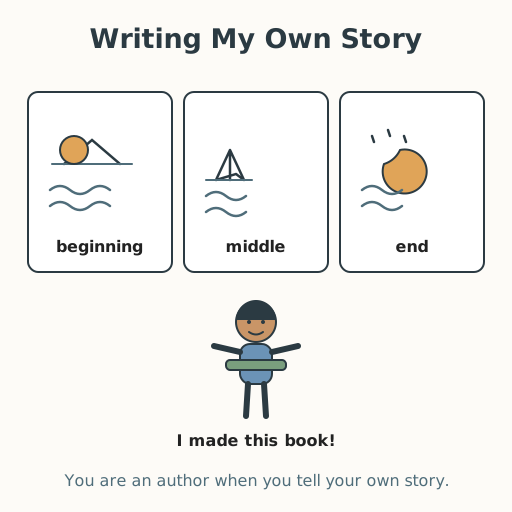
Lesson 11 — Writing My Own Story
Summary
Learners write their own story in a home-made book, using pictures, marks, and dictated words to tell a beginning, a middle, and an end — then read it aloud as its author.
Objectives
- Draw, dictate, or write marks to express an idea and tell what they mean. (D04.S3.K.01)
- Listen to a story or speaker and retell one important part in their own words. (D04.S1.K.01)
Connection
Everyone has stories inside them — things that happened, things they dreamed, things they wish for. Putting a story onto a page, with pictures and marks, lets it live outside you where others can find it. You are an author the moment you tell your own story.
Materials
- A folded paper booklet for each learner
- Drawing and writing tools (crayons, pencils, markers)
Preparation
- Fold and bind a small booklet for each learner (a few pages stapled or tied).
- Set out drawing tools.
Facilitator note
This lesson is written to the learner (“you”) so it works in a classroom and for a self-directed learner. This is the S3 capstone: the child authors a complete story. It may be told in pictures, in marks, in dictated words, or any mix — all are real writing at this age. Write down exactly what the child says, in their language, without “fixing” it. Some children will make one page; others many — both are celebrated. This lesson also closes the S1 loop: retelling their own story, in their own words, is the highest form of “one important part in my own words.”
Procedure
- Gather (5 min). What story lives inside you today? It can be real or make- believe. Choose one.
- Plan the three parts (5 min). A story has a beginning, a middle, and an end. Say yours out loud to a partner, or just in your head: what happens first? next? last?
- Make your book (20 min). On your pages, draw and write your story — one part per page. Use pictures and any marks you like. If a grown-up can, tell them your words and let them write them beside your pictures.
- Read it aloud (10 min). Read your book to a partner or the group, pointing to each page as you go. You are the author, so you know the story best.
- Close (5 min). Remember: you have a story no one else has, and now it lives on your pages. An author is anyone who tells their own story.
Differentiation
- Support: Provide a three-page booklet with one picture starter per page; let a learner tell the story aloud while an adult scribes every word.
- Extension: Invite learners to add a cover with a title, or to make a sequel page telling what happens after the end.
Assessment
- Artifact (portfolio): The learner’s home-made book, kept as a first authored story.
- Formative (performance): Can the learner “read” their story aloud, telling what each page means in their own words?
Home connection
At home, make a family storybook together: each person draws one page of a story you all invent, then read the whole book aloud.