Lesson 05 — Brushing My Teeth
Learners practice brushing their teeth with growing independence — morning and night, all surfaces, for about two minutes — and discover that clean teeth help a body eat, talk, and smile, while honoring the many ways people clean teeth worldwide.
Objectives
Objectives
- D03.S4.01.01 Perform daily self-care routines such as washing hands, brushing teeth, and dressing with growing independence.
Essential question
How do I care for my teeth every day?
Key vocabulary
Materials
Standard materials
- A toothbrush and toothpaste · per learner Each learner's own brush (or a demonstration brush); never share brushes
- A cup of water · per learner For rinsing
- A large tooth model or a picture · 1 To show how to brush every surface
Low-tech / no-cost
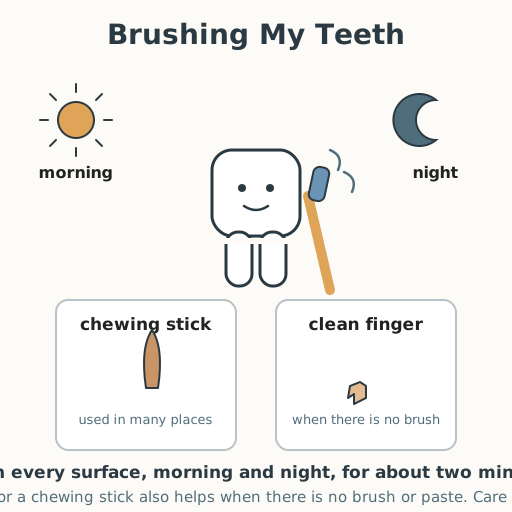
- A clean finger and water Where there is no brush, cleaning teeth with a clean finger and water, or a chewing stick, also helps — teach what is available
- Voice and body Practice the brushing motion on your own teeth with your finger while saying the steps; no brush needed to learn
Enriched / lab & device
- A two-minute timer or a song · 1 So learners brush long enough
- A tooth model with large teeth · 1 Practice the brushing motion on a big model before doing it on real teeth
Works in different contexts
- large-group Demonstrate on a big model or picture, then have the whole group practice the motion with a finger while singing a brushing song
- self-directed A learner brushes their own teeth following the steps, singing to time two minutes, then checks in a mirror if one is available
- outdoor-only Brush at an outdoor tap or with a cup of water; practice the circular motion with a finger or a clean twig if no brush is available
- multi-age Older learners demonstrate the steps and help younger ones reach back teeth and rinse without swallowing
- level-grouped Learners who can already brush on their own work at a station; others practice the motion with a finger first, then try with a brush
Lesson 5 — Brushing My Teeth
Summary
Learners practice brushing their teeth with growing independence — morning and night, all surfaces, for about two minutes — and discover that clean teeth help a body eat, talk, and smile. They learn that people around the world keep teeth clean in different ways, and that care is never a test.
Objectives
- Perform daily self-care routines such as brushing teeth with growing independence. (D03.S4.01.01)
Connection
Your teeth work hard every day — biting, chewing, and helping you talk and smile. They are a part of your body worth caring for. People everywhere clean their teeth, though not all the same way: some use a brush and paste, some use a clean finger, and in many places people have long used a small chewing stick. Today you will practice cleaning your teeth all by yourself.
Materials
- A toothbrush and toothpaste (each learner’s own, or a demonstration brush)
- A cup of water for rinsing
- A large tooth model or a picture
Preparation
- Ensure each learner has their own clean toothbrush (never share brushes).
- Set up a place to practice, with water and a place to spit safely.
- Have a two-minute song ready to time the brushing.
Facilitator note
This lesson is written to the learner (“you”). Never share toothbrushes, and supervise so toothpaste is not swallowed. Honor every context: where brushes or paste are unavailable, teach a clean-finger or chewing-stick method without shame. Where a learner cannot brush their own teeth, a caregiver or older peer can help — the goal is clean teeth, not doing it alone. Care is never a test — celebrate effort, not perfection. A learner who does not use a speaking voice points or acts out the steps; a learner who is blind or has low vision is guided hand-over-hand through the motion. A learner who is deaf or hard of hearing watches the demonstration from the front and follows picture step cards or a hand-over-hand model; each brushing step is shown on the mouth, not only told. The health facts are from the World Health Organization: brushing removes food and plaque that can hurt teeth and gums. This lesson extends Kindergarten’s “Brushing My Teeth” (U.00.002) into independent, self-checked practice.
Procedure
- Gather (5 min). Smile at a friend. Your teeth help you eat, talk, and smile. Today you will learn to care for them all by yourself.
- Meet the toothbrush (5 min). Hold your brush. A little water and a small dab of toothpaste is all you need — a dot the size of a pea.
- Remember the steps (10 min). Practice the motion with your finger first:
- Brush the tops (the chewing part) with small circles.
- Brush the fronts.
- Brush the backs.
- Brush the tongue side gently too.
- Spit out the foam — do not swallow the paste.
- Brush for real, on your own (15 min). Brush your own teeth, going around every part. Sing a short song in your head — about two minutes is enough. Rinse with a little water. Then check: run your tongue over your teeth — do they feel smooth and clean?
- When do we brush? (5 min). Name the times: in the morning and before bed. Share with a partner one time you will remember.
- Close (5 min). Clean teeth are a way of saying “I care for my body.”
Differentiation
- Support: Practice with a finger first, then brush together; use a picture card showing the steps.
- Support (deaf/hard-of-hearing): Face the learner for every step and pair each motion with its picture card; the finger-and-tongue check also works by feel.
- Support (motor-difference): A caregiver or peer helps reach back teeth while the learner leads as much as they can.
- Extension: Invite learners to make up their own two-minute brushing song and to count how many teeth they can feel with their tongue.
Assessment
- Formative (observation): Can the learner brush with growing independence, showing the steps and naming one time to brush?
- Self: The learner feels their teeth and reports whether they feel clean.
Home connection
Brush your teeth on your own, morning and night, this week. Ask a grown-up to watch and cheer you on.
Resources
- World Health Organization, “Oral health” (caring for teeth and mouth): https://www.who.int/news-room/fact-sheets/detail/oral-health