Lesson 06 — Dressing and My Daily Care
Learners practice dressing skills — buttons, zips, snaps, and ties — with growing independence, choose clothes for the weather, and assemble a "my day" self-care routine, always honoring every body, every ability, and every family's resources.
Objectives
Objectives
- D03.S4.01.01 Perform daily self-care routines such as washing hands, brushing teeth, and dressing with growing independence.
Essential question
How do I care for my body each day, with growing independence?
Key vocabulary
Materials
Standard materials
- A practice board or clothes with fasteners · 1 set Buttons, zips, snaps, and ties to practice on (a practice board or spare clothes)
- Weather and clothing picture cards · 1 set Sun, rain, cold, and heat cards matched with clothing cards
- A "my day" routine chart · 1 Picture cards for wake, wash, brush, dress, eat, in order
Low-tech / no-cost
- The learner's own clothes Practice fasteners on the clothes they are wearing; no board needed
- Voice and body Act out getting dressed and the day's routine; no cards needed
Enriched / lab & device
- Dressing frames (button, zip, snap, tie) · 1 set Montessori-style dressing frames for repeated fastener practice
- A picture book about getting ready · 1 A story showing a child getting dressed and ready for the day
Works in different contexts
- large-group Practice fasteners in small stations, then build one big "my day" routine chart together as a group
- self-directed A learner practices one fastener and arranges the "my day" cards in order, then checks with a grown-up or older peer
- outdoor-only Talk about dressing for the day's real weather and practice a fastener outside; arrange the routine by acting it out in order
- multi-age Older learners coach younger ones through buttons and zips, and help place the routine cards in order
- level-grouped Group learners by which fastener they are working on (buttons vs zips vs ties), so each practices at their own next step
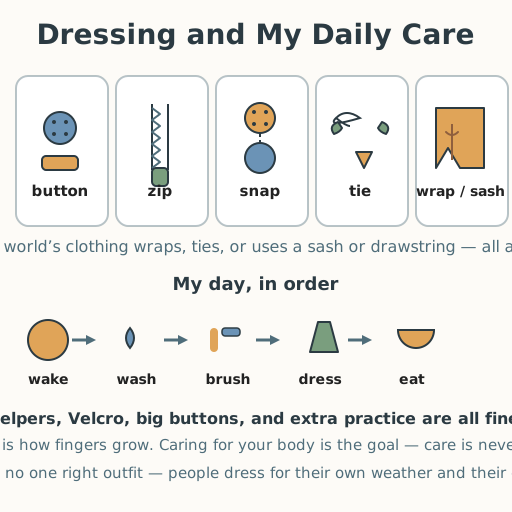
Lesson 6 — Dressing and My Daily Care
Summary
Learners practice dressing skills — buttons, zips, snaps, and ties — with growing independence, choose clothes for the weather, and assemble a “my day” self-care routine that joins washing hands, brushing teeth, and dressing. Every body, every ability, and every family’s resources are honored; care is never a test.
Objectives
- Perform daily self-care routines such as dressing with growing independence. (D03.S4.01.01)
Connection
Getting dressed is one of the first ways you take care of your own body each day. Buttons, zips, and ties need practice — and practice is how we grow. Dressing yourself is a way of saying “I can care for my body.” Some days you will need a little help, and that is okay too — care is never a test.
Materials
- A practice board or clothes with fasteners (buttons, zips, snaps, ties)
- Weather and clothing picture cards
- A “my day” routine chart
Preparation
- Gather practice boards or spare clothes with buttons, zips, snaps, and ties.
- Prepare weather cards (sun, rain, cold, heat) and matching clothing cards.
- Prepare a “my day” routine chart with picture cards: wake, wash hands and face, brush teeth, dress, eat.
Facilitator note
This lesson is written to the learner (“you”). No poverty judgment, ever. Some learners have few clothes or need help dressing; some fasteners are hard for many hands. Celebrate effort, never compare outfits or resources, and never imply there is a “right” way to dress. Some clothing fastens with buttons, zips, and snaps; much of the world’s clothing wraps, ties, or uses sashes and drawstrings instead — all are honored here. Honor motor differences: adaptive fasteners, Velcro, and help from a caregiver or peer are all fine — the goal is caring for the body, not doing it perfectly or alone. Weather and dress vary greatly around the world, and cultural dress is honored; there is no single “right” outfit for a season. A learner who is blind or has low vision practices fasteners by touch; a learner with a motor difference works on the fastener that fits their next step. A learner who is deaf or hard of hearing follows the demonstrations from the front, where the weather, clothing, and routine picture cards carry each step visually. Care is never a test. This lesson completes the S4.01.01 self-care trio (wash, brush, dress) and previews the unit’s body-autonomy lessons that follow.
Procedure
- Gather (5 min). Remember washing hands and brushing teeth — two ways we care for our body. There are more ways too. Getting dressed is one of them. Today we will practice, and practice is how we grow.
- Practice fasteners (15 min). Work on a practice board or your own clothes. Buttons, zips, snaps, and ties — each one is a small puzzle for your fingers. Go slow and steady. If it is hard at first, that is normal; keep trying. Fingers learn by doing.
- Dress for the weather (10 min). Match the clothing cards to the weather cards: sun, rain, cold, heat. People around the world dress for their own weather and their own life. There is no one “right” outfit — there are many ways to be dressed and ready.
- My day routine (10 min). Put the day in order: wake, wash hands and face, brush teeth, dress, eat. Arrange the picture cards, or act it out with your body. This is your own care — a little more of it you can do yourself each day.
- Close (5 min). Remember: every body and every ability is honored. Helpers, adaptive fasteners, and extra practice are all fine. Caring for your body is the goal, not being perfect.
Differentiation
- Support: Focus on one fastener the learner is closest to; practice together hand-over-hand, then let them try alone.
- Support (blind/low-vision): Practice fasteners by touch, naming each piece and each step as the fingers feel it; choose clothes by texture and by feeling the day’s weather.
- Support (deaf/hard-of-hearing): Face the learner for each demonstration and let the weather, clothing, and routine picture cards carry the steps visually.
- Support (motor-difference): Offer Velcro or large buttons, and let a caregiver or peer assist while the learner leads.
- Extension: Invite learners to put the routine in order from memory and to teach a fastener to a peer who is still learning it.
Assessment
- Formative (observation): Can the learner attempt a fastener and name or arrange one daily self-care step, with growing independence?
- Self: The learner names one self-care thing they will do on their own tomorrow.
Home connection
Practice one fastener at home — a button or a zip. With a grown-up, choose tomorrow’s clothes for the weather, and try to dress yourself as much as you can.