Lesson 06 — Maps and Globes — Home and Another Place
Learners use a simple map or globe to find where they live and one other place, and name one way the two places are different.
Objectives
Objectives
- D08.S3.01.02 Use a simple map or globe to find where they live and one other place, and tell one way the two places are different.
Essential question
How do I find my home and one other place on a map or globe, and how are they different?
Key vocabulary
Materials
Standard materials
- A simple map or globe · 1 A simple world map or globe, plus a hand-drawn map of the room or neighborhood, with a "home" marker
- Two place markers · 2 Small markers (pebbles, stickers, or a pointing stick) for "home" and "another place"
Low-tech / no-cost
- A map drawn large on the ground or paper A simple map of the room or neighborhood drawn with a stick or chalk; no printed map needed
- A ball or round fruit as a "globe" Any round thing, marked roughly, to show that a globe is the Earth in the shape of a ball
Enriched / lab & device
- A real globe · 1 per group For finding home and one other place and feeling the round shape
- A child-friendly map or atlas · 1 per pair Simple picture maps of the world for finding places
Works in different contexts
- large-group Find home together on the big map first, then one learner places the "another place" marker while the group names how it is different
- self-directed The learner marks home and one other place on a simple map, then tells a grown-up or peer one way the two places are different
- outdoor-only Draw a map of the outdoor space on the ground, mark "home," then mark a far place on a round fruit or drawn circle and name one difference
- level-grouped Learners who can read labels help others find the two places; the whole group names the difference
Lesson 6 — Maps and Globes: Home and Another Place
Summary
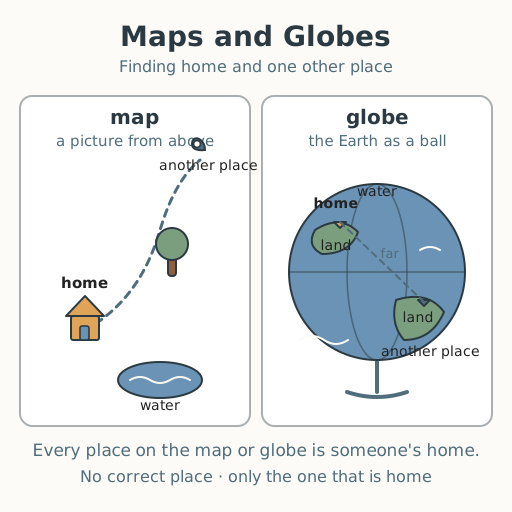
Learners use a simple map or globe to find where they live and one other place, and name one way the two places are different. A map is a picture of a place from above; a globe is the whole Earth in the shape of a ball.
Objectives
- Use a simple map or globe to find where they live and one other place, and tell one way the two places are different. (D08.S3.01.02)
Connection
Have you ever drawn a picture of your room from above, as if you were a bird looking down? That is a map — a picture that shows where things are. A globe is the whole Earth drawn as a ball you can turn. Maps and globes help people find their way, from the way to the market to the way across an ocean. Today you will find your own home and one other place, and notice how they are not the same.
Materials
- A simple map or globe, plus a hand-drawn map of the room or neighborhood
- Two place markers for “home” and “another place”
Preparation
- Prepare a simple map of the room or neighborhood (drawn is fine) with a clear “home” spot.
- Have a world map or globe ready, or a round object to stand in for a globe.
- Choose one friendly “other place” to find together (a place from a story, a far city or island, a place someone in the group knows).
Facilitator note
This lesson is written to the learner (“you”) so it works in a classroom and for a self-directed learner. No travel is required — the map and globe are found, not journeyed to. Never rank places: do not say the other place is more or less than home. “No correct place, only the one that is home” applies to every place on the map. A globe is the Earth as a ball; a map is one flattened view — both are real tools used by people everywhere. For a learner who is blind or has low vision, make the map tactile — raised lines of string or sand-glue for land, a smooth patch for water, a bump for home — so the places can be felt. “Another place” may be any place a learner is curious about; let them choose where possible.
Procedure
- Gather (5 min). Imagine a bird flying over your room or street. What would it see from above?
- Meet the map and globe (10 min). A map is a picture of a place from above. A globe is the whole Earth drawn as a ball. Look at both. Find the water and the land on each.
- Find home (10 min). On the room or neighborhood map, put your marker on your home — or the spot closest to it. Say or point: “Here is where I live.”
- Find another place (10 min). On the world map or globe, find one other place — a place from a story, a far island, a city someone in your group knows. Put the second marker there. Is it near or far from home?
- Name one difference (10 min). Ask: how are my home and this other place different? Is one by the sea and one far from water? Is one hot and one cold? Is one busy and one quiet? Name or show one difference.
- Close (5 min). Maps and globes let you hold the whole world in your hands. Every place on them is someone’s home, and each one is different.
Differentiation
- Support: Find only home on the room map today; find the other place together as a whole group.
- Blind/low-vision: Use a raised-line map and a round object with texture for land and water; find the places by touch.
- Non-speaking: Place markers and point to the difference, or act it out (shiver for cold, fan for hot), instead of speaking.
- Deaf/HH: The map and globe are visual by nature — find places by sight and sign the difference between the two places as you point to each.
- Motor difference: Use large pebbles or a pointing stick to mark places; a partner places the marker where the learner points or directs with eye-gaze.
- Extension: Find a third place and name one way it differs from both of the first two.
Assessment
- Formative (observation): Can the learner place or point to home and one other place on a map or globe?
- Formative (oral/performance): Can the learner name or show one way the two places are different?
Home connection
With a grown-up, look at any map you have — on a phone, in a book, or drawn by hand. Find where you live and one other place you are curious about. Name one way they are different.