Lesson 07 — What I'm Still Learning
Learners name one thing they are still learning and place it on a growth ladder — not yet, with help, on my own — discovering that "not yet" is information, never a verdict, and that everyone is growing at their own pace.
Objectives
Objectives
- D01.S2.02.01 Identify their personal strengths and one thing they are still learning to do.
Essential question
What am I still learning, and why is "not yet" a good thing?
Key vocabulary
Materials
Standard materials
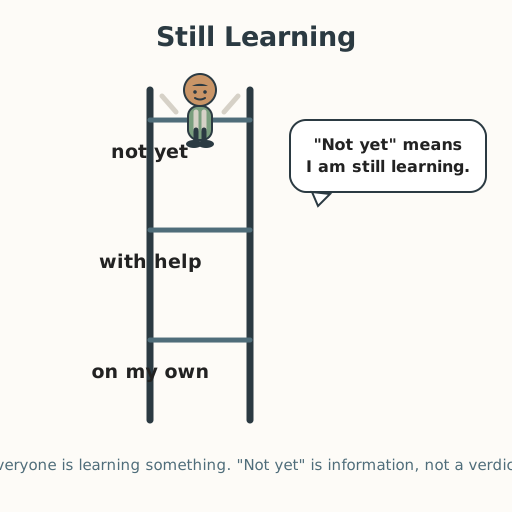
- Not-yet ladder poster · 1 A ladder with three rungs — "not yet," "with help," "on my own" — and a climber figure
- Index cards or paper slips · 1 per learner To write one thing they are still learning
- Crayons and pencils · per learner
Low-tech / no-cost
- A ladder drawn in the sand or on the ground Stand on the rung that matches where you are with a skill
- Voice and body Say your "not yet" aloud and take one step forward for the next small step
Enriched / lab & device
- A printed 'still learning' growth page · 1 per learner A page with the ladder and space to draw the skill at each rung, kept in the portfolio
- Photos or a short video of a skill being practiced over time · 1 per group Optional, to show that practice turns "not yet" into "I can"
Works in different contexts
- large-group Build one shared ladder together and invite volunteers to stand on the rung that matches them for a group skill
- self-directed A learner chooses one "not yet" skill, marks the rung they are on, and names the next small step
- outdoor-only Draw a ladder in the dirt and step up one rung as you name each small step toward a skill
- level-grouped Pair a learner who "can" a skill with one who is "not yet," so the first teaches and both grow
Lesson 7 — What I’m Still Learning
Summary
Learners name one thing they are still learning and place it on a growth ladder: not yet, with help, on my own. They discover that “not yet” is information, never a verdict — it simply says where the next step is. Everyone is growing, and no one’s pace is a measure of their worth.
Objectives
- Identify their personal strengths and one thing they are still learning to do. (D01.S2.02.01)
Connection
When a baby bird first flaps its wings, it cannot fly — not yet. It flutters, falls, tries again. “Not yet” does not mean “never” or “not good enough.” It means “I am on my way.” Maybe you cannot whistle yet, or swim yet, or read a long word yet. That is not a failure; it is the exact spot where you are growing. Even grown-ups have “not yet” things — a gardener learning a new crop, a cook learning a new dish.
Materials
- Not-yet ladder poster
- Index cards or paper slips
- Crayons and pencils
Preparation
- Prepare the ladder poster (three rungs: not yet, with help, on my own).
- Set out the cards and crayons.
- Arrange a circle for sharing (sharing is invited, never required).
Facilitator note
This lesson is written to the learner (“you”). The heart of this lesson is the “not yet” mindset: a skill not yet learned is information, never a verdict. Never let the ladder become a ranking — no one is “higher” than anyone else; different people are on different rungs for different skills. A learner who shares a “not yet” is showing courage; receive it warmly. “With help” and “on my own” are both good places to be. Model your own “not yet” first to make it safe.
Procedure
- Gather (5 min). Yesterday you found your strengths — things you can do well. Today you name one thing you are still learning. Everyone has one, even grown-ups.
- Meet the ladder (10 min). Look at the ladder. The bottom rung says not yet — I cannot do it yet, and that is okay. The middle rung says with help — I can do it when someone shows me or helps me. The top rung says on my own — I can do it by myself. You are on different rungs for different skills, and that is normal.
- Choose your “not yet” (10 min). Pick one thing you are still learning — tying your shoes, writing your name neatly, swimming, reading a hard word, sharing when it is hard. Write it or draw it on a card. Then point to the rung you are on.
- Name the next small step (10 min). For your “not yet,” name one small step you could take next — ask someone to show you, try once more today, practice a little each day. Share with a partner if you like, or keep it to yourself.
- Close (5 min). “Not yet” is not a bad grade — it is a signpost pointing to your next step. Say it together: “I can’t do it yet — and I am growing.”
Differentiation
- Support: Offer a picture menu of common “still learning” skills to choose from; use only two rungs (not yet, with help) to start.
- Extension: Choose a second skill, and for each, name the next step and who could help you with it.
Assessment
- Formative (observation): Can the learner name one thing they are still learning and place it on a rung of the ladder?
- Self-check: The learner says, “I am still learning ___, and my next step is ___.”
Home connection
Ask someone at home what they are still learning, and tell them one thing you are still learning too.
Resources
- CASEL SEL Framework (self-awareness and growth mindset): https://casel.org/fundamentals-of-sel/