Lesson 08 — Alike and Different
Learners explore how they are alike and different from others, sorting facts into a Venn — just me, just my friend, what we share — and discover that both sameness and difference matter: what we share joins us, and what is different makes each of us special.
Objectives
Objectives
- D01.S2.02.02 Describe how they are alike and different from others and why both matter.
Essential question
How am I like others, how am I different, and why do both matter?
Key vocabulary
Materials
Standard materials
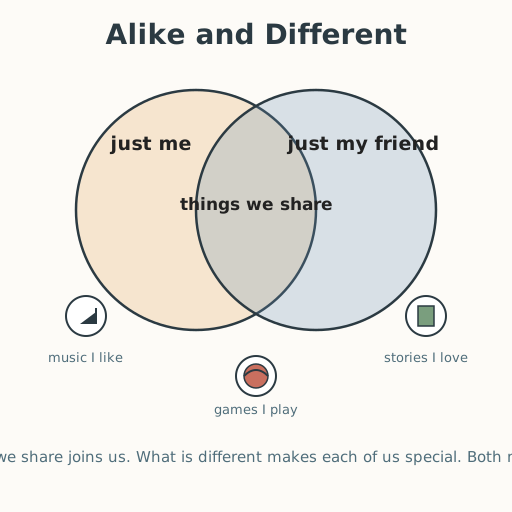
- Alike-and-different circles (Venn) poster · 1 Two overlapping circles — "just me," "just my friend," and "we share" in the middle
- Picture cards of people · 1 set Many kinds of people doing many kinds of things, from many places
- Paper and crayons · per learner
Low-tech / no-cost
- Two circles drawn on the ground Stand in one circle for "just me," the other for "just you," the overlap for "we share"
- Voice and a partner Say one thing that is the same and one thing that is different, with no poster at all
Enriched / lab & device
- A printed 'same and different' page · 1 per learner A Venn page for the learner to fill and keep in a portfolio
- Pictures or short video clips of children's lives around the world · 1 per group Optional, to notice how children everywhere are alike and different
Works in different contexts
- large-group Build one big Venn on the floor with rope or chalk and invite the whole group to place a fact in the right circle
- self-directed A learner fills a Venn page comparing themselves with a friend, then reads it to a trusted person
- outdoor-only Draw two overlapping circles in the dirt and stand in the circle that matches each fact you hear
- multi-age Pair learners of different ages to find one thing they share and one thing that is different, and talk about why both matter
Lesson 8 — Alike and Different
Summary
Learners explore how they are alike and different from others, sorting facts into two overlapping circles: just me, just my friend, and what we share. They discover that both sameness and difference matter — what we share joins us together, and what is different makes each of us special. No one is “more” or “less”; we are each a one-of-a-kind person who also belongs.
Objectives
- Describe how they are alike and different from others and why both matter. (D01.S2.02.02)
Connection
Children everywhere eat, sleep, laugh, and love to play — in a busy city, a mountain village, a fishing town by the sea, a desert camp. In those ways you are alike. But children also speak different languages, eat different foods, live in different kinds of homes, and play different games. In those ways you are different. Both matter: what you share with someone lets you play and work together, and what is different makes the world interesting — and makes you, you.
Materials
- Alike-and-different circles (Venn) poster
- Picture cards of people
- Paper and crayons
Preparation
- Draw the Venn poster (two overlapping circles: “just me,” “just my friend,” “we share”).
- Gather the picture cards of many kinds of people and places.
- Arrange partners and a floor space for the big Venn if using rope or chalk.
Facilitator note
This lesson is written to the learner (“you”). Keep the frame egalitarian: differences are facts to notice and celebrate, never a ranking — no skin tone, language, home, or food is “better.” If a learner shares a difference that carries stigma (a disability, a different family shape), receive it as simply another part of who they are, with warmth, not pity. Use the wide word “people” so every family and community shape is honored. Both circles matter equally; there is no “best” circle to be in.
Procedure
- Gather (5 min). You are a person, and you are also one of many people. Today you look at how you are alike (the same) and different from others.
- Meet the circles (10 min). Look at the Venn. One circle is just me — things true only about you. The other is just my friend — things true only about them. The middle, where the circles overlap, is what we share — things true about both of you.
- Sort the facts (15 min). With a partner, place facts into the circles: your name (just me), their name (just my friend), you both like to play (we share), you speak one language at home and they speak another (different), you both have families who love you (we share). Notice: no fact is “better” — each one simply tells something true about a person.
- People everywhere (10 min). Look at the picture cards of people from many places. Name one way they are all alike (everyone eats, sleeps, laughs, loves). Name one way they are different (foods, homes, languages, games). Say it together: both matter.
- Close (5 min). What you share joins you to others. What is different makes you special. You are alike and different — and that is exactly how a person should be.
Differentiation
- Support: Use two circles with no overlap at first (same / different), then add the shared middle; use pictures instead of words.
- Extension: Fill your own Venn page comparing yourself with a friend, and write one sentence about why a difference you share with them matters.
Assessment
- Formative (observation): Can the learner name one way they are like another person and one way they are different, and say why both matter?
- Artifact (portfolio): The learner’s completed “same and different” page.
Home connection
At home, find one thing you share with someone there and one thing that is different, and tell them why both matter.
Resources
- CASEL SEL Framework (social awareness and relationship skills): https://casel.org/fundamentals-of-sel/