Lesson 11 — My Story in Order
Learners turn their three-part plan into a short story of several sentences, written in order with first, next, and last, then read it back to a listener.
Objectives
Objectives
- D04.S3.02.01 Write a short narrative of several sentences in order, using words such as first, next, and last.
Essential question
How do I write a short story of several sentences in order?
Key vocabulary
Materials
Standard materials
- The learner's three-part plan · 1 The plan made in the previous lesson, ready to become sentences
- Writing paper with lines · several sheets In the home writing system, with room for a picture
Low-tech / no-cost
- Slate, sand, or reused paper Write the story where materials are scarce, then read it back
- A stick or finger for writing in sand Trace the story's sentences in sand or soil
Enriched / lab & device
- A three-page blank book · 1 One page each for first, next, and last, to make a real little book
- A recording of the learner reading the story · 1 Read the finished story aloud and keep the recording as a portfolio artifact
Works in different contexts
- large-group Write a shared class story together first, then learners write their own three-sentence story from their plans
- self-directed A learner turns their plan into sentences, reads the story back, and checks that the order matches first, next, and last
- multi-age Older learners help younger ones turn each planned picture into one sentence, then read the whole story together
- level-grouped Groups write at their own level — one sentence, three sentences, or a full page — all keeping the first-next-last order
- outdoor-only Write the story in sand or soil, one sentence per row, then read it back aloud before the wind carries it away
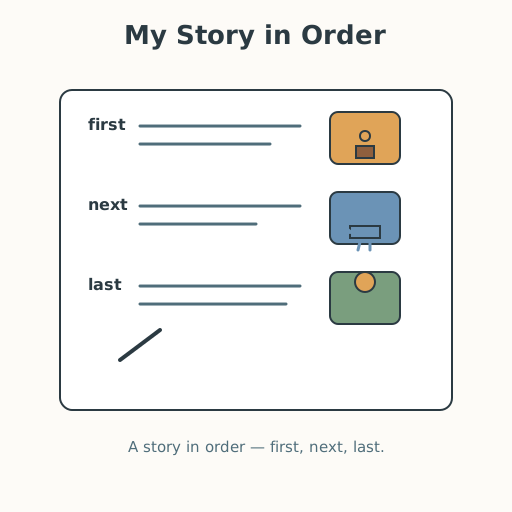
Lesson 11 — My Story in Order
Summary
Learners turn yesterday’s plan into a written story — several sentences in order, using first, next, and last — then read it back. The finished story becomes a portfolio artifact and a small act of authorship.
Objectives
- Write a short narrative of several sentences in order, using words such as first, next, and last. (D04.S3.02.01)
Connection
Every writer was once a child telling a story for the first time. Writing your story in order — first, next, last — is how you hand a piece of your day to someone who was not there. The words on the page keep the story safe, so it can be read again tomorrow, or far away, in your language and your script.
Materials
- Your three-part plan from last lesson
- Writing paper (in the home writing system, with room for a picture)
Preparation
- Have learners’ plans ready to return.
- Prepare writing paper appropriate to the home writing system.
Facilitator note
This lesson is written to the learner (“you”) so it works in a classroom and for a self-directed learner. This is a writing lesson built on explicit modeling: write one model story from a plan together, sentence by sentence, before learners write their own (Kirschner, Sweller & Clark, 2006). Several sentences is the goal — not a fixed count; a learner may write two clear sentences today and grow to four. The story is written in the learner’s home language and script; never require the Latin alphabet or English. Spelling grows through use; celebrate the attempt and note one pattern to grow, rather than marking errors as failure. A learner who uses an alternative or augmentative communication device, or who dictates to a scribe, is still the author — the ideas are theirs. Reading back is part of writing: it lets the author check the order.
Procedure
- Gather (5 min). Look at your three-part plan from last lesson. Today it becomes a real story on the page.
- Watch a model (10 min). Watch a plan become a story: one sentence for first, one for next, one for last. Notice how each sentence matches a box in the plan.
- Write your story (20 min). Write your story in order. Start with first, then next, then last. Use your plan. Draw a picture beside your sentences if you like.
- Read it back (10 min). Read your story aloud to yourself, then to a partner. Check: does the order match first, next, last? Fix anything that is out of order.
- Close (5 min). You are an author. You wrote a story in order, and it will keep its meaning every time it is read.
Differentiation
- Support: Write one sentence per box directly on the plan, then copy the three sentences onto paper; dictate to a scribe if writing is hard today.
- Support (AAC/dictation): The learner dictates the story to a scribe or composes it on a device — they are the author; the tool only writes.
- Extension: Add a fourth sentence that tells how the story felt at the end, and read the whole story with expression.
Assessment
- Formative (portfolio/performance): Does the learner’s written story contain several sentences in first-next-last order, and can they read it back accurately?
Home connection
Read your story to someone at home tonight, and ask them to tell you which part was “next.”
Resources
- Kirschner, Sweller & Clark (2006), “Why Minimal Guidance During Instruction Does Not Work” — explicit modeling before independent writing.