Lesson 10 — Building a Paragraph with Details and a Closing
Learners grow their topic sentence into a complete paragraph, adding at least two supporting details and a closing sentence, using the sandwich image to hold the three parts together.
Objectives
Objectives
- D04.S3.03.01 Write a paragraph with a topic sentence, at least two supporting details, and a closing sentence.
Essential question
How do I build a complete paragraph — topic sentence, supporting details, and a closing sentence?
Key vocabulary
Materials
Standard materials
- A topic sentence from last time · 1 The learner's own topic sentence, ready to grow into a paragraph
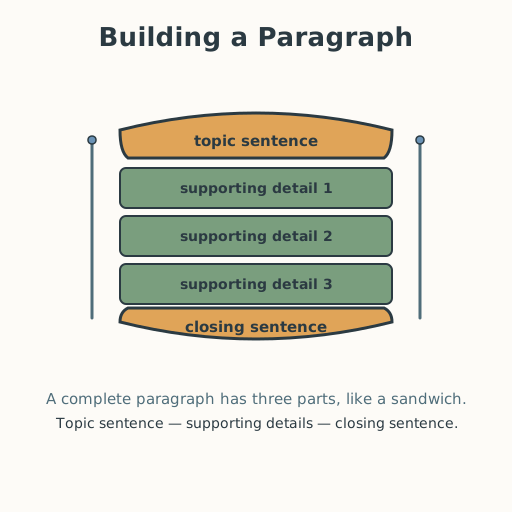
- A paragraph sandwich frame · 1 A sheet shaped like a sandwich — top bun (topic), fillings (details), bottom bun (closing)
Low-tech / no-cost
- Paper and pencil Write the paragraph by hand; the sandwich can be drawn
- Three fingers One finger per detail, then a closing — spoken first, then written
Enriched / lab & device
- A word processor · 1 Type the paragraph, color-coding the topic, details, and closing
- A paragraph organizer printout · 1 A printed sandwich organizer to fill in before writing
Works in different contexts
- large-group Build one paragraph together on the board — topic, two details, closing — then have learners build their own while the facilitator circulates
- self-directed A learner uses their topic sentence, adds two details and a closing, then reads the paragraph aloud to check the order
- multi-age Older learners model a full paragraph; younger learners add one detail or the closing to a shared paragraph
- level-grouped Group by writing comfort, not age; every group builds the same three-part sandwich, with confident writers modeling first
- outdoor-only Build a paragraph about something outside, telling it aloud in three parts — topic, details, closing — before writing it in a notebook or sand
Lesson 10 — Building a Paragraph with Details and a Closing
Summary
Learners grow their topic sentence into a complete paragraph, adding at least two supporting details and a closing sentence. The sandwich image — topic bun, detail fillings, closing bun — holds the three parts together in the learner’s mind.
Objectives
- Write a paragraph with a topic sentence, at least two supporting details, and a closing sentence. (D04.S3.03.01)
Connection
Think of a sandwich: the top bun starts it, the fillings are the heart of it, and the bottom bun finishes it. A paragraph is a sandwich made of words. The topic sentence is the top bun, the supporting details are the fillings, and the closing sentence is the bottom bun that holds it all together. Take away any part and it falls apart — in every language, on every table.
Materials
- A topic sentence from last time
- A paragraph sandwich frame
Preparation
- Have learners bring their topic sentences from Lesson 9.
- Prepare the sandwich frame (top bun, fillings, bottom bun).
- Have paper and pencils ready.
Facilitator note
This lesson is written to the learner (“you”) so it works in a classroom and for a self-directed learner. Building a paragraph is a foundational skill, so teach it explicitly with a worked example — model a complete three-part paragraph, then guide learners to build their own (Kirschner, Sweller & Clark, 2006). The structure to protect: topic sentence, at least two supporting details, closing sentence. Learners write in their home language and their own writing system — script-agnostic, no Latin alphabet assumed. Details may be facts, examples, or small reasons; the closing may restate the idea or give a final feeling. A learner who is Deaf or hard of hearing writes, signs, or dictates the paragraph; the thinking is the writing. A learner who is blind or has low vision builds the paragraph by dictation, on a braille writer, or by typing and listening back — the thinking is the writing. Celebrate a complete, honest paragraph in any wording; there is no single “correct” paragraph.
Procedure
- Gather (5 min). Remember your topic sentence — your top bun. Today we add the fillings and the bottom bun to make a whole paragraph.
- Meet the sandwich (5 min). Learn the three parts of a paragraph: top bun — the topic sentence you already wrote; fillings — at least two supporting details that tell more; bottom bun — a closing sentence that finishes the idea.
- Watch a worked example (10 min). The facilitator builds a paragraph aloud and on the board: topic sentence, then two details, then a closing. Watch how the sandwich comes together and stays together.
- Build your paragraph (20 min). Start with your topic sentence. Add two supporting details — facts or examples that tell more about your topic. Finish with a closing sentence that wraps it up. Write it all in order.
- Read it back (5 min). Read your whole paragraph aloud. Does it have all three parts? Does it make sense in order?
- Close (5 min). A paragraph is a sandwich of words — top bun, fillings, bottom bun. You built it, and it holds together.
Differentiation
- Support: Provide detail starters — “One thing I know is…”, “Another thing is…” — and a closing starter — “That is why…” — so the learner fills in the sandwich.
- Support (non-speaking): Sign or dictate the details and closing; the paragraph may be typed or written by a scribe.
- Support (blind/low vision): Build the paragraph by dictation, on a braille writer, or by typing and listening back; a scribe or device records it.
- Extension: Add a third supporting detail and notice how the extra filling makes the paragraph richer.
Assessment
- Formative (observation): Can the learner write a complete paragraph with a topic sentence, at least two supporting details, and a closing sentence, in order, in their own language and writing system?
Home connection
Build a word sandwich at home: write a paragraph about something you did today, with a topic sentence, two details, and a closing, and read it to someone.
Resources
- CASEL SEL Framework (self-efficacy — completing a piece of work with a clear structure): https://casel.org/fundamentals-of-sel/