Lesson 11 — Revising for Clarity
Learners revise their own paragraph for clarity, using three moves — add, remove, and rearrange — to make their meaning come through clearer, with support.
Objectives
Objectives
- D04.S3.03.02 Revise and edit their own writing for spelling, punctuation, and clarity, with support.
Essential question
How do I revise my writing to make my meaning clearer?
Key vocabulary
Materials
Standard materials
- A paragraph the learner wrote · 1 The learner's own paragraph from Lesson 10, ready to be made clearer
- A revise bookmark · 1 A small card with the three revise moves — add, remove, rearrange
Low-tech / no-cost
- Paper and pencil Revise by hand, crossing out and rewriting
- A spoken revision Say the paragraph aloud, hear the unclear part, and say it a clearer way
Enriched / lab & device
- A word processor · 1 Cut, paste, and rewrite to see the revision take shape
- A partner-revision routine · 1 per pair Read a partner's paragraph and ask one clarifying question
Works in different contexts
- large-group Revise one paragraph together on the board — find the unclear part, add, remove, or rearrange — then have learners revise their own
- self-directed A learner reads their paragraph aloud, marks the unclear part, and tries the three moves — add, remove, rearrange — until it is clearer
- multi-age Older learners read a younger learner's paragraph and ask one question that points to the unclear part; the younger learner then revises
- level-grouped Group by writing comfort, not age; every group uses the same three moves, with confident revisers modeling aloud
- outdoor-only Read the paragraph aloud while walking, stop at the unclear part, and revise it out loud before writing the new version
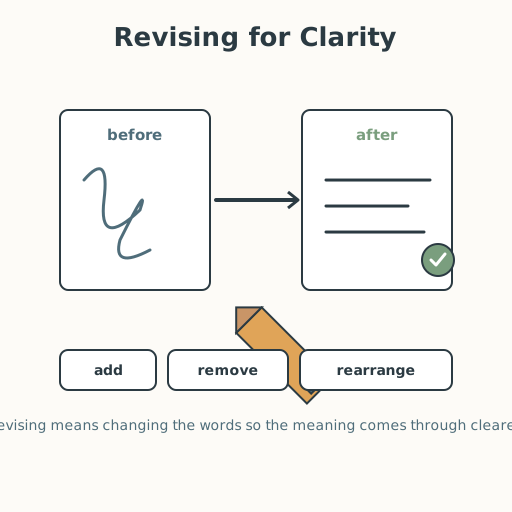
Lesson 11 — Revising for Clarity
Summary
Learners revise their own paragraph for clarity, using three moves — add, remove, and rearrange — to make their meaning come through clearer. Revision is about meaning: it asks “is this what I really meant, and can the reader see it?”
Objectives
- Revise and edit their own writing for spelling, punctuation, and clarity, with support. (D04.S3.03.02)
Connection
Think of telling a friend the way to your home. The first time, you might say it in a tangle, and they look confused. So you try again — you add a landmark, you take out the part that confused them, you put the steps in a better order. That trying-again is revising. Every good writer, in every language, does it: writing is not finished when the words first land; it is finished when the meaning comes clear.
Materials
- A paragraph the learner wrote (from Lesson 10)
- A revise bookmark (add, remove, rearrange)
Preparation
- Have learners bring their paragraphs from Lesson 10.
- Prepare the revise bookmark.
- Have pencils and space to rewrite ready.
Facilitator note
This lesson is written to the learner (“you”) so it works in a classroom and for a self-directed learner. Revision is a taught skill: model it explicitly with a worked example — read an unclear sentence aloud, find the confusing part, then add, remove, or rearrange — before guided practice (Kirschner, Sweller & Clark, 2006). The key shift to protect: revision is not about handwriting or spelling; it is about meaning. Keep the focus on “is this clear?” — in the learner’s home language and writing system, script-agnostic. Revision may be done by hand, aloud, in sign, or on a device. Honor the learner’s own voice and accent in their writing; there is no “correct” way to sound. Celebrate a revision that makes meaning clearer, whatever the wording. A learner who is Deaf or hard of hearing revises in sign or writing the same way. A learner who is blind or has low vision revises by dictation, on a braille writer, or by listening to the text read back and naming what to change.
Procedure
- Gather (5 min). Remember giving directions that tangled. What did you do? You tried again, and it came clear. That is revising.
- Meet the three moves (5 min). Learn the three revise moves: add — put in what is missing; remove — take out what does not help; rearrange — put the parts in a better order. All three make meaning clearer.
- Watch a worked example (10 min). The facilitator reads an unclear sentence aloud, says “that part confuses me,” and tries the moves: adds a word, removes a tangle, rearranges the order. Watch the meaning come clear.
- Revise your paragraph (15 min). Read your paragraph aloud. Find the part that is not clear. Try the three moves: add what is missing, remove what does not help, rearrange what is out of order. Write your new, clearer version.
- Read it back (5 min). Read your revised paragraph. Does the meaning come clearer now? If a part is still fuzzy, do one more move.
- Close (5 min). Revision is not fixing mistakes — it is making meaning. Add, remove, rearrange: the three moves of every clear writer, in every language.
Differentiation
- Support: Revise a single sentence first, using one move at a time; a partner may read the paragraph aloud while the learner listens for the unclear part.
- Support (non-speaking): Revise by signing or pointing to the parts to change; a scribe or device records the new version.
- Support (blind/low vision): Revise by dictation or on a braille writer, listening back to hear where the meaning is unclear.
- Extension: Revise a paragraph to say the same idea two ways — once shorter, once fuller — and notice what each is good for.
Assessment
- Formative (observation/self): Can the learner find an unclear part of their own paragraph and use add, remove, or rearrange to make the meaning clearer?
Home connection
Take a note you wrote at home — a message, a list, a story — and make it clearer with one of the three moves: add, remove, or rearrange.
Resources
- CASEL SEL Framework (self-management — improving one’s own work): https://casel.org/fundamentals-of-sel/