Lesson 15 — Measuring & Estimating Mass
Learners estimate and then measure how heavy things are, using grams and kilograms, and discover that one kilogram equals one thousand grams. The balance makes mass something you can see and compare before you read a number.
Objectives
Objectives
- D05.S4.03.01 Measure and estimate liquid volume and mass using standard units and solve real problems with them.
Essential question
How do I measure and estimate mass using grams and kilograms?
Key vocabulary
Materials
Standard materials
- A balance scale or simple hanger balance · 1 per group To compare and measure mass with standard weights
- Objects to weigh · 5 per group A fruit, a stone, a cup of seeds, a pencil, a small bottle
- A 1-kilogram reference and gram weights · 1 set per group A 1-kg bag (rice, sand, or beans) and smaller weights
Low-tech / no-cost
- A stick balance and found weights Hang a stick from string; balance objects against seeds, stones, or a known 1-kg bag
- Voice and body Hold one object in each hand and feel which is heavier; estimate by comparing to a known 1-kg bag
Enriched / lab & device
- A digital or kitchen scale · 1 per group To read mass in grams precisely
- A "mass hunt" recording sheet · 1 per group To record the mass of several real objects around the room
Works in different contexts
- large-group Weigh objects together on a balance, estimating as a class before each measure and reading the result aloud
- self-directed A learner estimates an object's mass, then balances it against standard weights and records both numbers
- outdoor-only Balance sticks, stones, and leaves on a hanger balance outdoors, comparing to a known 1-kg bag
- multi-age Older learners read the gram marks while younger learners add weights and watch the balance tip
- level-grouped Learners who measure easily order objects by mass and explain; others balance and compare with support
Lesson 15 — Measuring & Estimating Mass
Summary
Learners estimate and then measure how heavy things are, using grams and kilograms, and discover that one kilogram equals one thousand grams. The balance makes mass something you can see and compare before you read a number.
Objectives
- Measure and estimate liquid volume and mass using standard units and solve real problems with them. (D05.S4.03.01)
Connection
A market seller weighs a kilogram of rice; a baker weighs grams of yeast; a doctor checks how much a baby has grown; a cook weighs out spices so the dish is just right. Mass is how much matter a thing holds — how heavy it is — and we measure it in grams and kilograms. People have weighed goods at markets since the first scales were carved, because a fair trade depends on a fair measure. Today you weigh like a market-keeper: estimate first, then balance to check.
Materials
- A balance scale or hanger balance
- Five objects to weigh (fruit, stone, cup of seeds, pencil, small bottle)
- A 1-kilogram reference and gram weights
Preparation
- Give each group a balance, objects, a 1-kg reference, and gram weights.
- Clear a stable surface for balancing.
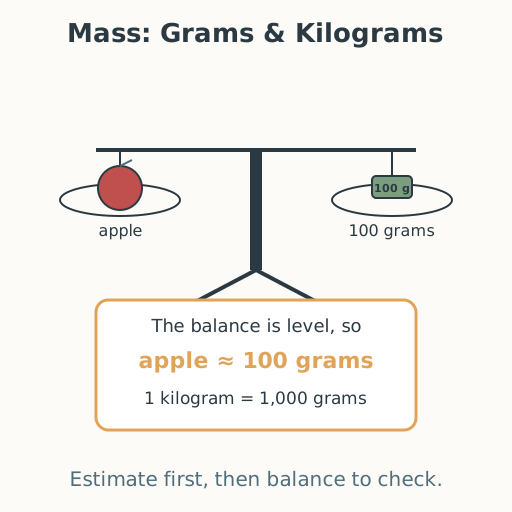
- Plan a worked example (an apple ≈ 100 g).
Facilitator note
This lesson is written to the learner (“you”). It introduces mass with the gram and kilogram — the new skill is estimating mass by feel and comparison, then measuring with a balance and standard weights. Teach with a worked example (philosophy §13): hold the 1-kg bag, feel an apple against it, then balance the apple with gram weights and read ≈ 100 g. Note the distinction between mass (how much matter) and weight (the pull of gravity) — at this age the practical word is “mass,” and we keep it concrete (Van de Walle et al., 2019). No one’s accuracy at estimating measures their smartness; estimation grows with practice, and “not yet” is information, never a verdict. The gram and kilogram are shared international units that make trade fair everywhere. Measure in the home language. For learners who are Deaf or hard of hearing, sign “heavier” and “lighter” and point to the tipping pan; for learners who are blind or low-vision, feel the balance tip and the weights in the hands. Learners with limited movement direct a partner to add weights. Mastery arrives at its own pace.
Procedure
- Gather — how heavy? (5 min). Hold a stone in one hand and a leaf in the other. Which is heavier? Mass is how much matter a thing holds, and we measure it in grams and kilograms.
- Worked example — the 1-kg feel (10 min). Lift the 1-kilogram bag. That is how one kilogram feels. Now hold the apple — is it more or less than a kilogram? Much less. Balance the apple against gram weights and read the total: about 100 grams. So 1 kilogram = 1,000 grams, and an apple is one tenth of that.
- Estimate, then measure (15 min). For each object: estimate its mass first — about how many grams? Write your estimate. Then balance it with gram weights and read the measure. How close were you? Record both numbers.
- Order by mass (8 min). Put your objects in order from lightest to heaviest by feel, then check with the balance. Were you right?
- Check with a friend (5 min). Trade estimates and measurements. Do you agree? Balance again together, kindly, if you differ.
- Close (2 min). Remember: mass is measured in grams and kilograms — 1,000 grams make a kilogram — and a fair measure is an honest measure.
Differentiation
- Support: Compare “heavier and lighter” against the 1-kg bag only today; add exact grams another day.
- Support (blind/low-vision): Feel the balance tip and the weight of each object in the hands.
- Extension: Find something in the room that is about 1 kilogram, and explain how you know by balancing it.
Assessment
- Formative (observation): Can the learner estimate an object’s mass, then measure it with a balance and gram weights and read the result?
- Artifact (portfolio): The learner’s estimate-and-measure record, kept as a record of measurement.
Home connection
At home, find something that weighs about 1 kilogram (a bag of rice, beans, or flour) and compare other things to it — then tell a grown-up which are heavier and lighter.
Resources
- Van de Walle, J. A., Karp, K. S., & Bay-Williams, J. M. (2019). Elementary and Middle School Mathematics: Teaching Developmentally (10th ed.). Pearson. (Measuring and estimating mass with grams and kilograms, developing benchmarks before precision.)