Lesson 10 — Choosing a Piece and Planning
Learners choose the kind of piece they will write — narrative, informative, or opinion — and plan it with a graphic organizer before drafting, so the writing process begins with a clear idea.
Objectives
Objectives
- D04.S3.04.01 Write a narrative, informative, or opinion piece organized into paragraphs with clear ideas.
- D04.S3.04.02 Use a simple writing process — plan, draft, revise, edit, and publish — on their own.
Essential question
How do I choose what to write and plan it before I draft?
Key vocabulary
Materials
Standard materials
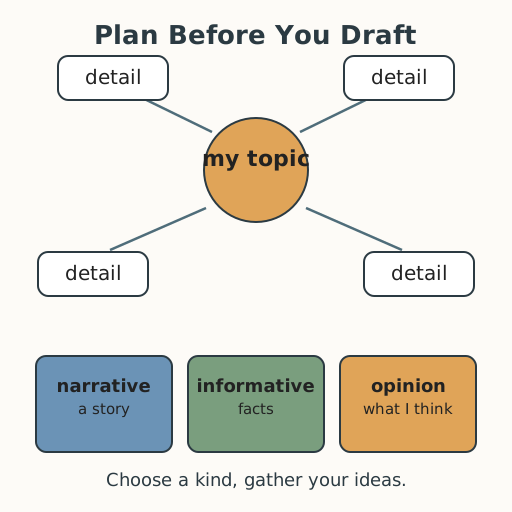
- A planning web or outline sheet · 1 A graphic organizer with a center box for the topic and branches for ideas and details
- A genre menu card · 1 A card describing the three kinds — narrative (a story), informative (facts), opinion (what I think and why)
Low-tech / no-cost
- A planning web drawn by hand Draw the web on paper, sand, or the ground with the topic in the center
- Voice and memory Plan the piece aloud — topic, ideas, details — before writing anything
Enriched / lab & device
- Printed planning organizers · 1 per learner Reusable webs, outlines, and three-column "idea" sheets for planning
- A digital brainstorming tool · 1 Build a planning web on a device, then rearrange ideas before drafting
Works in different contexts
- large-group Model planning one piece on the board, then each learner plans their own; a few share their webs for the group to comment on
- self-directed A learner chooses a kind and topic, fills a planning organizer, and checks that every planned detail supports the topic
- multi-age Older learners model choosing a kind and planning; younger learners choose a topic and add two ideas to a shared web
- level-grouped Each group plans pieces of different kinds — one narrative, one informative, one opinion — then groups compare their plans
- outdoor-only Plan a piece about something outdoors, drawing the web in the soil with a stick
Lesson 10 — Choosing a Piece and Planning
Summary
Learners choose the kind of piece they will write — narrative (a story), informative (facts), or opinion (what I think and why) — and plan it with a graphic organizer before drafting. This is the first step of the writing process, and the plan they make will carry through the lessons that follow.
Objectives
- Write a narrative, informative, or opinion piece organized into paragraphs with clear ideas. (D04.S3.04.01)
- Use a simple writing process — plan, draft, revise, edit, and publish — on their own. (D04.S3.04.02)
Connection
Builders do not stack bricks and hope. They draw a plan first. Writers are builders of ideas, and planning is the drawing. Before you write a story, a report, or your opinion, you choose what kind of piece it is and gather your ideas around one clear center. A few minutes of planning now saves confusion later — and makes the drafting that follows flow.
Materials
- A planning web or outline sheet
- A genre menu card (narrative, informative, opinion)
Preparation
- Prepare the planning organizers and genre menu card.
- Think of example topics for each kind to share.
Facilitator note
This lesson is written to the learner (“you”) so it works in a classroom and for a self-directed learner. Planning is a taught skill, so model it with a worked example: choose a kind and topic aloud, fill a planning web, and think aloud about which ideas belong (Kirschner, Sweller & Clark, 2006). Teach the three kinds plainly — narrative tells a story, informative gives facts, opinion says what you think and why — and let the learner choose the one that fits their purpose. The plan belongs to the learner and will grow across the coming lessons into a published piece, so keep it as a portfolio artifact. Honor plans in any form — web, outline, list, drawing — and in the learner’s home language. Planning is thinking made visible; there is no single “correct” plan.
Procedure
- Gather (5 min). Think of something you could write about. Is it a story, a set of facts, or your opinion? That choice comes first.
- Meet the three kinds (5 min). Learn them: a narrative tells a story; an informative piece gives facts; an opinion says what you think and why. Choose the one that fits your idea.
- Watch a worked example (10 min). The facilitator chooses a kind and a topic, then builds a planning web, thinking aloud: “This idea belongs in the center; these details branch from it; that one does not fit.” Watch the plan take shape.
- Plan your piece (15 min). Choose your kind and topic. Fill your planner: the topic in the center, your ideas and details branching out. Check that every branch supports the center.
- Share (5 min). Tell a partner your kind, your topic, and two planned ideas. Does the plan make sense to them?
- Close (5 min). A clear plan is a clear path. Keep your plan — you will draft it in the next lesson.
Differentiation
- Support: Choose from two prepared topics and use a simple three-box planner (idea, detail, detail).
- Support (non-speaking): Plan with drawings or picture cards around a center idea.
- Support (blind/low vision): Plan orally — name the kind, topic, and details — and record them by dictation, braille, or large print.
- Extension: Plan two pieces of different kinds on the same topic (a story and a report) and explain how the plan differs.
Assessment
- Formative (observation): Can the learner choose a kind (narrative, informative, or opinion) and produce a plan with a clear topic and supporting ideas?
- Portfolio: Keep the plan as the first artifact of the writing process.
Home connection
At home, plan what you would write about your day — choose the kind (story, facts, or opinion) and list your main idea and two details, then show someone your plan.
Resources
- Kirschner, P. A., Sweller, J., & Clark, R. E. (2006). Why minimal guidance during instruction does not work. Educational Psychologist, 41(2), 75–86.
- Graham, S., & Perin, D. (2007). Writing Next — explicit teaching of planning supports writing quality. (Widely used evidence base.)