Lesson 11 — Drafting into Paragraphs
Learners turn their plan into a first draft, writing one paragraph per idea and focusing on getting ideas down clearly, knowing that spelling and polish come later.
Objectives
Objectives
- D04.S3.04.02 Use a simple writing process — plan, draft, revise, edit, and publish — on their own.
Essential question
How do I turn a plan into a draft with paragraphs?
Key vocabulary
Materials
Standard materials
- The plan from the previous lesson · 1 The learner's own planning web or outline
- Draft paper · per learner Lined paper or a notebook for writing the draft
Low-tech / no-cost
- Any paper or a slate Write the draft on whatever surface is available; the plan can be held in memory
- Voice drafting Say the draft aloud paragraph by paragraph before writing it
Enriched / lab & device
- A word processor · 1 Type the draft on a device, one paragraph per block, easy to rearrange later
- A recording app for read-back · 1 Record yourself reading the draft aloud to hear how it flows
Works in different contexts
- large-group Model drafting one paragraph from a plan on the board, then learners draft their own; check in briefly with a few as they work
- self-directed A learner drafts from their plan, one paragraph per idea, and reads it back to check it follows the plan
- multi-age Older learners model drafting from a plan; younger learners draft one paragraph at a time with support
- level-grouped Each group drafts its piece, then a peer in the group reads it back to check the ideas are clear
- outdoor-only Draft about an outdoor topic, writing on paper or a slate with the plan beside you
Lesson 11 — Drafting into Paragraphs
Summary
Learners turn their plan into a draft, writing one paragraph per idea. The draft is a “sloppy copy” — the goal is to get the ideas down clearly and in order, with spelling and polish saved for revising and editing.
Objectives
- Use a simple writing process — plan, draft, revise, edit, and publish — on their own. (D04.S3.04.02)
Connection
A draft is a first try, not a final product. Just as a builder first raises the frame of a house and hangs the doors later, a writer first gets the ideas standing in order and polishes afterward. Giving yourself permission to draft freely — mistakes and all — is what lets the ideas come out. You can always fix it later; first, get it down.
Materials
- The plan from the previous lesson
- Draft paper
Preparation
- Have each learner’s plan ready.
- Provide draft paper or a notebook.
Facilitator note
This lesson is written to the learner (“you”) so it works in a classroom and for a self-directed learner. Drafting is a taught step in the writing process: model turning one plan branch into a paragraph, thinking aloud about how one idea becomes one paragraph (Kirschner, Sweller & Clark, 2006). Emphasize that the draft is a “sloppy copy” — do not correct spelling now; that belongs to editing. This keeps the focus on ideas and protects fluency. One idea per paragraph is the organizing rule. Honor drafts in the learner’s home language and writing system, and honor drafting by dictation, braille, or assistive technology. Every draft is a step, never a verdict — the goal is ideas on the page, not perfection.
Procedure
- Gather (5 min). Look at your plan. Today you will grow it into a draft. A draft is a first try — free and full of ideas, not yet polished.
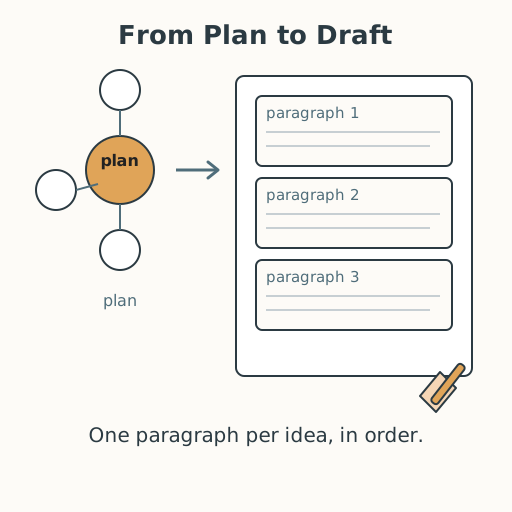
- Meet the drafting rule (5 min). Learn it: one paragraph per idea. Each branch of your plan becomes a paragraph, in order, so a reader can follow your thinking.
- Watch a worked example (10 min). The facilitator takes one branch of a plan and writes a paragraph from it, thinking aloud: “This idea becomes my topic sentence; these details support it; this is my closing.” Watch the plan become prose.
- Draft your piece (20 min). Write your draft from your plan, one paragraph per idea. Do not stop to fix spelling — just get the ideas down, clearly and in order.
- Read it back (5 min). Read your draft aloud (or sign it) to yourself or a partner. Does it follow your plan? Are the ideas in order?
- Close (5 min). A draft is a doorway, not a finished room. Keep it — next you will revise it to make your ideas even clearer.
Differentiation
- Support: Draft one paragraph at a time, pausing after each to check it matches the plan.
- Support (non-speaking): Draft by dictation, sign, or assistive technology, one paragraph per idea.
- Support (blind/low vision): Draft in braille or large print, or by dictation, from the plan held in memory or a raised organizer.
- Extension: Draft a longer piece with a clear paragraph for each planned idea and a one-sentence lead-in that tells the reader what is coming.
Assessment
- Formative (observation): Can the learner produce a draft that follows their plan, organized into paragraphs with one idea each?
- Portfolio: Keep the draft as the second artifact of the writing process.
Home connection
At home, take your plan and read your draft aloud to someone, then ask: “Can you follow my ideas from beginning to end?”
Resources
- Kirschner, P. A., Sweller, J., & Clark, R. E. (2006). Why minimal guidance during instruction does not work. Educational Psychologist, 41(2), 75–86.
- Graham, S., & Perin, D. (2007). Writing Next — separating drafting from editing supports writing fluency. (Widely used evidence base.)