Lesson 12 — Revising for Clear Ideas
Learners revise their draft to make ideas clearer, using three moves — add what is missing, remove what is extra, reorder what is out of place — with a checklist and partner feedback.
Objectives
Objectives
- D04.S3.04.02 Use a simple writing process — plan, draft, revise, edit, and publish — on their own.
Essential question
How do I revise to make my ideas clearer?
Key vocabulary
Materials
Standard materials
- The learner's draft · 1 The draft from the previous lesson
- A revision checklist · 1 Prompts — "Is each idea clear?" "Did I add what's missing?" "Did I remove what's extra?" "Is the order right?"
Low-tech / no-cost
- The draft and a friend's ears Read the draft to a partner and ask the checklist questions aloud, making changes by hand
- Marks on paper or slate Add, cross out, and draw arrows to reorder by hand
Enriched / lab & device
- A word processor with insert and move · 1 Revise on a device — add, cut, and reorder sentences easily
- A peer-review pair sheet · 1 per pair A sheet for partners to note one place that is clear and one place to clarify
Works in different contexts
- large-group Revise a shared paragraph together on the board, the group suggesting what to add, remove, or reorder before learners revise their own
- self-directed A learner reads their draft with the checklist, marks places to add, remove, or reorder, and makes the changes
- multi-age Older learners model a revision; younger learners suggest one detail to add to a shared piece
- level-grouped Pairs within a group exchange drafts and give one "clear" and one "clarify" note, then revise
- outdoor-only Read the draft aloud outdoors and revise it by adding, crossing out, or reordering, using the open space to "move" ideas
Lesson 12 — Revising for Clear Ideas
Summary
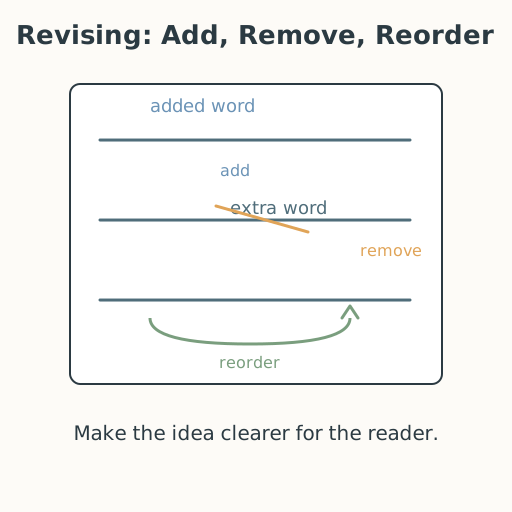
Learners revise their draft to make ideas clearer, using three moves — add what is missing, remove what is extra, and reorder what is out of place — guided by a checklist and a partner’s kind feedback. Revising is about ideas (not spelling, which comes next).
Objectives
- Use a simple writing process — plan, draft, revise, edit, and publish — on their own. (D04.S3.04.02)
Connection
Revision is where writing gets good. A first draft is like a garden just planted — the plants are there, but some need thinning, some need moving into the sun, and some need a little more soil. Revising is tending: you add what helps the idea grow, remove what crowds it, and move what is in the wrong place. Every great writer revisits and reworks.
Materials
- The learner’s draft
- A revision checklist
Preparation
- Have each learner’s draft ready.
- Prepare the revision checklist.
Facilitator note
This lesson is written to the learner (“you”) so it works in a classroom and for a
self-directed learner. Revising is a taught step: model it on a shared paragraph with a
worked example — add, remove, reorder — thinking aloud about why each change clarifies
the idea (Kirschner, Sweller & Clark, 2006). Keep the distinction sharp for learners:
revising works on ideas; editing (the next lesson) works on spelling and
punctuation. Frame peer feedback as help, not judgment — one “this is clear” and one
“this could be clearer” — so the writer stays in charge of their own piece (a cooperative,
not competitive, act; see docs/facilitation.md). Honor revisions in the learner’s home
language and writing system, and honor revising by dictation, braille, or assistive
technology. Mastery means the learner can name the change they made and why it helps.
Procedure
- Gather (5 min). Read your draft as a reader, not a writer. Where might a reader stumble or wonder? Those are the places to revise.
- Meet the three moves (5 min). Learn them: add what is missing, remove what is extra, reorder what is out of place. Revising is about ideas, not spelling.
- Watch a worked example (10 min). The facilitator revises a shared paragraph, thinking aloud: “This idea is unclear — I will add a detail… this part is extra — I will remove it… this sentence belongs earlier — I will move it.” Watch the idea grow clearer.
- Revise your draft (20 min). Use the checklist. Read your draft and ask: is each idea clear? Mark places to add, remove, or reorder, then make the changes.
- Partner check (5 min). Trade drafts. Tell your partner one place that is clear and one place that could be clearer. Then decide which suggestion to keep — it is your piece.
- Close (5 min). Revision is care for the reader. Your ideas are clearer now — next, you will polish the words.
Differentiation
- Support: Revise with one move at a time, focusing on “add” first, using a prepared list of possible details.
- Support (non-speaking): Revise by dictation, sign, or assistive technology, naming each move.
- Support (blind/low vision): Revise from a draft in braille or large print or by dictation, with the checklist read aloud.
- Extension: Revise for word choice too — replace two ordinary words with more exact ones — and explain how each change sharpens the idea.
Assessment
- Formative (peer/observation): Can the learner make and explain revisions (add, remove, reorder) that make their ideas clearer?
- Portfolio: Keep the marked-up draft as the third artifact of the writing process.
Home connection
At home, read your revised draft to someone and ask them to name one part that is clear and one part they would make clearer — then decide what you will change.
Resources
- Kirschner, P. A., Sweller, J., & Clark, R. E. (2006). Why minimal guidance during instruction does not work. Educational Psychologist, 41(2), 75–86.
- Graham, S., & Perin, D. (2007). Writing Next — explicit teaching of revision strategies supports writing quality. (Widely used evidence base.)