Lesson 06 — Safe on the Road and in the Water
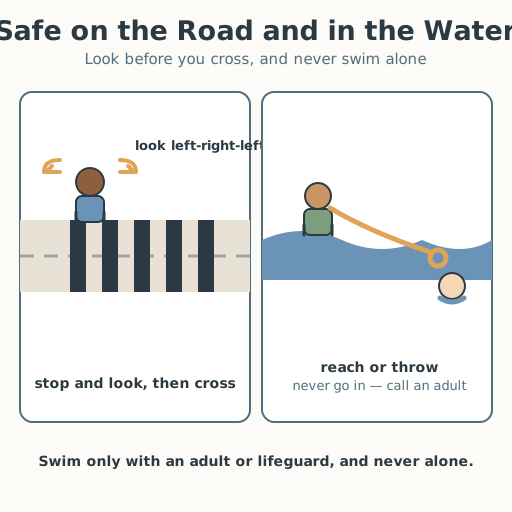
Learners name and practice basic road and water safety rules: stop, look left-right-left, and cross at a safe place; walk and wear a helmet; swim only with an adult or lifeguard and never alone; and reach or throw to help someone in the water rather than going in. Calm, clear, and empowering.
Objectives
Objectives
- D03.S4.04.01 Name and practice basic safety rules for home, road, water, and weather, such as fire, crossing, swimming, and storms.
Essential question
What safety rules keep me safe on roads and in the water?
Key vocabulary
Materials
Standard materials
- Road and water safety rule cards · 1 set Rules — stop, look left-right-left, and cross at a safe place; walk, don't run; wear a helmet when cycling; swim only with an adult or lifeguard; never swim alone; reach or throw, don't go in, to help
- A "my safety rules" chart · 1 The growing unit chart, now adding road and water rules
- Paper and crayons · per learner To draw one road or water rule
Low-tech / no-cost
- Voice and body Practice "stop, look left-right-left" and a safe crossing with an imagined road; practice calling for an adult near imagined water; no cards needed
- A drawn road and river Draw a road and a river in the dirt or on paper and walk the safe steps with a finger or a stick
Enriched / lab & device
- A road-safety poster or sign set · 1 Real or pictured crossing signs, crosswalks, and helmets to identify
- A local water-safety visit or video · 1 A lifeguard or water-safety chart to reinforce swimming with an adult
Works in different contexts
- large-group Demonstrate crossing and the "reach or throw" rule at the front, then send pairs to act out one rule each while others draw
- self-directed A learner reads or hears each rule, practices the motions, and draws one rule with its action
- outdoor-only Practice a safe crossing on a real (or marked) path and name the water rules aloud; reach-and-throw can be acted with a stick
- multi-age Older learners model crossing and "reach or throw" while younger learners copy and retell the rule
- level-grouped Learners who can retell the rules teach them back; others match each rule card to its action with support
Lesson 6 — Safe on the Road and in the Water
Summary
Learners name and practice basic road and water safety rules: stop, look left-right-left, and cross at a safe place; walk and wear a helmet; swim only with an adult or lifeguard and never alone; and reach or throw to help someone in the water rather than going in. Calm, clear, and empowering.
Objectives
- Name and practice basic safety rules for road and water. (D03.S4.04.01)
Connection
Every day you are a pedestrian — a person on foot — near roads, and many days you are near water, whether a pool, a river, a lake, or the sea. Roads and water are wonderful parts of life, and a few simple rules let you enjoy them safely. Today you will learn and practice those rules.
Materials
- Road and water safety rule cards
- The growing “my safety rules” chart
- Paper and crayons
Preparation
- Prepare the rule cards and add road and water columns to the “my safety rules” chart.
- Prepare to demonstrate a safe crossing and the “reach or throw” action.
- Keep the tone calm and encouraging; this is about capability, not fear.
Facilitator note
This lesson is written to the learner (“you”). Teach and practice; do not frighten. Road rules: stop, look left-right-left, and cross at a safe place (a crosswalk or corner) with an adult or when it is clear; walk, don’t run; and wear a helmet when cycling. Water rules: swim only with an adult or lifeguard and never swim alone; and if you see someone in trouble in the water, reach or throw something (a stick, a rope, a float) and call an adult — never go in yourself, because the person in trouble could pull a child under. Honor that roads and water look very different around the world — busy city streets, quiet lanes, rivers, seas, and wells — so adapt the specific “where to cross” and “where to swim” to the learner’s own place. In places where cars drive on the left (much of Asia, Africa, and the United Kingdom, for example), reverse the look order: stop, look right-left-right, then cross — always look both ways and look again toward the nearest oncoming traffic. A learner who uses a wheelchair practices looking and a safe crossing route and the “reach or throw” rule with a rope; a learner who is blind or has low vision practices the steps by listening for traffic and being guided through the motions; a learner who is deaf or hard of hearing follows the demonstration and cards from the front, since every rule is shown, not only told. The road rules follow widely used pedestrian-safety guidance (look left-right-left, cross at a crosswalk), and the water rules follow lifesaving guidance (swim with a lifeguard, reach or throw — don’t go in), as promoted by the World Health Organization and water-safety organizations. This lesson continues D03.S4.04.01 and leads into weather safety.
Procedure
- Gather (5 min). Remember the safety rules you already know from home and fire. Now add the rules for two more places you go all the time: roads and water.
- Road rules (15 min). To cross a road, stop at the edge, look left, right, and left again, and cross only at a safe place — a crosswalk or corner — with an adult or when it is clear. (In places where cars drive on the left, look right, left, and right again — always look both ways and toward the nearest traffic.) Walk, don’t run. If you cycle, wear a helmet. Practice the crossing steps with an imagined road: stop, look left, look right, look left, cross.
- Water rules (15 min). In water, the biggest rule is never swim alone — swim only with an adult or a lifeguard watching. If someone is in trouble in the water, reach or throw something to them (a stick, a rope, a float) and call an adult — never go in yourself. Practice the reach-and-throw action with an imagined rope or stick.
- Match rule to place (5 min). Which rule is for the road, and which for the water? “Wear a helmet” is road; “reach or throw” is water; “look left-right-left” is road; “never swim alone” is water. Point to each rule card.
- Close (5 min). Say it together: “On the road I stop, look left-right-left, and walk. In the water I swim with an adult and reach or throw — never go in. I know my safety rules.”
Differentiation
- Support: Practice one rule at a time with a partner; accept spoken, drawn, or gestured answers.
- Support (non-speaking): Order the rule cards and act out each rule with the body.
- Support (blind/low-vision): Say the steps aloud in order and practice the motions with a guide.
- Extension: Describe the specific safe place to cross near your own home or school, and name who watches when you swim.
Assessment
- Formative (observation): Can the learner name and act out the road and water rules — with “look left-right-left” and “swim with an adult” included?
- Self: The learner names the rule they practiced best and one rule they will use this week.
Home connection
With a grown-up, find the safest place to cross the road near your home and practice stop-look-left-right-left. Name who must be with you before you swim.
Resources
- World Health Organization, “Drowning” (supervision and reach-or-throw save lives): https://www.who.int/news-room/fact-sheets/detail/drowning
- World Health Organization, “Road traffic injuries” (pedestrian safety): https://www.who.int/news-room/fact-sheets/detail/road-traffic-injuries