Lesson 07 — Safe in Weather and Storms
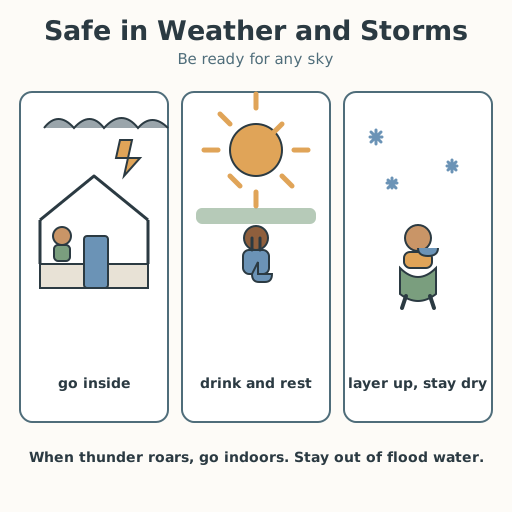
Learners name and practice basic weather and storm safety rules: go inside and away from windows in a storm, "when thunder roars, go indoors," stay out of flood water, drink water and rest in heat, and layer up and stay dry in cold. Calm, clear, and empowering.
Objectives
Objectives
- D03.S4.04.01 Name and practice basic safety rules for home, road, water, and weather, such as fire, crossing, swimming, and storms.
Essential question
What safety rules keep me safe in different weather and in storms?
Key vocabulary
Materials
Standard materials
- Weather safety rule cards · 1 set Rules — go inside and away from windows in a storm; when thunder roars, go indoors; stay out of flood water; drink water and rest in heat; layer up and stay dry in cold
- A "my safety rules" chart · 1 The unit chart, now adding weather rules
- Paper and crayons · per learner To draw one weather rule
Low-tech / no-cost
- Voice and body Act out each weather rule — moving to "shelter," drinking water in "heat," layering in "cold"; no cards needed
- A drawn sky Draw a storm cloud, sun, and snow in the dirt or on paper and point to the rule for each
Enriched / lab & device
- A weather-safety poster or map · 1 A chart of local weather dangers and the safe place to shelter
- A weather report to read · 1 A simple printed or projected weather report, to practice deciding what to do
Works in different contexts
- large-group Read each weather scenario, have the group act out the safe response, and record the rule on the chart
- self-directed A learner reads or hears each scenario, decides the safe response, and draws one weather rule
- outdoor-only Look at the real sky, name the weather, and act out the rule for it; find the nearest shelter together
- multi-age Older learners read the scenarios while younger learners act out the safe response; everyone finds the nearest shelter
- level-grouped Learners who can explain why each rule matters teach it back; others match each weather card to its safe action with support
Lesson 7 — Safe in Weather and Storms
Summary
Learners name and practice basic weather and storm safety rules: go inside and away from windows in a storm, “when thunder roars, go indoors,” stay out of flood water, drink water and rest in heat, and layer up and stay dry in cold. Calm, clear, and empowering.
Objectives
- Name and practice basic safety rules for weather and storms. (D03.S4.04.01)
Connection
The sky changes every day — sun, rain, wind, snow, thunder, heat, and cold. Weather is not something to fear; it is something to understand and prepare for. When you know the simple rule for each kind of weather, a storm becomes a moment to be safe and calm, not scared. Today you will learn those rules.
Materials
- Weather safety rule cards
- The growing “my safety rules” chart
- Paper and crayons
Preparation
- Prepare the weather rule cards and add a weather column to the chart.
- Prepare a simple, local weather danger list (what weather actually happens where you are) so the rules feel real, not abstract.
- Keep the tone calm; the message is “you can be ready,” never “be afraid.”
Facilitator note
This lesson is written to the learner (“you”). Teach readiness, not fear. Storm rules: in a storm, go inside and stay away from windows; for lightning, the saying is “when thunder roars, go indoors”; and stay out of flood water, which can be deeper and dirtier than it looks. Heat rules: drink water and rest in the shade when it is very hot. Cold rules: layer up (wear layers of clothes) and stay dry when it is very cold. Adapt to the learner’s own climate — some places face monsoons and floods, others heat and dust, others snow and ice, and a learner should learn the rules for the weather they actually meet, while still hearing that weather differs worldwide. Never make the lesson frightening; frame storms as things people have safely weathered in every land for all of human history. A learner who uses a wheelchair learns the nearest accessible shelter and the heat rule of drinking water and resting; a learner who is blind or has low vision learns each rule by hearing and by being guided to the shelter; a learner who is deaf or hard of hearing follows the cards and demonstration from the front, since every rule is shown, not only told. The storm, heat, and cold rules follow widely used weather-safety guidance from public-health and meteorological organizations. This lesson completes D03.S4.04.01 and leads into the unit’s online-safety capstone.
Procedure
- Gather (5 min). You already know the rules for home, fire, road, and water. Now add the rules for the sky: weather and storms.
- Storm rules (15 min). In a storm, go inside and stay away from windows. For lightning, remember: “when thunder roars, go indoors.” And stay out of flood water — it can be deeper, faster, and dirtier than it looks. Point to each rule card and act out moving to shelter.
- Hot and cold rules (10 min). When it is very hot, drink water and rest in the shade. When it is very cold, layer up — wear layers of clothes — and stay dry. Act out drinking water in the “heat” and putting on layers in the “cold.”
- Match weather to rule (5 min). Which rule for which weather? “Go inside and away from windows” is for a storm; “drink water and rest” is for heat; “layer up and stay dry” is for cold. Point to each rule card.
- Close (5 min). Say it together: “In a storm I go inside; in heat I drink and rest; in cold I layer up and stay dry. I can be ready for any weather.”
Differentiation
- Support: Teach one weather type at a time and act it out; accept spoken, drawn, or gestured answers.
- Support (non-speaking): Order the weather cards and act out each safe action.
- Support (blind/low-vision): Say each rule aloud in order and be guided to the nearest shelter.
- Extension: Describe the weather danger your own region faces most and the exact safe place your family would shelter.
Assessment
- Formative (observation): Can the learner name and act out the storm, heat, and cold rules — with “go inside” and “stay out of flood water” included?
- Self: The learner names one weather rule and the weather it goes with.
Home connection
With a grown-up, name the weather your home faces most and decide together the safe place to shelter in a storm. Practice saying “when thunder roars, go indoors.”
Resources
- World Meteorological Organization, “Weather” (storm and severe-weather early warnings and safety): https://wmo.int/themes/weather
- World Health Organization, “Heat” and “Cold” health guidance (hydration, shade, and layering): https://www.who.int/health-topics/climate-change