Lesson 08 — Movement Helps Muscles and Mood
Learners complete the picture of how movement benefits the body: it builds muscles and lifts mood. They learn that muscles strengthen with use, and that movement releases brain chemicals that lift mood, then explore movement traditions from around the world — dance, games, martial arts, walking — as joyful, universal ways people move.
Objectives
Objectives
- D03.S2.05.02 Explain how regular movement benefits the heart, muscles, and mood.
Essential question
How does movement build muscles and lift mood?
Key vocabulary
Materials
Standard materials
- Muscles and mood poster · 1 A poster with two panels — a strong arm lifting and a smiling face with a rising sun — labeled 'movement builds muscles' and 'movement lifts mood'
- Movement traditions cards · 1 set Cards showing movement traditions from around the world — dance, martial arts, games, walking — as joyful ways people move
- Pencils · per learner
Low-tech / no-cost
- Voice, body, and a remembered game or dance Move to a remembered dance, game, or walk and notice the muscles working and the mood lifting; no cards needed
- A 'move and name' circle In a circle, each person shares one way their family or culture moves for joy, then the group tries a gentle version together
Enriched / lab & device
- A world movement wall · 1 A shared map or wall where learners pin pictures or names of movement traditions from many places, building a global gallery of joyful movement
- A short video of a traditional dance or game · 1 A clip of a dance, martial art, or game from another culture to watch and discuss as joyful movement
Works in different contexts
- large-group Go through the two panels together, then share movement traditions as a whole group and try a gentle shared movement
- multi-age Younger learners name a movement that makes them happy; older learners explain which muscles it builds and why mood lifts after moving
- self-directed A learner lists three ways people in their family or place move for joy, and writes how movement builds muscles and lifts mood
- level-grouped Learners ready to extend explain the role of brain chemicals such as endorphins in lifting mood after movement
- outdoor-only Play a remembered game or walk, then sit and name the muscles used and how the mood changed; no paper needed
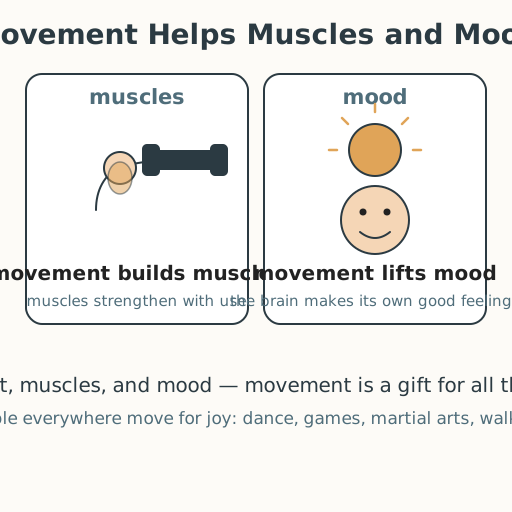
Lesson 8 — Movement Helps Muscles and Mood
Summary
Learners complete the picture of how movement benefits the body: it builds muscles and lifts mood. They learn that muscles strengthen with use and that movement releases brain chemicals that lift mood, then explore movement traditions from around the world — dance, games, martial arts, walking — as joyful, universal ways people move.
Objectives
- Explain how regular movement benefits the heart, muscles, and mood. (D03.S2.05.02)
Connection
After you have run, danced, or played hard, two things happen: your muscles feel warm and strong, and your mood feels lighter — a grin comes easier. Movement is how muscles grow, and it is also how the brain makes its own good feelings. All over the world, people have found joyful ways to move together — a harvest dance, a ball game, a martial art, a long walk to the river. The muscles get their strength and the heart gets its exercise, and the mood gets its lift, everywhere on Earth.
Materials
- Muscles and mood poster
- Movement traditions cards
- Pencils
Preparation
- Print or draw the muscles and mood poster (two panels: movement builds muscles; movement lifts mood).
- Prepare a set of movement traditions cards (dance, martial arts, games, walking, and others from many places).
- Arrange a circle and space to move gently.
Facilitator note
This lesson is written to the learner (“you”). The ideas to land are that movement builds
muscles and lifts mood, and that people everywhere move for joy, not just for exercise.
Invite learners to share movement traditions from their own families and places, and honor
every one with curiosity — never ranking one as better. Keep any shared movement gentle,
optional, and inclusive of every body (seated and adapted versions count fully). Note that
the mood lift is a real, chemical effect, not just a feeling — this is evidence, and it is for
everyone. See docs/facilitation.md and docs/contexts.md.
Procedure
- Gather (5 min). Last time you learned movement makes your heart stronger. Today, two more gifts of movement: muscles and mood.
- Meet the two gifts (10 min). Look at the poster. First, muscles: every muscle in your body strengthens when you use it — lifting, climbing, dancing, carrying. Second, mood: when you move, your brain releases chemicals that lift your mood — a real, natural good feeling. That is why you often feel lighter and happier after moving.
- Explore movement traditions (10 min). Look at the cards — a harvest dance, a ball game, a martial art, a long walk. These are ways people in different places have moved for joy and health for a very long time. Share one way your family or place moves for joy with a partner.
- Move and notice (15 min). Choose one gentle way to move — a remembered dance step, a game, a walk, or simple stretches. Move for a few minutes. Then stop and notice: which muscles worked? How does your mood feel now? Write both on your page.
- Close (5 min). Movement is not a chore to check off; it is a joy your body and mind are built for. Muscles get strong, the heart gets strong, and the mood lifts — a gift every body can share.
Differentiation
- Support: Provide picture cards of muscles and a word bank of mood words; scribe the learner’s two sentences.
- Extension: Name one muscle group used in a specific movement tradition, and explain how endorphins and other brain chemicals lift mood after movement.
Assessment
- Formative (observation): Can the learner explain that movement builds muscles and lifts mood, and name one way people move for joy in a specific culture or place?
- Self-check: The learner says in one sentence how their own mood felt after moving, and whether that matches the “movement lifts mood” idea.
Home connection
Share one movement your family or culture enjoys, and try it together — then notice the muscles and the mood after.
Resources
- Regular physical activity strengthens muscles and supports mental wellbeing; exercise triggers the release of chemicals in the brain, including endorphins, that help lift mood. See the World Health Organization physical activity fact sheet and its notes on physical activity and mental health: https://www.who.int/news-room/fact-sheets/detail/physical-activity. Movement traditions such as dance, martial arts, and games are practiced across cultures as joyful forms of movement — a global and anthropological observation, not a value judgment.