Lesson 03 — A Presentation with One Main Idea
Learners begin building a short presentation by learning to state a single, clear main idea. They meet a worked example, use a sentence frame to shrink a topic into one memorable sentence, and give that sentence aloud to a small audience. Supporting reasons and a conclusion follow in the next lesson.
Objectives
Objectives
- D04.S1.05.02 Give a short presentation with a clear main idea, supporting reasons, and a conclusion.
Essential question
How do I state one clear main idea my audience will remember?
Key vocabulary
Materials
Standard materials
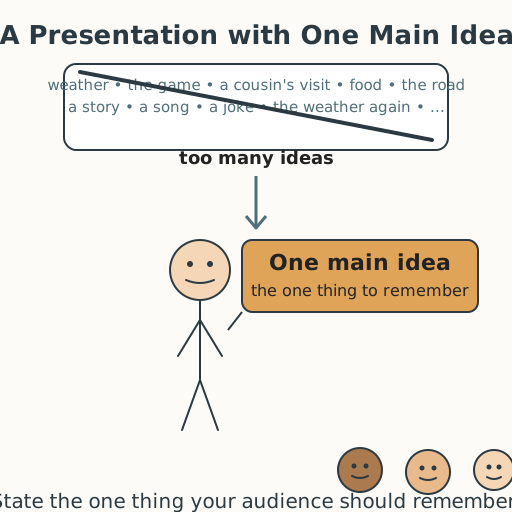
- Main-idea poster · 1 A poster showing a speaker holding a single bright "main idea" banner, with a smaller faded list of "too many ideas" crossed out
- Main-idea sentence frame · 1 per learner A frame such as "Today I want you to know one thing — ___." for stating a main idea in one sentence
- Topic cards · 1 set per group Cards naming simple topics learners care about — a game, an animal, a place, a food, a hobby — to build a main idea around
Low-tech / no-cost
- Voice and a topic of your own Choose one thing you care about and say its main idea in one sentence aloud; no card or poster needed
- A 'one idea or many' game Say a sentence aloud and have partners signal with one finger (one clear idea) or many fingers (too many ideas at once)
Enriched / lab & device
- A recording device · 1 per group To record and replay each learner's one-sentence main idea and hear whether it is clear
- A main-idea lasso chart · 1 A shared chart where learners post a topic, then a one-sentence main idea, then the "one thing to remember"
Works in different contexts
- large-group Model shrinking a rambling topic into one clear main idea on the board, then have small groups do the same for their topics
- multi-age Younger learners name a topic while older learners help shape it into a single clear main-idea sentence
- self-directed A learner picks a topic, writes three possible main-idea sentences, and chooses the clearest one, saying why
- level-grouped Learners ready to extend revise a main idea to suit two different audiences and compare how the wording changes
- outdoor-only Stand where the whole group can hear, pick something visible around you, and state its main idea in one clear sentence
Lesson 3 — A Presentation with One Main Idea
Summary
Learners begin building a short presentation by learning to state a single, clear main idea. They meet a worked example, use a sentence frame to shrink a topic into one memorable sentence, and give that sentence aloud to a small audience. Supporting reasons and a conclusion follow in the next lesson.
Objectives
- Give a short presentation with a clear main idea. (D04.S1.05.02)
Connection
A speaker stands up and talks about the weather, then a game, then a cousin’s visit — and you leave not sure what you were meant to remember. Now imagine another speaker who begins, “I want you to know one thing: every year, monarch butterflies travel farther than any classroom in this building.” You remember it. A presentation works when it has one main idea, stated clearly at the start — like a single strong rope the audience can hold onto, whether you speak under a tin roof or in a courtyard.
Materials
- Main-idea poster
- Main-idea sentence frame
- Topic cards
Preparation
- Print or draw the main-idea poster (one bright banner vs. a crossed-out tangle of ideas).
- Copy a sentence frame for each learner.
- Cut topic cards naming simple, appealing topics.
Facilitator note
This lesson is written to the learner (“you”). The idea to land is that a strong presentation rides on one clear main idea, not many. Model the shrinking of a rambling example into one sentence, and let learners choose topics they genuinely care about — interest is the engine of clarity. Speaking in the home language is welcome; the goal is being understood by the audience in front of them. Keep the tone warm and unranked: a main idea is “clear” or “not yet clear,” never “good” or “bad.” Use explicit instruction for the sentence frame, then let choice and practice carry the rest.
Procedure
- Gather (5 min). Think of a time a speaker lost you — too many ideas at once. Today you start building a short presentation, and you begin with its heart: the main idea — the one thing you want your audience to remember.
- Meet the main idea (10 min). Look at the poster. One side shows a tangle of many small ideas, crossed out. The other shows one bright banner: “I want you to know one thing: monarch butterflies migrate farther than most animals their size.” A main idea is one clear sentence, stated early. Everything else in a presentation serves that sentence.
- Learn the frame (5 min). Read the sentence frame: “Today I want you to know one thing: ___.” Practice saying it once with a simple topic, aloud.
- Find your main idea (15 min). Pick a topic you care about — from the cards or your own life. Say the topic to yourself, then shrink it into one clear main-idea sentence using the frame. Say it to a small audience (a partner or group). They answer one question: “Can you tell me the one thing they wanted you to remember?” If they can, your main idea is clear.
- Close (5 min). A clear main idea is a gift to your audience — it tells them exactly what to hold onto. You have now built the spine of your presentation.
Differentiation
- Support: Offer a menu of ready main ideas to choose from, then let the learner say one aloud and adjust it. A learner may show their main idea instead of speaking — pointing to a prepared card, signing, or using a communication device — and may present while seated; the audience still states back the one idea.
- Extension: Write a main idea, then rewrite it for a different audience (younger children, a grandparent) and notice how the wording shifts.
Assessment
- Formative (performance/peer): Can the audience state back the speaker’s one main idea after a single hearing?
- Self-check: The learner asks, “If someone repeated my main idea, would it match the one I meant to send?”
Home connection
Tell someone at home one thing you learned today in a single clear sentence — and ask if they can repeat your main idea.
Resources
- Clear main ideas and explicit organization support audience comprehension (see the research summarized in Hattie, Visible Learning, on teacher clarity). For a classroom framing of speaking and listening, see CASEL: https://casel.org/fundamentals-of-sel/.