Lesson 08 — Author's Purpose and Point of View
Learners learn to identify an author's purpose (to persuade, inform, or entertain) and point of view (whose eyes the reader sees through). They examine short texts through a two-part lens — "Why did the author write this?" and "Whose point of view is it, and whose voice is missing?" — and compare two points of view on one event.
Objectives
Objectives
- D04.S2.05.02 Distinguish fact from opinion and identify the author's purpose and point of view.
Essential question
Why did the author write this, and from whose point of view?
Key vocabulary
Materials
Standard materials
- Purpose poster · 1 A poster with three doors labeled "to persuade," "to inform," "to entertain," each with an example and the question "Why did the author write this?"
- Point-of-view lens card · 1 per pair A card asking "Whose eyes do we see through?" and "Whose voice is missing?" to use on any text
- Short texts to examine · 1 set per group A few short texts — an ad, a fact sheet, a story, a letter — each with a different purpose and point of view
Low-tech / no-cost
- A 'why did they write this?' game Say or show a short text aloud and have partners signal with three fingers (persuade), two (inform), or one (entertain)
- Voice and a story told twice Tell one small event from two different points of view aloud — the seller and the buyer, the climber and the watcher — and notice what changes
Enriched / lab & device
- A purpose-and-view text set · 1 per group Several texts on one topic (an ad, a news note, a personal letter) to compare purposes and points of view
- A class 'whose voice is missing?' wall · 1 A shared wall where learners post a text, its purpose, its point of view, and the voice that is left out
Works in different contexts
- large-group Examine one text's purpose and point of view aloud together, then have groups do the same for the other texts and share
- multi-age Younger learners name the purpose from pictures while older learners name the point of view and the voice that is missing
- self-directed A learner reads a short text, writes its purpose and point of view, and asks whose voice is missing
- level-grouped Learners ready to extend compare two texts on the same topic and explain how different points of view change what is told
- outdoor-only Tell one nearby event from two points of view — a gardener and a bird, a seller and a shopper — and notice what each notices
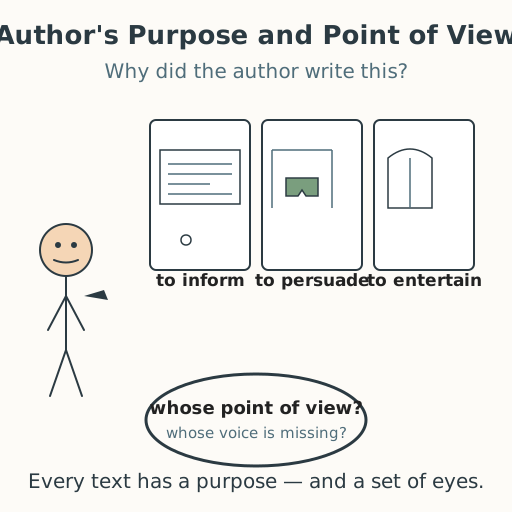
Lesson 8 — Author’s Purpose and Point of View
Summary
Learners learn to identify an author’s purpose (to persuade, inform, or entertain) and point of view (whose eyes the reader sees through). They examine short texts through a two-part lens — “Why did the author write this?” and “Whose point of view is it, and whose voice is missing?” — and compare two points of view on one event.
Objectives
- Identify an author’s purpose and point of view. (D04.S2.05.02)
Connection
A seller at the market tells you the fruit is the finest anywhere; a sign lists the prices; a grandmother tells a funny story about the same market. Three texts, one place, three purposes — one wants to persuade you, one to inform you, one to entertain you — and each comes from a different point of view. The seller sees the market one way, the sign sees numbers, the grandmother sees a story. Reading well means asking two questions: why did this person write this? and through whose eyes am I seeing it?
Materials
- Purpose poster
- Point-of-view lens card
- Short texts to examine
Preparation
- Print or draw the purpose poster (three doors: persuade / inform / entertain).
- Copy the point-of-view lens card for each pair.
- Gather a few short texts with different purposes and points of view (an ad, a fact sheet, a story, a letter).
Facilitator note
This lesson is written to the learner (“you”). The ideas to land are that every text has a
purpose and a point of view, and that a thoughtful reader asks after both. The
egalitarian lens matters here: the question “whose voice is missing?” is a habit of mind that
notices who is left out — the worker, the child, the other side. Keep it gentle and curious,
not accusatory; a text that leaves a voice out is not evil, just incomplete. Where possible,
use texts from many cultures and both oral and written traditions. See docs/facilitation.md
on inquiry over creed.
Procedure
- Gather (5 min). Last lesson you told facts from opinions. Today you ask about the person behind the words: why did the author write this, and whose point of view is it?
- Meet purpose (10 min). Look at the poster. Authors usually write to do one of three things: persuade (change your mind or your action), inform (teach you facts), or entertain (give you a story or a laugh). The ad persuades; the fact sheet informs; the grandmother’s story entertains.
- Meet point of view (10 min). Now the lens card: “Whose eyes do we see through?” The seller sees the market as a living; the sign sees prices; the grandmother sees a memory. And ask the second question: “Whose voice is missing?” Who else is at that market that none of these three shows us?
- Examine texts (15 min). With your group, read each short text. For each one, answer: what is its purpose (persuade, inform, entertain)? What is its point of view? Whose voice is missing?
- Close (5 min). You are not a sponge that soaks up words — you are a reader who asks why, and through whose eyes. That question is the beginning of thinking for yourself.
Differentiation
- Support: Use texts with a single, obvious purpose and a clearly named speaker; provide the three purpose labels as a visual to point to.
- Extension: Take one event and write two short versions from two different points of view, noticing what each chooses to tell and leave out.
Assessment
- Formative (observation/peer): Can the learner name a text’s purpose and point of view, and notice whose voice is missing?
- Self-check: The learner asks, “Could I say why this was written and through whose eyes — and name one voice it leaves out?”
Home connection
Ask about a sign, ad, or story you meet today: why was it written, and whose point of view does it show? Share your answer with someone.
Resources
- Author’s purpose and point of view are standard comprehension targets (see Duke & Pearson’s
synthesis and the IES practice guides). The question “whose voice is missing?” reflects the
curriculum’s egalitarian and global lenses (
docs/philosophy.md§4).