Lesson 09 — Write for a Purpose and Audience
Learners learn to write for a purpose and an audience, choosing an appropriate style and structure. They meet the idea that the same idea takes different forms for different readers, choose a real writing task (purpose + audience), draft it, and check that each choice — words, order, and form — fits the reader.
Objectives
Objectives
- D04.S3.05.01 Write for different purposes and audiences, choosing an appropriate style and structure.
Essential question
How do I choose my style and structure to fit my purpose and audience?
Key vocabulary
Materials
Standard materials
- Purpose-and-audience chooser poster · 1 A poster showing that purpose plus audience shape style and structure — for example, an invitation, a set of instructions, and a request, side by side
- Writing task cards · 1 set per group Cards naming a purpose and an audience — "explain how to wash hands to a younger child," "invite the whole village to a festival," "request a repair from a neighbor"
- Blank writing paper · per learner Paper for drafting, with a simple line for purpose and audience at the top
Low-tech / no-cost
- Voice and a real task Say aloud how you would explain one thing to two different audiences — a small child and an elder — and notice how your words change
- A 'same idea, different audience' game Partners take one idea and speak it first to a friend, then to a respected elder, noticing the changes in style
Enriched / lab & device
- A purpose-and-audience gallery · 1 A wall where learners post pieces written for different purposes and audiences and compare their styles
- A digital writing tool · 1 per group To draft, revise, and format a piece for a chosen purpose and audience where devices are available
Works in different contexts
- large-group Compare two pieces written for the same idea but different audiences on the board, then have learners choose and draft their own task
- multi-age Younger learners say one idea to two audiences aloud while older learners write both versions and compare their choices
- self-directed A learner picks a purpose and audience, drafts one piece, then checks whether each choice (words, order, form) fits that audience
- level-grouped Learners ready to extend write the same idea for three different audiences and annotate exactly what they changed and why
- outdoor-only Choose a real task outside — explaining a game, inviting someone to help — and speak or write it to fit the audience right there
Lesson 9 — Write for a Purpose and Audience
Summary
Learners learn to write for a purpose and an audience, choosing an appropriate style and structure. They meet the idea that the same idea takes different forms for different readers, choose a real writing task (purpose + audience), draft it, and check that each choice — words, order, and form — fits the reader.
Objectives
- Write for different purposes and audiences, choosing an appropriate style and structure. (D04.S3.05.01)
Connection
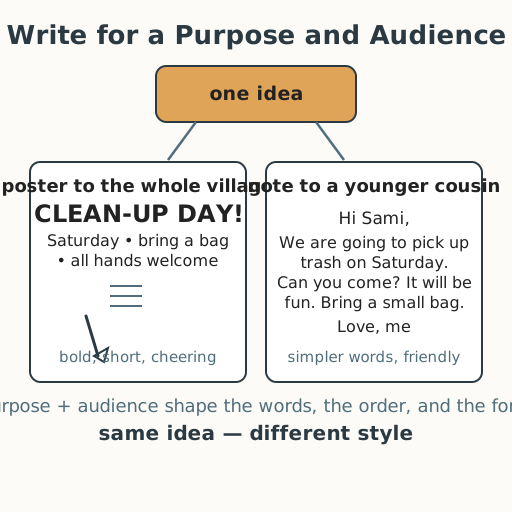
You want people to come to a clean-up day. For the whole village you might write a big, bold poster with short, cheering words. For your younger cousin you might write a warm note with simpler words and a “can you come?” at the end. Same idea, two readers, two very different pieces. Writing well is not finding one “right” way — it is choosing words, order, and form to fit who will read it and what you want them to do.
Materials
- Purpose-and-audience chooser poster
- Writing task cards
- Blank writing paper
Preparation
- Print or draw the purpose-and-audience poster (invitation / instructions / request side by side).
- Copy writing task cards for each group.
- Provide blank drafting paper with a line for “purpose” and “audience” at the top.
Facilitator note
This lesson is written to the learner (“you”). The idea to land is that style and structure are choices, not rules, and the right choice depends on purpose and audience. Writers may write in their home language; the goal is a piece that works for its reader. Model one “same idea, two audiences” contrast aloud, then let learners choose tasks they find real and meaningful. Keep feedback about whether the piece fits the reader, not about “correctness.” Writing is a skill — pair the choice-making with a worked example before independent drafting (Kirschner, Sweller & Clark, 2006).
Procedure
- Gather (5 min). Think of one thing you want to tell people — a game you know, a place you love, a task that needs doing. Today you learn that how you write it depends on who reads it and what you want.
- Meet the chooser (10 min). Look at the poster. One idea — a clean-up day — becomes a bold poster for the whole village and a warm note for a younger cousin. Your purpose (to invite, to teach, to request) and your audience (who reads it) together shape your style (your words and tone) and your structure (your order and form).
- Choose a task (10 min). Pick a writing task card, or invent your own: a purpose and an audience. Write them at the top of your page: “I am writing to ___ for ___.”
- Draft it (15 min). Draft your piece so it fits your reader. Ask yourself as you go: are these the words this reader would understand? Is this the form they would notice — a poster, a note, a list, a letter? Does it do what I want it to do?
- Check and share (10 min). Read your draft to a partner who pretends to be your audience. Do they understand it? Would they act? Adjust if needed.
- Close (5 min). You have just done what writers everywhere do: matched the words to the reader. Next lesson you will take one idea and write it a second way.
Differentiation
- Support: Provide a starter sentence and a choice of two audiences; allow drawing with labels as the draft.
- Extension: Write the same idea for three different audiences and annotate exactly what changed — words, order, and form — and why.
Assessment
- Formative (peer/portfolio): Does the piece fit its stated purpose and audience in word choice, order, and form?
- Self-check: The learner asks, “If my audience read this, would it make sense to them and move them the way I intended?”
Home connection
Write a real note for someone at home — a reminder, a request, or an invitation — choosing words that fit them, and see how they respond.
Resources
- Writing for authentic purposes and audiences supports engagement and transfer (see Graham & Perin, “Writing Next,” Carnegie Corporation, 2007). On explicit instruction for novice writers, see Kirschner, Sweller & Clark (2006).