Lesson 13 — Many Writing Systems
Learners discover that many writing systems exist and learn to identify a few. They meet four big types — alphabets, abjads, abugidas, and character scripts — through five examples (Latin, Arabic, Devanagari, Chinese characters, and Hangul), sort script samples, and celebrate the scripts present in their own classroom and homes.
Objectives
Objectives
- D04.S4.05.01 Recognize that many writing systems exist, such as alphabets and character scripts, and identify a few.
Essential question
How do different writing systems work, and how can I identify a few?
Key vocabulary
Materials
Standard materials
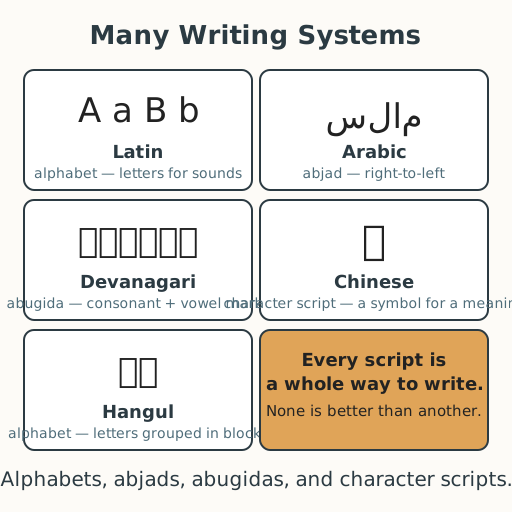
- Writing-systems poster · 1 A poster showing five scripts side by side — Latin, Arabic, Devanagari, Chinese characters, and Hangul — each with a sample and its type label
- Script sample cards · 1 set per group Cards showing a word in several scripts to match with their names and types
- A 'name the script' sorting page · 1 per learner A page to sort script samples under the headings alphabet, abjad, abugida, and character script
Low-tech / no-cost
- Voices and names in the room Learners share their home language and, where they can, write their name in its script; the group notices the different systems present
- A 'how many signs?' game Hold up a sample and have learners signal how the script works — one symbol per sound, per syllable, or per meaning
Enriched / lab & device
- A script gallery · 1 A wall of scripts contributed by learners and their families, with names and type labels, growing across the unit
- A writing-systems slide set · 1 per group Digital images of signs, books, and labels in many scripts, to identify scripts in the world where devices are available
Works in different contexts
- large-group Introduce the five scripts on the poster together, then have groups sort sample cards under the four type headings
- multi-age Younger learners match a script to its name while older learners explain *how* each script encodes sound or meaning
- self-directed A learner studies the poster, sorts the sample cards, and writes the type and one fact about each script
- level-grouped Learners ready to extend research a sixth script (for example, Cherokee syllabary, Ge'ez, or Thai) and add it to the poster
- outdoor-only Hunt for scripts in the world around you — on signs, packaging, and clothing — and name any you can identify
Lesson 13 — Many Writing Systems
Summary
Learners discover that many writing systems exist and learn to identify a few. They meet four big types — alphabets, abjads, abugidas, and character scripts — through five examples (Latin, Arabic, Devanagari, Chinese characters, and Hangul), sort script samples, and celebrate the scripts present in their own classroom and homes.
Objectives
- Recognize that many writing systems exist, such as alphabets and character scripts, and identify a few. (D04.S4.05.01)
Connection
Two children write the word for “water.” One writes “water,” another writes “水,” a third writes “पानी,” and a fourth writes “물.” All four are writing, and all four are right. Human beings have invented many writing systems — hundreds — and each one records language in its own way. No script is better or more “advanced” than another; each is a beautiful, working invention, shaped by the people who use it. When you can recognize a few, a whole world of signs, books, and names opens up.
Materials
- Writing-systems poster
- Script sample cards
- A “name the script” sorting page
Preparation
- Print or draw the writing-systems poster (Latin, Arabic, Devanagari, Chinese characters, Hangul, with type labels).
- Copy script sample cards for each group.
- Copy the sorting page.
Facilitator note
This lesson is written to the learner (“you”). The idea to land is that many writing systems
exist, each a valid and complete way to write, and that a few big types can be recognized:
alphabets (letters for sounds, like Latin and Hangul), abjads (mostly consonant letters,
like Arabic), abugidas (a consonant base plus vowel marks, like Devanagari), and
character scripts (a symbol for a meaning, like Chinese). Take care to be accurate: Arabic
is written right-to-left; Devanagari’s vowel marks sit around the consonant; Chinese characters
mostly stand for meanings (morphemes), not just sounds. Above all, treat every script and every
learner’s home script as equally worthy — never rank them. Invite learners to share their
own scripts; this is a celebration, not a comparison. The technical facts here are evidence;
the claim that “no script is better” is a value we hold (docs/philosophy.md §4–5).
Procedure
- Gather (5 min). Think of all the ways people you know write things down. Today you learn that there isn’t one way to write — there are many writing systems, and you can learn to recognize a few.
- Meet the types (10 min). Look at the poster. Five systems, four big ideas about how writing can work. Alphabets write sounds with letters — Latin (“A a B b”) and Hangul (“한글,” where letters are grouped into syllable blocks). Abjads write mostly consonants and let readers add the vowels — Arabic (“سلام,” written right-to-left). Abugidas start with a consonant and add vowel marks around it — Devanagari (“नमस्ते”). Character scripts use a symbol for a meaning — Chinese (“水” means “water”).
- Sort the samples (15 min). With your group, take the script sample cards and sort them under the headings: alphabet, abjad, abugida, character script. For each one, say why you placed it there.
- Name what’s in the room (15 min). Which scripts do you and your classmates already know or use? Where you can, write your name in your home script and share it. Add any new scripts to your sorting page.
- Close (5 min). Every script on that poster is a whole way of thinking and writing, used by millions of people. Knowing a few — and honoring them all — is part of being a citizen of a many-voiced world.
Differentiation
- Support: Start with two systems (the learner’s own script and one new one), and use the “one symbol per sound / syllable / meaning” hand signals. Offer the scripts as large cards and describe each aloud — its shape, direction, and how it encodes sound — so learners with low vision can follow by listening and tracing.
- Extension: Research a sixth script — Cherokee syllabary, Ge’ez (used for Amharic), or Thai — and add it to the poster with its type and a sample.
Assessment
- Formative (observation/self): Can the learner identify the script types of a few samples and name at least two writing systems?
- Self-check: The learner asks, “Can I point to each sample and say how it records language — by sound, by consonant, by consonant-plus-vowel, or by meaning?”
Home connection
Ask someone at home to show you their writing system or one they know, and learn one new thing about how it works.
Resources
- The typology of writing systems (alphabet, abjad, abugida, logographic) is standard in
linguistics; see Peter T. Daniels & William Bright, eds., The World’s Writing Systems
(Oxford, 1996), and John DeFrancis on Chinese writing. The claim that no script is inherently
better is a value commitment (
docs/philosophy.md§4).