Lesson 12 — Writing My Report in My Own Words
Learners turn their research notes into a short report written in their own words. They meet the rule that copying a source word-for-word without credit is plagiarism, practice restating a fact in their own words, and write a short report with a simple sources line that gives credit.
Objectives
Objectives
- D04.S3.05.02 Gather information from several sources, note key facts, and write a short report in their own words.
Essential question
How do I write what I learned in my own words, and give credit to my sources?
Key vocabulary
Materials
Standard materials
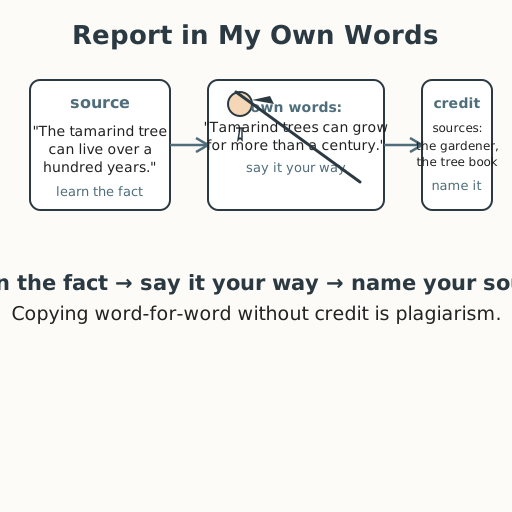
- Own-words poster · 1 A poster contrasting copying a source word-for-word with restating it in one's own words plus a credit line, with "copying = not okay" crossed out
- Source notes from Lesson 11 · 1 per learner Each learner brings their note cards from the research lesson
- Report frame · 1 per learner A simple frame — opening sentence, key facts in own words, a closing sentence, and a "sources" line
Low-tech / no-cost
- Voice and your notes Say each key fact aloud in your own words, then write exactly what you said; no poster needed
- A 'copied or my own words' game Read a source line and two versions aloud — one copied, one reworded — and have partners signal which is the learner's own words
Enriched / lab & device
- A 'sources I used' template · 1 per learner A simple template for listing sources — "I learned from ___, ___, and ___." — to attach to the report
- A digital writing tool · 1 per group To draft and revise the report where devices are available
Works in different contexts
- large-group Model turning one note card into two own-words sentences on the board, then have learners draft their own report
- multi-age Younger learners say one fact in their own words aloud and have it scribed, while older learners write the full report with sources
- self-directed A learner drafts the report from their notes, checks that every sentence is their own words, and lists their sources
- level-grouped Learners ready to extend add a sentence explaining why they trust a fact two sources agree on
- outdoor-only Dictate your report aloud to a partner while looking at your notes — then write down only what you actually said
Lesson 12 — Writing My Report in My Own Words
Summary
Learners turn their research notes into a short report written in their own words. They meet the rule that copying a source word-for-word without credit is plagiarism, practice restating a fact in their own words, and write a short report with a simple sources line that gives credit.
Objectives
- Write a short report in their own words, gathering information from several sources and noting key facts. (D04.S3.05.02)
Connection
A friend finds a fact and reads it to you word-for-word from a book. That’s fine — if they say where it came from. But if they hand in the book’s exact sentences as if the words were their own, something is wrong: that is plagiarism, taking someone else’s words without credit. The honest way is to learn the fact, then say it in your own words and name your source: “I learned from the gardener and the tree book that tamarind trees can live more than a century.” Own words plus credit — that is a report you can be proud of.
Materials
- Own-words poster
- Source notes from Lesson 11
- Report frame
Preparation
- Print or draw the own-words poster (copying crossed out vs. own words + credit).
- Have learners bring their note cards from Lesson 11.
- Copy the report frame.
Facilitator note
This lesson is written to the learner (“you”). The two ideas to land are own words and credit — and that copying without credit is plagiarism, which is about honesty and fairness to the person who did the work, not just a school rule. Frame it through the ethics lens: we give credit because we value people’s work. Model restating one note in own words (a novice skill — use a worked example and guided practice; Kirschner, Sweller & Clark, 2006). Honor home languages: writing the report in a home language is welcome, and paraphrasing into a second language is advanced, valuable work. Keep the credit format simple and age-appropriate.
Procedure
- Gather (5 min). Last lesson you gathered key facts from several sources. Today you turn those notes into a report — but there is one important rule: the words must be your own, and you must give credit.
- Meet own words (10 min). Look at the poster. A source says: “The tamarind tree can live over a hundred years.” Copying it word-for-word and calling it yours is plagiarism — crossed out. Own words: “Tamarind trees can grow for more than a century.” Same fact, your words. Then credit: “Sources: the gardener, the tree book.” That is the honest three-step: learn the fact, say it your way, name your source.
- Practice restating (10 min). Take one note card. Read the key fact, then turn the card over and say it in your own words without looking. Write what you said. Check: did the fact stay true, but in your words? This is the skill from Lesson 1, now on the page.
- Write your report (15 min). Using the report frame, write your short report: an opening sentence that says your topic, your key facts in your own words, a closing sentence, and a sources line naming where your facts came from.
- Check for honesty (10 min). Read your report next to your note cards. Is every sentence in your own words? Did you credit your sources? Ask a partner to check too.
- Close (5 min). You have done what honest writers everywhere do: gathered, understood, and shared — in your own voice, with credit given. That report is your capstone’s raw material.
Differentiation
- Support: Provide a sentence bank to restate each fact, and allow a shorter report with two facts and one source.
- Extension: Add a sentence noting where two sources agree, and use two different ways to restate the same fact, choosing the clearer one.
Assessment
- Formative (portfolio/self): Is the report written in the learner’s own words with key facts from several sources and a credit line?
- Self-check: The learner asks, “Would someone reading my report and my sources say the facts are true, the words are mine, and the credit is given?”
Home connection
Share one fact from your report with someone at home — in your own words — and tell them which source it came from.
Resources
- Paraphrasing and citation are foundational to research writing; see Graham & Perin, “Writing
Next” (Carnegie Corporation, 2007) and the IES “Teaching Secondary Students to Write
Effectively” practice guide. The ethics of credit (not passing off others’ work as one’s own)
is a values commitment; see
docs/philosophy.md§4–5.