Lesson 14 — Language and Culture
Learners discover that language is tied to culture by comparing words for family, food, and respect across languages. They see how different languages make different distinctions (one word for "uncle" versus several; informal and formal "you"), share words from their own home languages, and reflect on what each reveals about what a culture values.
Objectives
Objectives
- D04.S4.05.02 Describe how language is tied to culture, such as words for family, food, or respect that differ across languages.
Essential question
How do words for family, food, and respect show what a culture values?
Key vocabulary
Materials
Standard materials
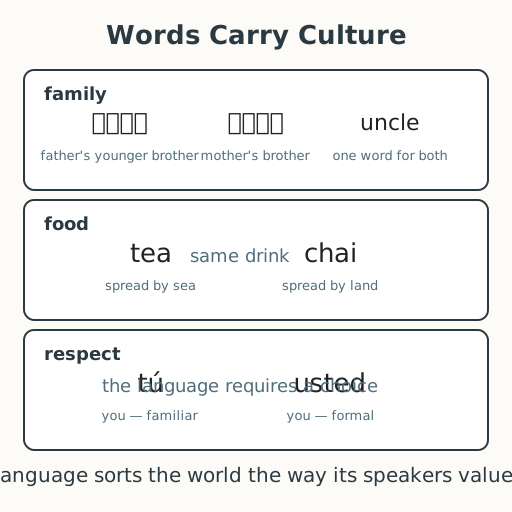
- Language-and-culture poster · 1 A poster with three rows — family, food, respect — each showing how different languages make different distinctions (for example, one word for "uncle" versus several)
- Word comparison cards · 1 set per group Cards with family, food, and respect words from several languages, to sort and discuss what each reveals
- A 'my language, my culture' page · 1 per learner A page to record a word or two from the learner's home language and what it reveals about their family's culture
Low-tech / no-cost
- Voices and family words Learners share a word from their home language for a family member, a food, or a polite form, and what it shows
- A 'how do you say respect?' circle Take turns sharing how each learner's language shows respect in words — and notice the variety
Enriched / lab & device
- A multilingual word wall · 1 A growing wall of family, food, and respect words in many languages, with what each reveals, built across the unit
- A recording of greetings and thanks · 1 per group Learners record a word from several languages and listen back to notice sound and meaning differences
Works in different contexts
- large-group Explore one row of the poster (family, then food, then respect) aloud together, then have groups discuss the word cards
- multi-age Younger learners share a family word in their home language while older learners explain the distinction it makes and what it reveals
- self-directed A learner records a few words from their home language on the page and writes what each reveals about their family's culture
- level-grouped Learners ready to extend compare how two languages handle respect or kinship and discuss what each culture foregrounds
- outdoor-only Walk and talk — find objects or places outside and share the word for each in two languages, noticing what the words reveal
Lesson 14 — Language and Culture
Summary
Learners discover that language is tied to culture by comparing words for family, food, and respect across languages. They see how different languages make different distinctions (one word for “uncle” versus several; informal and formal “you”), share words from their own home languages, and reflect on what each reveals about what a culture values.
Objectives
- Describe how language is tied to culture, such as words for family, food, or respect that differ across languages. (D04.S4.05.02)
Connection
In English, one word — “uncle” — names your father’s brother and your mother’s brother. In Hindi, they are different people with different words: चाचा (chacha, father’s younger brother) and मामा (mama, mother’s brother). In Spanish, you say tú to a friend and usted to someone you respect or do not know well. Languages are not just different labels for the same things — they sort the world differently, and the way they sort it shows what a culture cares about: exactly how you are related, or exactly how much respect to show.
Materials
- Language-and-culture poster
- Word comparison cards
- A “my language, my culture” page
Preparation
- Print or draw the language-and-culture poster (family / food / respect rows).
- Copy word comparison cards for each group.
- Copy the “my language, my culture” page.
Facilitator note
This lesson is written to the learner (“you”). The idea to land is that words carry culture:
the distinctions a language makes reveal what its speakers value, and no language’s
distinctions are “better” — they are different and each is meaningful. Use accurate examples
and check them (Hindi chacha/mama; Spanish tú/usted; Japanese honorifics; the two
routes that spread the word “tea”/“chai”). Invite learners to be the experts on their own home
languages; treat every contribution as a gift, and never rank or correct a learner’s language.
The linguistic facts are evidence; the claim that all languages are equally worthy is a value
we hold (docs/philosophy.md §4–5).
Procedure
- Gather (5 min). Think of a word you use with your family that a stranger might not know — a name for a relative, a dish, a way of saying “please.” Today you learn that words carry culture: they show what a people values.
- Meet family words (10 min). Look at the poster’s first row. English has one word, “uncle.” Hindi has चाचा (chacha) and मामा (mama) — it sorts the father’s side and the mother’s side. Neither is better; each shows what that culture pays attention to.
- Meet food and respect words (10 min). Row two: the same drink spread by sea as “tea” and by land as “chai” — one word, two journeys, two sounds. Row three: Spanish has tú (familiar) and usted (formal). The language requires you to choose how much respect to show. What does that reveal?
- Compare and share (15 min). With your group, sort the word cards into family, food, and respect — and talk about what each word reveals. Then, on your page, write a word or two from your home language and one thing it reveals about your family’s culture.
- Close (5 min). A language is a map of what its speakers treasure. Listening for the words that don’t translate — and the distinctions they make — is how you meet a culture with respect.
Differentiation
- Support: Focus on one row (family) with two concrete examples, and allow drawing the relationship or the food alongside the word.
- Extension: Compare how two languages handle respect or kinship in more depth, and reflect on what each culture foregrounds.
Assessment
- Formative (observation/self): Can the learner give an example of how a language’s words for family, food, or respect differ and say what that difference reveals?
- Self-check: The learner asks, “Can I name one word in my home language and explain what it shows about my family’s culture?”
Home connection
Ask someone at home for one word that doesn’t translate easily, and learn the story behind what it shows about your family’s way of life.
Resources
- Kinship terminology and honorifics as windows into culture are standard in linguistic
anthropology; see Daniel L. Everett, Language: The Cultural Tool, and the classic work of
Edward Sapir and Benjamin Lee Whorf on language and thought. The spread of the words “tea”
and “chai” is documented in the World Atlas of Language Structures and popular linguistic
histories. The claim that all languages are equally valid is a value commitment
(
docs/philosophy.md§4).