Lesson 15 — Present My Report
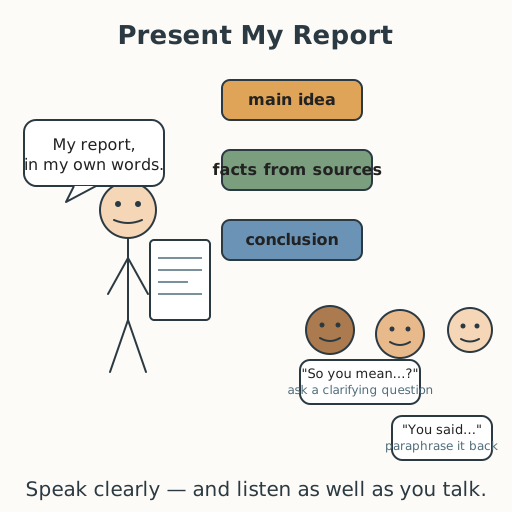
Learners deliver the capstone of the unit: they present the short report they researched and wrote, using the skills of the whole unit — a clear main idea, supporting facts, a conclusion, their own words, and credit to sources. The audience practices paraphrasing a point back and asking a clarifying question, and learners celebrate the many languages and writing systems honored along the way.
Objectives
Objectives
- D04.S1.05.01 Paraphrase a speaker's points accurately and ask clarifying questions when unsure.
- D04.S1.05.02 Give a short presentation with a clear main idea, supporting reasons, and a conclusion.
- D04.S2.05.01 Explain how an author uses structure, such as cause and effect or problem and solution, to organize ideas.
- D04.S2.05.02 Distinguish fact from opinion and identify the author's purpose and point of view.
- D04.S3.05.01 Write for different purposes and audiences, choosing an appropriate style and structure.
- D04.S3.05.02 Gather information from several sources, note key facts, and write a short report in their own words.
- D04.S4.05.01 Recognize that many writing systems exist, such as alphabets and character scripts, and identify a few.
- D04.S4.05.02 Describe how language is tied to culture, such as words for family, food, or respect that differ across languages.
Essential question
How do I share my research clearly, in my own words, with respect for all languages?
Key vocabulary
Materials
Standard materials
- Presentation check poster · 1 A poster listing the presentation's parts — clear main idea, supporting facts, a conclusion, own words, and credit to sources — with a self-check question for each
- The learner's report from Lesson 12 · 1 per learner Each learner brings the short report they wrote, to present
- A listening-and-question guide · 1 per learner A card reminding listeners to paraphrase one point back and ask one clarifying question
Low-tech / no-cost
- Voice and your report Deliver your report aloud from your own notes; the audience paraphrases one point back and asks one clarifying question
- A sharing circle Sit in a circle and present in turn; each listener says back one point and asks one question, with no materials needed
Enriched / lab & device
- A recording device · 1 per group To record each presentation for the learner's portfolio and for self-review
- A class gallery of reports · 1 A wall where final reports are displayed, each with its sources and a note of the learner's home language where relevant
Works in different contexts
- large-group Present in small groups rather than to the whole room, so every learner speaks and is heard; rotate a peer questioner per group
- multi-age Younger learners present one fact and answer one question, while older learners present the full report and field several questions
- self-directed A learner rehearses their report aloud, records or scripts it, and self-checks each part against the poster before sharing with anyone available
- level-grouped Learners ready to extend field questions that compare sources, structure, and word choice, explaining their decisions
- outdoor-only Gather in a circle outside; each learner presents, and listeners paraphrase one point back and ask one clarifying question
Lesson 15 — Present My Report
Summary
Learners deliver the capstone of the unit: they present the short report they researched and wrote, using the skills of the whole unit — a clear main idea, supporting facts, a conclusion, their own words, and credit to sources. The audience practices paraphrasing a point back and asking a clarifying question, and learners celebrate the many languages and writing systems honored along the way.
Objectives
- Paraphrase a speaker’s points accurately and ask clarifying questions when unsure. (D04.S1.05.01)
- Give a short presentation with a clear main idea, supporting reasons, and a conclusion. (D04.S1.05.02)
- Explain how an author uses structure, such as cause and effect or problem and solution. (D04.S2.05.01)
- Distinguish fact from opinion and identify an author’s purpose and point of view. (D04.S2.05.02)
- Write for different purposes and audiences, choosing an appropriate style and structure. (D04.S3.05.01)
- Gather information from several sources, note key facts, and write a short report in their own words. (D04.S3.05.02)
- Recognize that many writing systems exist and identify a few. (D04.S4.05.01)
- Describe how language is tied to culture, such as words for family, food, or respect. (D04.S4.05.02)
Connection
You have spent this unit becoming a listener who paraphrases and asks, a reader who sees structure and purpose, a writer who matches words to a reader, and a researcher who honors sources and languages. Today all of it comes together in one act as old as human speech: sharing what you know with others — standing or seated — and listening while they share back. A report is not finished until it reaches someone else’s ears.
Materials
- Presentation check poster
- The learner’s report from Lesson 12
- A listening-and-question guide
Preparation
- Print or draw the presentation check poster (main idea, facts, conclusion, own words, credit).
- Have learners bring their short report from Lesson 12.
- Copy the listening-and-question guide.
Facilitator note
This lesson is written to the learner (“you”). This is the unit’s summative performance —
the moment learners show what they can do, not to be ranked but to be seen and celebrated.
Keep audiences small and warm so every voice is heard; rotate a peer questioner. Listeners
practice the unit’s listening skills (paraphrase + clarifying question), so everyone is doing
the work, not just the presenter. Honor home languages: presenting in a home language is
welcome, and a learner may tell how their report relates to their language and its writing
system. Assess for growth and mastery, never against one another (docs/philosophy.md §8).
See docs/facilitation.md on assessing without ranking.
Procedure
- Gather (5 min). Look back over this unit: you paraphrased and asked questions, built a presentation, saw how authors structure and persuade, wrote for real readers, researched several sources, wrote in your own words, and honored many languages and scripts. Today you present your report.
- Check your presentation (10 min). Use the poster. Does your presentation have a clear main idea, supporting facts from several sources, a conclusion, your own words, and credit to your sources? Rehearse it once, softly, to yourself.
- Present (20 min). In a small group, take turns presenting your report. Speak so your audience can hear and follow. If your report relates to your home language or script, tell them that too.
- Listen well (15 min). When a classmate presents, your job is the unit’s first skill: paraphrase one point back in your own words, and ask one clarifying question. This is how a listener honors a speaker.
- Close and celebrate (10 min). Notice what you can do now that you could not do before this unit. Thank one presenter whose words you understood better because you listened well. Your voice, your words, and your respect for every language are part of one skill: being a person who communicates with care.
Differentiation
- Support: Present one fact plus a credit line; allow the learner to point to their report instead of speaking — via pointing, signing, or a device — and to present while seated; a partner may voice or present alongside them if invited.
- Extension: Field follow-up questions that compare sources, structure, and word choice, and explain the choices you made as a writer.
Assessment
- Summative (performance/portfolio): Does the presentation show a clear main idea, supporting facts from several sources, a conclusion, the learner’s own words, and credit — and does the learner paraphrase and ask a clarifying question as a listener?
- Self-check: The learner asks, “Did my audience get my main idea, and did I help a classmate by saying their point back and asking one good question?”
Home connection
Present your report to someone at home, and ask them to tell you one thing they’ll remember — then say it back to check you heard them.
Resources
- The capstone integrates the unit’s skills; on performance assessment and mastery without
ranking, see the framing in
docs/facilitation.mdanddocs/contexts.md(Bloom, 1984; Hattie, Visible Learning). On explicit instruction for novice skills, see Kirschner, Sweller & Clark (2006).