Lesson 08 — Writing and Evaluating Simple Expressions
Learners write simple expressions with a variable for real situations (n apples per basket plus loose ones → 3n + 2), and evaluate them by substituting a number for the variable. They interpret what the expression means in the situation.
Objectives
Objectives
- D05.S2.05.02 Write and evaluate simple expressions and interpret what they mean in a real situation.
Essential question
How do I write a simple expression for a real situation and find its value?
Key vocabulary
Materials
Standard materials
- Expression cards · 1 set per group Cards pairing a real situation (n apples per basket plus loose ones) with its expression
- Variable substitution chart · 1 per learner A chart for evaluating an expression for several values of the variable
- Expression recording page · 1 per learner A page to write expressions for situations and evaluate them
Low-tech / no-cost
- Cups and counters Use a cup as the variable (unknown amount) and stones or seeds as counters; build the expression with real objects
- Voice patterns Chant the situation ("three baskets of n plus two loose") and substitute numbers aloud, acting it out
Enriched / lab & device
- A simple spreadsheet · 1 per group A spreadsheet with a formula cell that evaluates an expression for different values of a variable, where devices allow
- An expression-match game · 1 per group A game matching situations to expressions and to their values for given variable amounts
Works in different contexts
- large-group Model writing and evaluating one expression on the board, then have groups match situations to expressions and share one
- multi-age Younger learners substitute numbers into a ready-made expression while older learners write the expression from the situation
- self-directed A learner works the recording page alone, writing and evaluating expressions and checking against the worked example
- level-grouped Learners ready to extend write expressions with two operations and parentheses, and evaluate for a table of values
- outdoor-only Use a cup or basket as the variable and real objects outdoors to build and evaluate each expression
Lesson 8 — Writing and Evaluating Simple Expressions
Summary
Learners write simple expressions with a variable for real situations (n apples per basket plus 2 loose → 3n + 2) and evaluate them by substituting a number for the variable. They interpret what the expression means in the situation and check that the answer makes sense.
Objectives
- Write a simple expression for a real situation and evaluate it by substituting a value for the variable. (D05.S2.05.02)
Connection
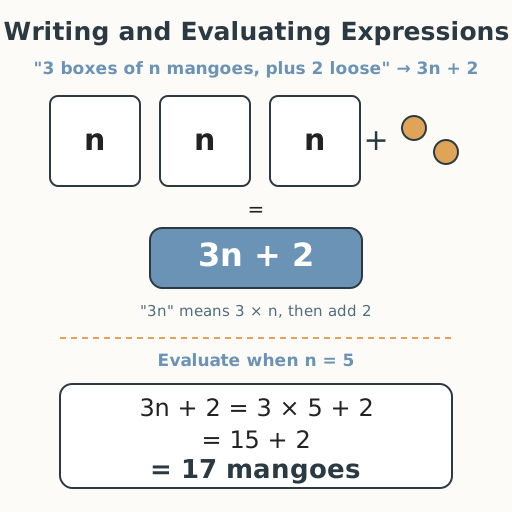
A market seller packs n mangoes into each box. If you take 3 boxes plus 2 loose mangoes, how many do you have? You cannot count them yet because you do not know n — but you can write 3n + 2. The moment someone says “each box holds 5,” you substitute: 3 × 5 + 2 = 17. A variable is a box that can hold any number, and an expression is a recipe that tells you what to do with it. Cooks, builders, and shopkeepers use such recipes every day.
Materials
- Expression cards
- Variable substitution chart
- Expression recording page
Preparation
- Copy expression cards for groups and the recording page for each learner.
- Copy the variable substitution chart.
- Have a worked example ready: 3 boxes of n mangoes plus 2 loose → 3n + 2; n = 5 → 17.
Facilitator note
This lesson is written to the learner (“you”). The ideas to land: (1) a variable is a
letter that stands for an unknown or changing amount; (2) an expression combines numbers,
variables, and operations (3n + 2 means “three times n, then add 2”); and (3) to evaluate,
you substitute a number for the variable and do the operations in order. Model a worked
example first (Kirschner, Sweller & Clark, 2006), then guide a second before independent work.
Two common slips: treating “3n” as “3 + n” (it means 3 × n), and doing operations out of
order. Retrieval: ask learners to recall the coordinate relationship y = 2x from last lesson —
that is itself an expression, now given a name. The algebra here is evidence; the habit of
writing a rule clearly so anyone can follow it is an egalitarian value (clear rules are shareable
rules, docs/philosophy.md §4). Note: variables are a human convention — different traditions
use different symbols, but the idea of “a number you do not know yet” is universal.
Procedure
- Gather (5 min). Last time you saw the relationship y = 2x on a grid. Today you write such rules yourself — using a variable, a letter that stands for a number you do not know yet.
- Meet variables and expressions (10 min). A seller packs n mangoes per box. “Three boxes plus 2 loose” is written 3n + 2: the 3n means “3 times n,” and the + 2 means “plus 2.” This whole rule is called an expression.
- Worked example — write (10 min). Write an expression for: “5 baskets of n oranges plus 3 loose.” That is 5n + 3. What about “n cookies shared by 4”? That is n ÷ 4.
- Worked example — evaluate (10 min). Evaluate 3n + 2 when n = 5. Substitute: 3 × 5 + 2. Multiply first: 15, then add 2: 17. So 3 boxes of 5 mangoes plus 2 loose is 17 mangoes.
- Practice with a partner (10 min). Take your expression cards: match each situation to its expression, then evaluate it for the value given. Check each other: did you multiply where it says multiply, and do operations in order?
- Close (5 min). A variable is a box that can hold any number, and an expression is the recipe for what to do with it. Write the recipe first, then substitute the number — that is the whole skill.
Differentiation
- Support: Use only expressions like n + 3 and 4n (no two operations at first); keep the substitution chart with one clear value. Describe each step aloud and use cups/counters so learners with low vision can follow by touch.
- Extension: Write expressions with parentheses and two operations (2(n + 3)) and evaluate for a table of several values.
Assessment
- Formative (observation/self): Can the learner write an expression for a real situation and evaluate it correctly by substitution?
- Self-check: The learner asks, “Does my expression match the situation word for word, and did I substitute and operate in the right order?”
Home connection
Find a situation at home with an unknown amount (a bag with n things, a recipe for n people) and write an expression for it; then pick a number and evaluate it.
Resources
- Variables and simple expressions are standard in elementary mathematics; see John A. Van de
Walle, Elementary and Middle School Mathematics (10th ed., 2019). The note that variables
are a human convention used across traditions is a factual observation; the value that clear
rules should be shareable by everyone is a commitment (
docs/philosophy.md§4).