Lesson 11 — Finding Volume by Counting Unit Cubes
Learners find the volume of right rectangular prisms by building them with unit cubes and counting the cubes. They see volume as the amount of space a box holds, counted in cubic units, and discover that counting by layers (cubes in one layer times number of layers) is a fast way to find the total.
Objectives
Objectives
- D05.S3.05.02 Find the volume of right rectangular prisms using unit cubes and formulas, and explain what volume measures.
Essential question
How do I find the volume of a box by counting unit cubes?
Key vocabulary
Materials
Standard materials
- Unit cubes · 1 set per group Cubes (wood, plastic, or folded paper) to build rectangular prisms and count layers
- Prism-building cards · 1 set per group Cards describing a prism to build (e.g., 3 layers of 4 cubes) and count
- Volume recording page · 1 per learner A page for recording built prisms, layer counts, and total unit cubes
Low-tech / no-cost
- Folded paper cubes Fold paper into unit cubes, or use equal-sized seeds, stones, or clay balls as units to build and count
- Drawn cubes Draw a prism on paper or in the dirt and count the visible layers and cubes
Enriched / lab & device
- A digital 3-D block builder · 1 per group A tool that stacks virtual unit cubes and shows the total, where devices allow
- A volume-exploration station · 1 Several real boxes of different sizes to fill with unit cubes and compare how much each holds
Works in different contexts
- large-group Build one prism together and count its cubes layer by layer, then have groups build and count their own and share totals
- multi-age Younger learners count cubes in one layer while older learners multiply layers to find the total volume
- self-directed A learner builds prisms from cards alone, counts cubes by layers, and checks totals against the worked example
- level-grouped Learners ready to extend build taller prisms and explain why multiplying the layers gives the total without counting every cube
- outdoor-only Build prisms from equal stones or clay cubes outdoors and count the layers to find the volume
Lesson 11 — Finding Volume by Counting Unit Cubes
Summary
Learners find the volume of right rectangular prisms by building them with unit cubes and counting. They see volume as the amount of space a box holds, counted in cubic units, and discover that counting by layers — cubes in one layer times the number of layers — is a fast way to find the total.
Objectives
- Find the volume of right rectangular prisms by counting unit cubes and explain that volume measures the amount of space a box holds. (D05.S3.05.02)
Connection
A carpenter makes a wooden box for storing grain. How much grain can it hold? You can answer by filling the box with unit cubes — little blocks, one unit on every side — and counting them. A box that holds 24 unit cubes has a volume of 24 cubic units. Volume is simply “how much fits inside,” and it is how people measure a box of rice, a water tank, or a delivery crate anywhere in the world.
Materials
- Unit cubes
- Prism-building cards
- Volume recording page
Preparation
- Provide unit cubes (or folded paper cubes) for each group.
- Copy prism-building cards and the recording page.
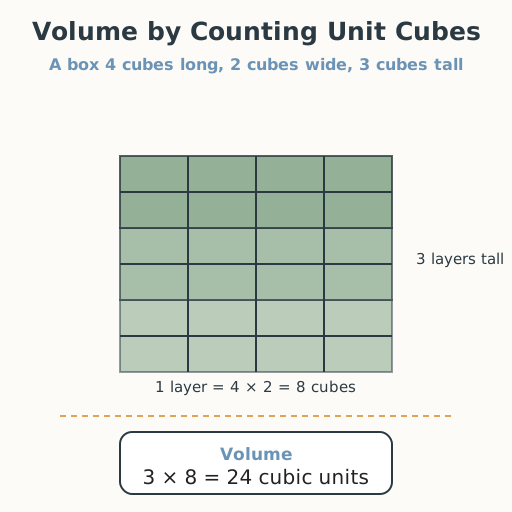
- Have a worked example ready: a prism 4 by 2, three layers tall = 24 cubic units.
Facilitator note
This lesson is written to the learner (“you”). The ideas to land: (1) a unit cube is a
cube 1 unit long, wide, and tall, and it gives us a cubic unit for measuring space; (2)
volume is the number of unit cubes that fill a box with no gaps or overlaps; and (3) you can
count by layers — cubes in one layer × number of layers. Model a worked example first
(build 4 × 2, three layers tall, count 8 per layer × 3 = 24), then guide a second (Kirschner,
Sweller & Clark, 2006). Common slip: counting only the cubes you can see and forgetting the
hidden ones — layer counting fixes this. Retrieval: ask learners to recall perimeter from Lesson
10 and contrast it with volume (perimeter is around, volume is inside). Volume facts here are
evidence; the habit of measuring so a container is honestly labeled is a fairness value
(docs/philosophy.md §4). If unit cubes are unavailable, equal stones or folded paper cubes
work just as well.
Procedure
- Gather (5 min). Recall: what is perimeter, and how is it different from how much fits inside a box? Today you measure the inside — volume.
- Meet the unit cube (5 min). A unit cube is a cube that is 1 unit long, 1 unit wide, and 1 unit tall. It is the basic block for measuring space — one cubic unit.
- Worked example — build and count (15 min). Build a box with a base of 4 cubes by 2 cubes, stacked 3 layers tall. Count the bottom layer: 4 × 2 = 8 cubes. You have 3 layers, so 8 + 8 + 8 = 24, or 3 × 8 = 24 cubic units. Count by layers so you do not miss hidden cubes.
- Practice with a partner (20 min). Take your prism-building cards, build each prism, count the cubes in one layer, then multiply by the number of layers. Record each volume. Check each other: did you count every layer, even the hidden ones?
- Close (5 min). Volume is how much space a box holds, measured in cubic units. Count one layer, then multiply by the layers — and you have found the volume without counting every cube one by one.
Differentiation
- Support: Use prisms only 1–2 layers tall and count every cube with a finger; describe each layer aloud. Use large, tactile cubes so learners with low vision can follow by touch.
- Extension: Build taller prisms (4–5 layers) and explain why layer × layers gives the total without counting each cube.
Assessment
- Formative (observation/self): Can the learner build a prism and find its volume in cubic units by counting layers?
- Self-check: The learner asks, “Did I count the cubes in one layer and multiply by the number of layers, including the hidden ones?”
Home connection
Find a box at home and fill it (or imagine filling it) with equal cubes; count one layer and the number of layers to estimate its volume.
Resources
- Volume as unit-cube counting is standard in elementary mathematics; see John A. Van de Walle,
Elementary and Middle School Mathematics (10th ed., 2019). The fairness value of honest
measurement of containers is a commitment (
docs/philosophy.md§4).