Lesson 12 — The Volume Formula and What Volume Measures
Learners move from counting cubes to the volume formula. They see that length × width gives the cubes in one layer, and × height gives the layers, so V = l × w × h. They apply the formula to labeled boxes and explain that volume measures the space inside, in cubic units.
Objectives
Objectives
- D05.S3.05.02 Find the volume of right rectangular prisms using unit cubes and formulas, and explain what volume measures.
Essential question
How do I find volume with a formula, and what does volume really measure?
Key vocabulary
Materials
Standard materials
- Labeled box diagrams · 1 per pair Diagrams of boxes with length, width, and height labeled, to compute volume with the formula
- Volume formula cards · 1 set per group Cards with box dimensions to compute volumes using V = l × w × h
- Volume formula recording page · 1 per learner A page for recording dimensions and computed volumes
Low-tech / no-cost
- Real boxes and measuring Measure real boxes with hands, string, or a ruler, then multiply length × width × height to find volume
- Drawn boxes in the dirt Draw a box and its dimensions in the dirt or on paper, then multiply to find the volume
Enriched / lab & device
- A digital 3-D volume tool · 1 per group A tool that shows a box, lets learners set length, width, height, and displays the volume, where devices allow
- A packing-and-shipping challenge · 1 A real challenge to find which box holds more, using the volume formula and comparing cubic units
Works in different contexts
- large-group Derive the formula together from a built prism, then have pairs compute volumes and share one worked result
- multi-age Younger learners multiply length × width for the base while older learners multiply by height for the full volume
- self-directed A learner works the recording page alone, applying V = l × w × h and checking answers against the worked example
- level-grouped Learners ready to extend find a missing dimension given volume and two sides, and compare volumes of different boxes
- outdoor-only Measure a real box or crate outdoors and multiply its length, width, and height to find its volume in cubic units
Lesson 12 — The Volume Formula and What Volume Measures
Summary
Learners move from counting cubes to the volume formula. They see that length × width gives the cubes in one layer, and × height gives the number of layers, so V = l × w × h. They apply the formula to labeled boxes and explain that volume measures the space inside, in cubic units.
Objectives
- Find the volume of right rectangular prisms using the formula V = l × w × h and explain that volume measures the amount of space inside. (D05.S3.05.02)
Connection
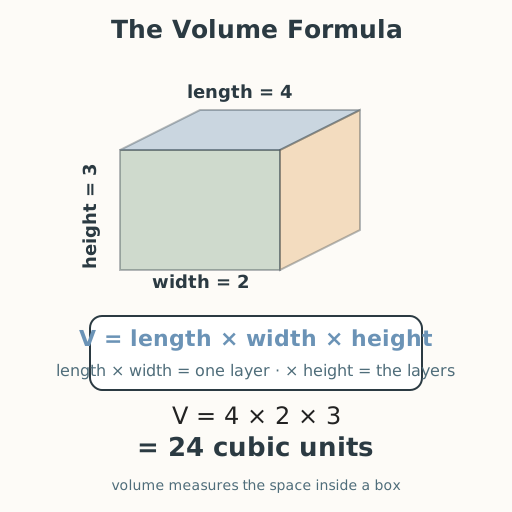
A water tank is 4 units long, 2 units wide, and 3 units tall. How much water can it hold? You could fill it with unit cubes and count — 24 of them. Or you can see the shortcut: the floor of the tank holds 4 × 2 = 8 cubes in one layer, and there are 3 layers, so 8 × 3 = 24 cubic units. That shortcut is the volume formula, and it is how engineers, builders, and water workers everywhere figure out how much a tank, a crate, or a silo can hold.
Materials
- Labeled box diagrams
- Volume formula cards
- Volume formula recording page
Preparation
- Copy box diagrams for pairs and formula cards for groups.
- Copy the recording page.
- Have worked examples ready: V = 4 × 2 × 3 = 24; a second box, e.g., 5 × 3 × 2 = 30.
Facilitator note
This lesson is written to the learner (“you”). The idea to land: volume = length × width ×
height, where length × width is the area of one layer and × height multiplies by the number of
layers. Connect this back to last lesson’s cube counting so the formula is not magic. Model a
worked example first (Kirschner, Sweller & Clark, 2006), then guide a second. Common slips:
multiplying only two numbers, or writing the answer in square units instead of cubic units.
Retrieval: ask learners to recall the unit-cube lesson and restate why volume is counted in
cubic units. The formula is evidence; the habit of computing capacity honestly (so a tank is
correctly sized for everyone who depends on it) is a fairness value (docs/philosophy.md §4).
Procedure
- Gather (5 min). Recall: how did you find volume last lesson? Today you turn that counting into a fast formula.
- From cubes to formula (10 min). Last lesson you counted: one layer of 4 × 2 = 8 cubes, times 3 layers = 24. Notice the numbers: 4 (length) × 2 (width) × 3 (height) = 24. So the volume formula is V = l × w × h: length × width gives the base layer, × height gives the layers.
- Worked example (10 min). A tank is 4 long, 2 wide, 3 tall. Use the formula: V = 4 × 2 × 3 = 24 cubic units. Label it “cubic units” because you are measuring space.
- Practice with a partner (20 min). Take your box diagrams and formula cards. For each, multiply length × width × height, write the answer with cubic units, and check each other: did you multiply all three? Is the unit “cubic units”?
- Close (5 min). Volume measures the space inside a box, in cubic units. Length × width × height is just “how many cubes fit,” written as a formula you can use on any box.
Differentiation
- Support: Keep dimensions small (2–4) and draw the layers beside each problem; describe each step aloud. Use tactile box models so learners with low vision can follow by touch.
- Extension: Given a volume and two dimensions, find the missing dimension; compare two boxes to say which holds more and by how much.
Assessment
- Formative (observation/self): Can the learner compute volume with V = l × w × h and explain that it measures space in cubic units?
- Self-check: The learner asks, “Did I multiply length, width, and height, and did I write cubic units? Can I explain where the formula comes from?”
Home connection
Measure a box at home (in any unit), multiply its length, width, and height, and tell someone its volume and what it could hold.
Resources
- The volume formula V = l × w × h is standard in elementary mathematics; see John A. Van de
Walle, Elementary and Middle School Mathematics (10th ed., 2019). The fairness value of
honestly sizing containers that serve a community is a commitment (
docs/philosophy.md§4).