Lesson 13 — Converting Measurement Units
Learners convert among different-sized metric measurement units for length (m, cm, km), mass (g, kg), and capacity (mL, L). They learn the rule: converting to a smaller unit multiplies, converting to a larger unit divides, and they practice each direction.
Objectives
Objectives
- D05.S4.05.01 Convert among different-sized standard measurement units and use the conversions to solve real problems.
Essential question
How do I convert among different-sized standard measurement units?
Key vocabulary
Materials
Standard materials
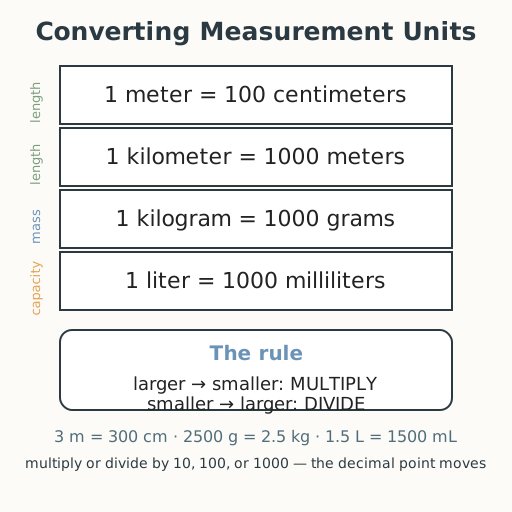
- Unit conversion chart · 1 A chart of metric relationships — 1 m = 100 cm, 1 km = 1000 m, 1 kg = 1000 g, 1 L = 1000 mL
- Conversion cards · 1 set per group Cards with amounts to convert (e.g., 3 m to cm, 2500 g to kg)
- Conversion recording page · 1 per learner A page for recording conversions and the rule used
Low-tech / no-cost
- A string and marks Mark a meter on a string, then divide it into centimeters by eye or with marks, to see 100 cm in a meter
- Real measures Use a liter bottle, a kilogram of grain, or a meter of string to feel each unit before converting
Enriched / lab & device
- A digital unit converter · 1 per group A converter to check hand-computed conversions, where devices allow
- A measurement station · 1 Real items to measure and convert — lengths, masses, and liquid amounts
Works in different contexts
- large-group Model one conversion in each category (length, mass, capacity) on the board, then have groups convert cards and share one
- multi-age Younger learners convert within length only while older learners convert across mass and capacity too
- self-directed A learner works the recording page alone, converting amounts and checking against the worked examples
- level-grouped Learners ready to extend convert in both directions (larger↔smaller) and explain the multiply/divide rule
- outdoor-only Measure real lengths, masses of gathered objects, or water amounts outdoors and convert them between units
Lesson 13 — Converting Measurement Units
Summary
Learners convert among different-sized metric units for length (m, cm, km), mass (g, kg), and capacity (mL, L). They learn the rule: converting to a smaller unit multiplies; converting to a larger unit divides — and they practice both directions.
Objectives
- Convert among different-sized standard measurement units within the metric system. (D05.S4.05.01)
Connection
A cook reads a recipe that calls for 500 milliliters of milk, but the jug is marked in liters — so the cook converts: 500 mL = 0.5 L. A runner’s route is 1.5 kilometers, and the marker posts are in meters — that is 1500 m. A farmer weighs 2500 grams of grain and records it as 2.5 kilograms. Converting units lets people who use different-sized measures share the same amount — a cook, a runner, and a farmer all over the world do it daily.
Materials
- Unit conversion chart
- Conversion cards
- Conversion recording page
Preparation
- Print or draw the unit conversion chart.
- Copy conversion cards for groups and the recording page.
- Have worked examples ready: 3 m = 300 cm; 2500 g = 2.5 kg.
Facilitator note
This lesson is written to the learner (“you”). The ideas to land: (1) the metric relationships
— 1 m = 100 cm, 1 km = 1000 m, 1 kg = 1000 g, 1 L = 1000 mL; (2) the rule — larger to
smaller: multiply; smaller to larger: divide. Model a worked example in each category
(Kirschner, Sweller & Clark, 2006), then guide a second. Common slip: multiplying when you
should divide (or vice versa) — anchor the rule to a concrete feel (a meter is longer than a
centimeter, so 3 m is more centimeters: 300). Retrieval: ask learners to recall the place-value
work of Lesson 1 — metric conversions are multiplying/dividing by 10, 100, and 1000, which just
moves the decimal point. Note the global fact: the metric system is used in almost every country;
a few also use other units (inches, feet, pounds, ounces) — different conventions, none “better,”
but metric is the shared language of science and trade (docs/philosophy.md §4). The
relationships are evidence; the value that shared units let everyone trade and measure fairly is
a commitment.
Procedure
- Gather (5 min). Recall: in place value, what happens to a number when you multiply by 100? Today you use that to convert measurement units.
- Meet the relationships (10 min). Look at the conversion chart: 1 m = 100 cm, 1 km = 1000 m, 1 kg = 1000 g, 1 L = 1000 mL. These are the bridges between bigger and smaller units.
- The rule (5 min). Going larger → smaller, you get more units, so multiply. Going smaller → larger, you get fewer units, so divide.
- Worked examples (15 min). Convert 3 m to cm: larger → smaller, multiply: 3 × 100 = 300 cm. Convert 2500 g to kg: smaller → larger, divide: 2500 ÷ 1000 = 2.5 kg. Convert 1.5 L to mL: 1.5 × 1000 = 1500 mL.
- Practice with a partner (10 min). Take your conversion cards. For each, decide which direction you are going, then multiply or divide. Check each other: did you pick the right operation, and does your answer make sense (more of a smaller unit, fewer of a larger)?
- Close (5 min). Converting units is choosing to multiply or divide by 10, 100, or 1000. Feel the size of each unit first, and the rule follows.
Differentiation
- Support: Convert within length only, using the chart; describe each step aloud and act out the sizes with a meter string and centimeter marks so learners with low vision can follow.
- Extension: Convert in both directions across all three categories and explain the multiply/divide rule in your own words.
Assessment
- Formative (observation/self): Can the learner convert among metric units in both directions, choosing multiply or divide correctly?
- Self-check: The learner asks, “Did I go larger→smaller (multiply) or smaller→larger (divide), and does my answer make sense?”
Home connection
Find a measure at home (a bottle in liters, a bag in grams, a distance in kilometers) and convert it to the other unit, telling someone how you did it.
Resources
- Metric conversions are standard in elementary mathematics; see John A. Van de Walle,
Elementary and Middle School Mathematics (10th ed., 2019). The fact that the metric system
is the near-universal standard (SI) while some places also use other units is documented; the
value that shared units enable fair trade is a commitment (
docs/philosophy.md§4).