Lesson 08 — Earth, Moon, and Sun: Day Length and Moon Phases
Learners describe the Earth–Moon–Sun system: Earth's spin makes day and night (about 24 hours), and the Moon's orbit around Earth makes the phases, because we see different parts of the Moon's sunlit half as it travels. They model the system and predict the Moon's changing shape.
Objectives
Objectives
- D06.S4.05.01 Describe the Earth, Moon, and Sun system and explain day length, moon phases, and eclipses.
Essential question
Why do we have day and night, and why does the Moon change shape in the sky?
Key vocabulary
Materials
Standard materials
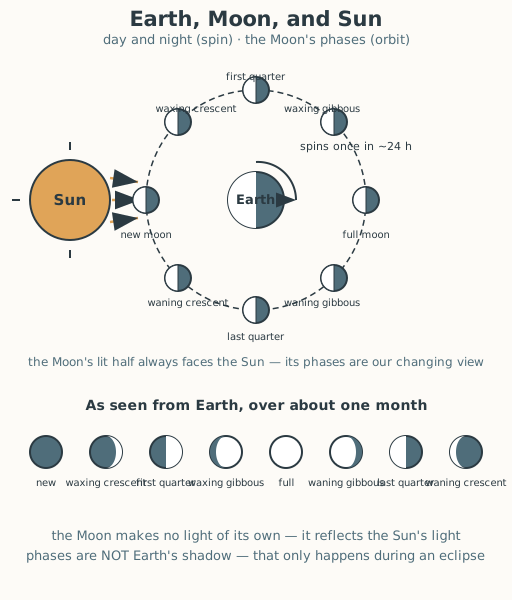
- Earth–Moon–Sun diagram · 1 per pair The graphic showing Earth's spin, the Moon's orbit, and the eight phases
- A ball (Earth) and a smaller ball (Moon) and a lamp or torch (Sun) · 1 set per group To model the Moon's orbit and watch the lit shape change
- Moon-phase observation chart · 1 per learner A page to sketch the Moon's shape on several nights
Low-tech / no-cost
- A ball, a smaller stone, and the Sun itself Hold the stone (Moon) out toward the Sun and turn; watch its lit shape change from your eyes
- Voice and body One learner is the Sun (holds arms out), one the Earth (spins), one the Moon (walks around Earth, always facing the Sun); no objects needed
Enriched / lab & device
- A short Moon-phase animation or a Moon-phase app · 1 per group To replay the orbit and watch the lit shape change over a month
- A lunar calendar from a real tradition · 1 per group To connect the phases to how people have kept time by the Moon
Works in different contexts
- large-group Model the Earth–Moon–Sun with three learners at the front while the group predicts the phase before each position is revealed
- multi-age Younger learners act out day/night (spin) and point to "big light / no light"; older learners name all eight phases and explain why the lit half always faces the Sun
- self-directed A learner studies the diagram, models the orbit with a ball and lamp if available, and sketches the phase they would see from each position
- level-grouped Learners ready to extend explain why a full moon rises at sunset and a new moon is near the Sun in the sky, using the model
- outdoor-only Hold a small ball (Moon) out toward the Sun and turn slowly; watch its lit shape change exactly as the real Moon's does
Lesson 8 — Earth, Moon, and Sun: Day Length and Moon Phases
Summary
Learners explain two movements of the Earth–Moon–Sun system: Earth rotates (spins) once in about 24 hours, making day and night; and the Moon orbits Earth about once a month, making the phases — because we always see only part of the Moon’s sunlit half. They model both movements and predict the Moon’s shape from where it stands.
Objectives
- Describe the Earth, Moon, and Sun system, and explain day length and moon phases. (D06.S4.05.01)
Connection
Every evening, if you look up, the Moon may look different from the night before — a thin crescent, a half-circle, a full round face — then it thins again. People all over the world have kept time by this cycle: many calendars, from the Islamic calendar that sets the month of Ramadan to the lunar calendars that set many New Year festivals across Asia, follow the Moon. And every morning the Sun comes up because our own Earth is turning. Today you learn the two motions that make the day and the month.
Materials
- Earth–Moon–Sun diagram
- A ball (Earth), a smaller ball (Moon), and a lamp or torch (Sun)
- Moon-phase observation chart
Preparation
- Print or draw the Earth–Moon–Sun diagram and a moon chart per learner.
- Set up one lamp (Sun) per group, or arrange to use the real Sun outdoors.
- Recall Grade 3: Earth’s rotation makes day and night; its orbit makes the seasons.
Facilitator note
Written to the learner (“you”). Two movements, two effects: rotation → day and
night (~24 hours, so “day length” is about one full turn); the Moon’s orbit →
phases. The key insight to land is that the Moon does not make its own light — it
reflects the Sun’s light, and its lit half always faces the Sun. The phases are
just our changing view of that lit half, not Earth’s shadow on the Moon (that
misconception is exactly what the next lesson, eclipses, corrects — preview it). The
ball-and-lamp model is the worked example: model one full orbit slowly, and have
learners predict the phase before you reveal each position. This honors the
predict → test → observe loop. Keep the lunar-calendar mention respectful and
factual: many cultures use lunar calendars, and none is “better” — that is a value we
hold (docs/facilitation.md).
Procedure
- Gather (5 min). Think of the last time you saw the Moon. What shape was it? Why do you think it changes? Say your guess — that is a prediction.
- Meet the two motions (10 min). Look at the diagram. Earth rotates (spins) on its axis once in about 24 hours — that is one day and night, so our day length is about 24 hours. The Moon orbits Earth about once every 29–30 days. The Moon makes no light of its own; it reflects the Sun’s light, so its lit half always faces the Sun.
- Why phases happen (10 min). As the Moon travels around Earth, we see different parts of its lit half: new moon (lit half faces away — we see none), waxing crescent, first quarter, waxing gibbous, full moon (we see the whole lit half), then waning gibbous, last quarter, and waning crescent. The Moon itself does not change — our view of it does.
- Model it (15 min). With a lamp (the Sun) and a ball (the Moon), stand where Earth is and move the Moon slowly around you, always keeping its lit side toward the lamp. At each position, predict what shape you will see, then look. Record it on your chart. Compare with the diagram.
- Close (5 min). One turning Earth gives you a day; one orbiting Moon gives you a month of changing faces. Both are just motion — spin and orbit — and both are happening right now, over your head.
Differentiation
- Support: Start with only four phases (new, first quarter, full, last quarter) and the ball-and-lamp model; name each shape aloud.
- Extension: Explain why the same phase is visible to people in different countries on the same night, and why a full moon rises around sunset.
Assessment
- Formative (observation/peer): Can the learner model the Moon’s orbit and predict at least four phases correctly, and state that the Moon reflects sunlight?
- Self-check: The learner asks, “Can I explain day/night with Earth’s spin and the phases with the Moon’s orbit — without saying Earth’s shadow makes the phases?”
Home connection
Watch the Moon for a few nights and sketch its shape on the chart. After several days, tell someone what changed and why.
Resources
- NASA, “The Moon” — moon phases and the Earth–Moon–Sun system: https://science.nasa.gov/moon/
- NASA Space Place, “What Are the Moon’s Phases?” (age-appropriate): https://spaceplace.nasa.gov/moon-phases/en/