Lesson 06 — What to Say in an Emergency
Learners learn exactly what to say when they call for help: their name, their location, and what happened — then to stay on the line and answer the helper's questions. A worked example models the call, pairs role-play it, and each learner completes a take-home emergency- information card with their name, location, a trusted adult, and the local emergency number.
Objectives
Objectives
- D03.S4.05.01 Describe how to respond in an emergency, including how to call for help and what information to give.
Essential question
What information do I give when I call for help in an emergency?
Key vocabulary
Materials
Standard materials
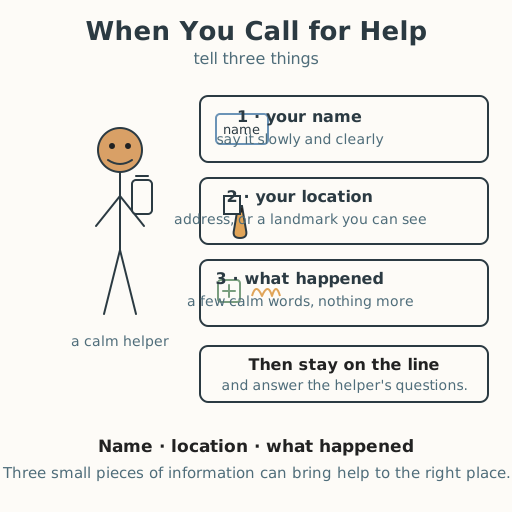
- Give-three-things poster · 1 A poster showing the three things to tell a helper — your name, your location, and what happened — with a picture of a calm child speaking
- Emergency-information card · 1 per learner A fill-in card with lines for name, home address or location, a trusted adult's phone, and the local emergency number — a take-home portfolio artifact
- Role-play scripts · 1 per pair Short scripts for a helper and a caller so pairs practice giving the three pieces of information calmly
Low-tech / no-cost
- Three-finger reminder Hold up three fingers — name, location, what happened — and practice saying all three aloud; no paper needed
- Pair role-play with a pretend phone Use a hand as a phone and practice the call with a partner, one as the caller and one as the helper
Enriched / lab & device
- A practice (non-dialing) phone simulator · 1 per pair A toy or simulator phone so pairs practice the full call — greeting, three pieces of information, staying on the line — without dialing a real number
- A recorded helper call (child-appropriate) · 1 A short, calm audio of a helper asking for name, location, and what happened, to hear the rhythm of a real call
Works in different contexts
- large-group Model one full call as a worked example on the board, then have pairs role-play and fill their own information cards
- multi-age Younger learners practice saying name, location, and what happened with the three-finger reminder while older learners run the full role-play and check each card
- self-directed A learner fills their emergency-information card, writes the three things to say, and says them aloud to check they are complete
- level-grouped Learners ready to extend explain why to stay on the line and follow the helper's questions, and practice answering a follow-up question
- outdoor-only Practice the call in pairs with a hand-phone, and name a real nearby landmark to describe a location; fill the card on any scrap of paper
Lesson 6 — What to Say in an Emergency
Summary
Learners learn exactly what to say when they call for help: their name, their location, and what happened — then to stay on the line and answer the helper’s questions. A worked example models the call, pairs role-play it, and each learner completes a take-home emergency-information card with their name, location, a trusted adult, and the local emergency number.
Objectives
- Describe how to respond in an emergency, including what information to give. (D03.S4.05.01)
Connection
Imagine the phone is answered by a helper who wants to send aid right away — but they cannot see you. They need to know three things, and you are the one who can tell them: who you are, where you are, and what happened. Say your name clearly. Say your location — your address, or a landmark you can see, like “beside the blue water pump” or “the shop by the big mango tree.” Then say what happened, in a few calm words: “someone fell and cannot get up,” “there is a fire in the kitchen.” Then stay on the line and answer their questions. Three pieces of information — that is the whole skill, and it can bring help to the right place.
Materials
- Give-three-things poster
- Emergency-information card
- Role-play scripts
Preparation
- Print or draw the give-three-things poster (name, location, what happened).
- Copy an emergency-information card for each learner and a role-play script for each pair.
- Recall Lesson 5 (recognize, get safe, get help, call); today is what to say once you are on the call.
- Prepare the correct local emergency number and a sample nearby landmark for the location line.
Facilitator note
This lesson is written to the learner (“you”). The idea to land is the three pieces of
information — name, location, what happened — plus staying on the line. Model the full call
once as a worked example (explicit instruction for a novice skill), then let pairs role-play
with a pretend phone. Keep every scenario mild and calm; never simulate graphic injury. Some
learners may not know a formal street address — that is normal and fine; teach them to describe
a landmark (“the well,” “the blue house,” “next to the school”) as a valid location. Send
the card home so a family can confirm the number and address together. See docs/facilitation.md.
Procedure
- Gather (5 min). Last time you learned the four steps: recognize, get safe, get help, call the number. Today: what do you say when the call is answered?
- Meet the three things (10 min). Look at the poster. A helper who cannot see you needs three things. Your name — say it slowly and clearly. Your location — an address, or a landmark you can see. What happened — a few calm words, nothing more. Then stay on the line and answer their questions; do not hang up until they say you can.
- Watch the worked example (5 min). Your facilitator and a partner show one full call. “Hello, what is your name?” “My name is Amina.” “Where are you?” “The blue house by the water pump.” “What happened?” “Someone fell and cannot get up.” “Stay with me. Help is on the way.” Notice the order: name, location, what happened.
- Role-play with a partner (15 min). Take turns — one of you is the caller, one the helper. Use the scripts or make your own mild example. Say all three things, then stay on the line for two more questions. Then switch roles.
- Fill your card (5 min). On your emergency-information card, write your name, your location (address or landmark), one trusted adult, and the local emergency number. Take it home to check with your family.
- Close (5 min). Three things — name, location, what happened — and help can find you. That is a small skill with a big result. Next time, we turn to a different kind of safety: the right to say yes or no about your own body.
Differentiation
- Support: Use the three-finger reminder and a sentence frame (“My name is ___. I am at ___. ___ happened.”); practice with the facilitator before pairing.
- Accessibility: A learner who does not speak can point to the three things on their card or the poster, write them, or use a communication board, sign, or device — a partner can read them aloud for the role-play, or the “call” can be acted non-verbally. Learners who are seated or use a device take the caller or helper role the same way.
- Extension: Explain why to stay on the line and follow the helper’s questions, and practice answering a follow-up (“Is the person awake?”).
Assessment
- Formative (performance/peer): In role-play, can the learner give their name, location, and what happened calmly, and stay on the line for a follow-up question?
- Self-check: The learner reads their completed card and checks all three pieces of information plus the emergency number are present and correct.
Home connection
Take your emergency-information card home, confirm the number and location with your family, and practice the three things — name, location, what happened — together.
Resources
- Emergency-call guidance for children centers on giving the caller’s name, a clear location (address or nearby landmark), and a brief description of what happened, then staying on the line and following the dispatcher’s questions. This is standard practice in emergency-dispatch training worldwide (see national emergency-service and Red Cross / Red Crescent first-aid guidance). Practice should always be non-dialing, with a family confirming the local number.