Lesson 07 — My Body, My Consent
Learners learn that their body belongs to them and that consent is permission they give or do not give for someone to touch them — a hug, a handshake, a pat. They practice saying "no" and "stop" with a firm voice, learn to ask before touching someone, and name a trusted adult to tell. The lesson is warm, age-appropriate, and free of any sexual content.
Objectives
Objectives
- D03.S4.05.02 Explain the idea of consent for one's own body and respect for the boundaries of others.
Essential question
What does consent for my own body mean, and how do I say yes or no?
Key vocabulary
Materials
Standard materials
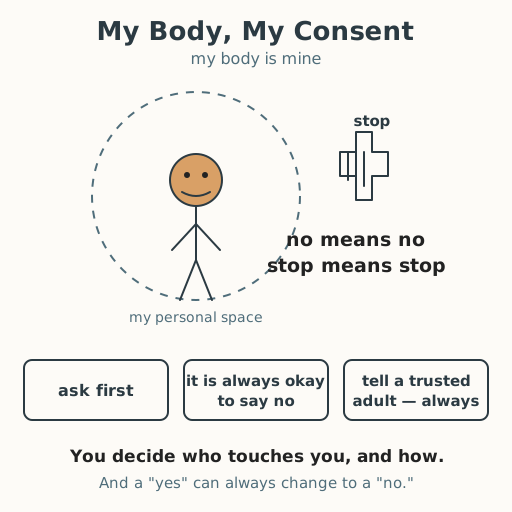
- Consent poster · 1 A poster showing a child with a personal-space bubble, a raised "stop" hand, and the words "ask first," "no means no," "stop means stop," "it is always okay to say no"
- My body, my choice page · 1 per learner A page with sentence starters — "It is always okay to say no to ___," "Before I touch someone, I ___," "A trusted adult I can tell is ___"
- Pencils and crayons · per learner
Low-tech / no-cost
- Personal-space bubble walk Walk with arms outstretched to feel your own space, and practice saying "no" and "stop" with a firm voice; no paper needed
- Circle of trusted adults Sit in a circle and name, one by one, an adult each learner trusts and could tell anything; voices only
Enriched / lab & device
- Consent role-play cards · 1 set per group Cards with everyday situations — a hug, a handshake, a high-five, a pat on the head — for learners to practice asking and answering yes or no
- A short book or video on body boundaries · 1 A gentle, age-appropriate story or clip about personal space and saying no, to reinforce the idea
Works in different contexts
- large-group Present the poster together and chant the phrases, then have pairs practice asking and answering before completing the page
- multi-age Younger learners practice saying "no" and "stop" with a firm voice while older learners model asking first and explain why consent matters
- self-directed A learner reads the poster, completes the page, and practices saying "no means no" and "stop means stop" aloud to themselves
- level-grouped Learners ready to extend role-play a full ask-and-answer ("May I hug you?" → "No, thank you" → "Okay!") and name why a "no" must always be accepted
- outdoor-only Use the personal-space walk and a spoken circle of trusted adults to hold the same ideas with no paper needed
Lesson 7 — My Body, My Consent
Summary
Learners learn that their body belongs to them and that consent is permission they give or do not give for someone to touch them — a hug, a handshake, a high-five, a pat. They practice saying “no” and “stop” with a firm voice, learn to ask before touching someone, and name a trusted adult to tell. The lesson is warm, age-appropriate, and free of any sexual content.
Objectives
- Explain the idea of consent for one’s own body. (D03.S4.05.02)
Connection
Your body is yours. You get to decide who touches you and how — a hug, a handshake, a pat on the head, a high-five — and you can say yes or no to any of them. Consent is that permission: it is given or not given, and only you can give it for your own body. “No means no” and “stop means stop” — when you say them, they must be respected, right away. And it is always okay to say no, even to someone you love, even to a grown-up, even to a hug that is meant kindly. If anyone touches you in a way that feels wrong, or keeps going after you say stop, tell a trusted adult — always, and it is never your fault.
Materials
- Consent poster
- My body, my choice page
- Pencils and crayons
Preparation
- Print or draw the consent poster (a child with a personal-space bubble, a “stop” hand, and the phrases “ask first,” “no means no,” “stop means stop,” “always okay to say no”).
- Copy a my-body-my-choice page for each learner.
- Prepare a calm, private-feeling space; this lesson can raise feelings, so keep the tone warm and unhurried.
Facilitator note
This lesson is written to the learner (“you”). The idea to land is that a child’s body is
their own, “no” and “stop” must always be respected, and a trusted adult is there to help. It
is developmentally appropriate and contains no sexual content: we talk only about everyday
touch (hugs, handshakes, high-fives, pats) and personal space. Do not introduce sexual
topics at this grade. Keep it empowering, never frightening: the child’s right to say no, and to
get help, is the whole point. Reassure learners that if something ever feels wrong, telling a
trusted adult is always the right thing and never their fault. Some learners may disclose
something difficult — respond calmly, thank them for telling you, and follow your local
child-protection/safeguarding procedure. See docs/facilitation.md on holding difficult topics.
Procedure
- Gather (5 min). You have learned to keep your body well and to call for help in an emergency. Today, a different kind of safety: the rule that your body is yours.
- Meet consent (10 min). Look at the poster. Consent means permission. For your own body, only you give it. A hug, a handshake, a high-five, a pat on the head — you can say yes or no to each. The words are simple: “No means no” and “stop means stop.” When you say them, they must be respected right away. And it is always okay to say no — even to someone you love, even to a grown-up.
- Practice the voice — with words or without (10 min). Say it out loud with a firm, clear voice: “No.” “Stop, please.” “No, thank you.” Now say a friendly yes: “Yes, a high-five!” A learner who does not speak can say the same thing without words: a raised “stop” hand (as on the poster), a head shake, a “stop”/“no” card, or a sign — any clear signal is a real “no,” and any clear “yes” (a nod, a thumbs-up) works too. Notice: a yes can change to a no at any time, and that is always allowed. Practice the bubble too — stretch your arms out, or trace the bubble small with your hands from a chair, to feel your personal space, the space around you that belongs to you.
- Ask before you touch (10 min). Consent goes both ways — before you touch someone, even for a hug, you ask first: “May I hug you?” And if they say no, you say “Okay!” and that is the end of it, with no pouting and no pushing.
- Name a trusted adult (5 min). On your page, finish these: “It is always okay to say no to ___.” “Before I touch someone, I ___.” “A trusted adult I can tell is ___.” That adult is someone who will listen and help, no matter what.
- Close (5 min). Your body is yours, and everyone else’s is theirs. No means no, stop means stop, ask first, and always tell a trusted adult. Next time, you will practice the other side: respecting everyone else’s boundaries.
Differentiation
- Support: Provide a word bank (hug, handshake, high-five, pat) and a picture of a trusted adult; practice the voice together as a group.
- Accessibility: “No” and “stop” may be expressed without speech — a raised stop hand, a head shake, a card, or a sign — and “yes” with a nod, thumbs-up, or card. The personal-space bubble can be practiced seated. Partners honor any clear signal as a full answer.
- Extension: Role-play a full ask-and-answer (“May I hug you?” → “No, thank you” → “Okay!”) and write one sentence about why a “no” must always be accepted, never argued with.
Assessment
- Formative (observation): Can the learner state that their body is their own, say “no” and “stop” with a firm voice, name asking-first, and identify one trusted adult to tell?
- Self-check: The learner reads their three completed sentences and checks they can name an adult and say “no means no” and “stop means stop.”
Home connection
At home, talk about who your trusted adults are, and practice saying “no” and “stop” — and hearing a “no” — with a firm, kind voice.
Resources
- Teaching children body autonomy and consent in age-appropriate, non-sexual terms — that their body is their own, that “no” and “stop” must be respected, and that they should tell a trusted adult — is standard in child-safety education and reflected in the UN Convention on the Rights of the Child’s protection of children from harm (Art. 19). See also child-protection guidance from UNICEF and the Red Cross / Red Crescent. This lesson stays at everyday touch and personal space; sexual content is not appropriate at this grade.