Lesson 08 — Respecting Others' Boundaries (Capstone)
The unit capstone turns consent outward: learners practice respecting others' boundaries with a three-step flow — ask first, listen to words and body cues, and respect the answer, accepting a "no" as a full answer. They then review the whole unit — the six nutrients and their jobs, too little and too much over time, the four emergency steps, and the consent rule — into a single portfolio page that ties health, safety, and respect together.
Objectives
Objectives
- D03.S4.05.02 Explain the idea of consent for one's own body and respect for the boundaries of others.
- D03.S3.05.01 Explain how nutrients such as carbohydrates, proteins, fats, vitamins, minerals, and water support different parts of the body.
Essential question
How do I respect others' boundaries — and how does everything I learned this unit fit together?
Key vocabulary
Materials
Standard materials
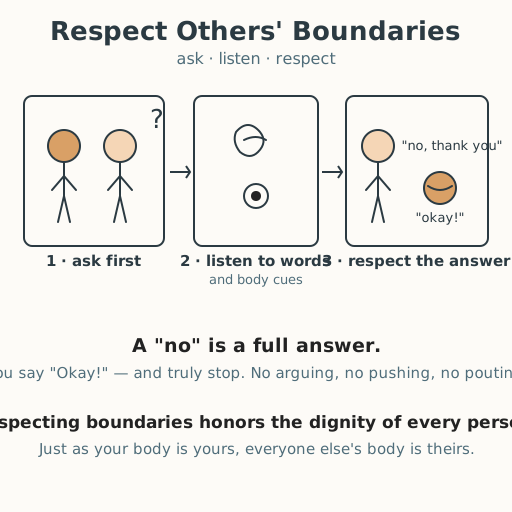
- Ask–listen–respect poster · 1 A poster showing a three-step flow — ask first, listen to words and body cues, respect the answer — with two children, one asking and one answering
- Boundary role-play cards · 1 set per group Cards with everyday situations (a hug, borrowing a pencil, joining a game, a high-five) for practicing ask–listen–respect
- Unit review page · 1 per learner A one-page review (one nutrient and its job, one too-little and one too-much effect over time, the four emergency steps, and the consent rule) — a portfolio artifact
Low-tech / no-cost
- Ask–listen–respect walk-through Walk through the three steps with a partner using only voices and bodies, then discuss; no paper needed
- Round-table recall In a circle, each learner recalls one thing from the unit — a nutrient, an emergency step, or the consent rule — building the review aloud
Enriched / lab & device
- A consent-and-boundaries reflection journal · 1 per learner A small journal page for writing a reflection on respecting boundaries, kept as a portfolio artifact
- A short video on reading body cues · 1 A gentle, age-appropriate clip showing faces and body language that signal yes or no, to sharpen the skill of listening with the eyes
Works in different contexts
- large-group Review as a whole class on the board, then have small groups role-play ask–listen–respect and each learner complete the review page
- multi-age Younger learners practice asking and accepting a "no" while older learners name body cues that signal yes or no and lead the unit review
- self-directed A learner completes the unit review page, practices the three steps, and writes a short reflection on respecting boundaries
- level-grouped Learners ready to extend explain why respecting a "no" is not just kind but necessary, and connect consent to the dignity of every body
- outdoor-only Practice ask–listen–respect in pairs and run the recall as a spoken round, with the review page drawn or written on any available surface
Lesson 8 — Respecting Others’ Boundaries (Capstone)
Summary
The unit capstone turns consent outward: learners practice respecting others’ boundaries with a three-step flow — ask first, listen to words and body cues, and respect the answer, accepting a “no” as a full answer. They then review the whole unit — the six nutrients and their jobs, too little and too much over time, the four emergency steps, and the consent rule — into a single portfolio page that ties health, safety, and respect together.
Objectives
- Explain the idea of consent for one’s own body and respect for the boundaries of others. (D03.S4.05.02)
- Explain how nutrients such as carbohydrates, proteins, fats, vitamins, minerals, and water support different parts of the body. (D03.S3.05.01)
Connection
Consent has two sides. Last time you learned that your body is yours and you can say no. Today, the other side: everyone else’s body is theirs, too — and you are the one who must respect it. That means ask first (“May I hug you?”), listen to their words and their body — a step back, a frown, a shake of the head all say “no” without a sound — and respect the answer. A “no” is a full answer: you do not argue, push, or pout; you say “Okay!” and that is that. Respecting boundaries is how we honor the dignity of every person, whatever their size, shape, or way of living.
Materials
- Ask–listen–respect poster
- Boundary role-play cards
- Unit review page
Preparation
- Print or draw the ask–listen–respect poster (three steps: ask first, listen to words and body cues, respect the answer).
- Copy a set of boundary role-play cards and a unit review page for each learner.
- Recall the whole unit: nutrients (Lessons 1–2), too little and too much over time (Lessons 3–4), emergency response (Lessons 5–6), and consent (Lesson 7).
Facilitator note
This lesson is written to the learner (“you”). It has two jobs: (1) land respect for others’
boundaries — ask, listen, respect, and accept a “no” as full — and (2) review the unit
into one portfolio artifact. Keep the consent content at the same age-appropriate level as
Lesson 7 (everyday touch and personal space; no sexual content). Model the ask–listen–respect
flow as a worked example before pairs role-play, and watch that every “no” in role-play is met
with a graceful “Okay!” — that is the skill. The review page is a chance to catch any learner
who has not yet got a concept and let them revisit it (“not yet” is information, never a
verdict). See docs/facilitation.md and docs/contexts.md.
Procedure
- Gather (5 min). You have traveled through this whole unit — fuel and build, protect and regulate, too little and too much over time, emergencies, and your own consent. Today you finish the last piece: respecting others’ boundaries — and then you tie it all together.
- Meet the three steps (10 min). Look at the poster. One — ask first: before you touch someone or join their game or borrow their things, ask. Two — listen: hear their words, and watch their body cues — a smile and open arms say yes; a step back, a frown, a shake of the head say no. Three — respect the answer: a “no” is a full answer. Say “Okay!” and stop. No arguing, no pushing, no pouting.
- Watch the worked example (5 min). Two learners show it. “May I hug you?” — the other steps back a little and shakes their head. “No, thank you.” The first smiles and says “Okay!” — and does not hug. That is respect, in one moment.
- Role-play (15 min). With a partner, practice the three steps with the cards — a hug, a high-five, borrowing a pencil, joining a game. Take turns asking and answering. Every time someone says no, the other answers “Okay!” and truly stops.
- Review the unit (15 min). On your review page, write or draw: one nutrient and its job; one too-little and one too-much effect over time (about the inside, never size or shape); the four emergency steps and the three things to say; and the consent rule (no means no, stop means stop, ask first). Check with a partner: is anything missing?
- Close (5 min). Healthy, safe, and strong — you know what your body needs, how to keep yourself and others safe, and how to honor every person’s boundaries. That is the whole unit, carried into how you live.
Differentiation
- Support: Provide a partially filled review page and picture prompts; work in a small group with the facilitator.
- Accessibility: A “no” or “yes” may be shown without words — a head shake or nod, a raised stop hand, a card, or a sign — and the ask–listen–respect flow can be practiced seated. Reading body cues is itself non-verbal, so a step back, frown, or head shake is honored as a full “no.”
- Extension: Write a short reflection on why respecting a “no” is not just kind but necessary, and connect consent to the dignity of every body — and give one example from real life.
Assessment
- Formative/summative (performance/portfolio): Can the learner demonstrate ask–listen–respect (including accepting a “no” as full) and complete the review page covering nutrients, too little/too much over time, emergency response, and consent?
- Peer-check: Partners confirm each other’s review pages are complete and that every “no” in role-play was met with “Okay!”
- Self-check: The learner asks, “Can I name the six nutrients, the four emergency steps, and the consent rule — and did I respect every ‘no’ I heard?”
Home connection
At home, practice asking before touching or borrowing, and share your unit review page — one thing about nutrients, one about emergencies, and one about consent — with your family.
Resources
- Respecting others’ boundaries — asking before touching, reading verbal and non-verbal cues, and accepting a “no” as a full answer — is standard in child-safety and social-emotional learning and supports the dignity of every person (see UNICEF child-protection guidance and the UN Convention on the Rights of the Child, Art. 19). The nutrient review draws on the World Health Organization “Healthy diet” fact sheet and micronutrient guidance cited in Lessons 1–4. Consent content here remains age-appropriate and non-sexual.