Lesson 01 — Values Shape Our Choices
Learners explain how a person's **values** shape their **choices** by analyzing a worked example and story cards, then writing or telling their own example of a value guiding a choice.
Objectives
Objectives
- D09.S1.05.01 Explain how a person's values can shape their choices, using a story or example.
Essential question
How do my values shape the choices I make?
Key vocabulary
Materials
Standard materials
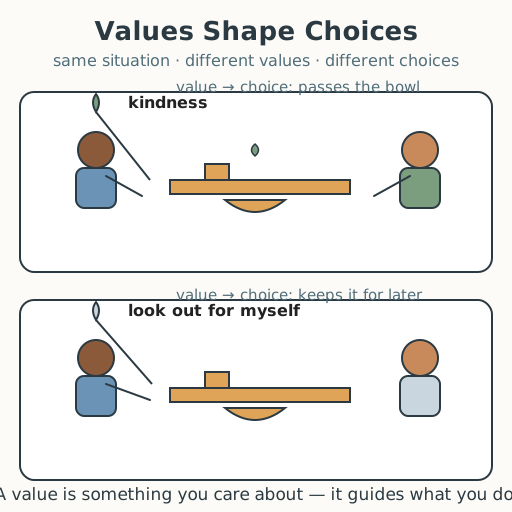
- Value-and-choice poster · 1 A poster showing two characters in the same situation making different choices because they hold different values, with the flow value → choice
- Story cards · 1 set per pair Short stories where a character's value shapes a choice (sharing, honesty, fairness, care)
- Value-and-choice page · 1 per learner A page to name a value, describe the choice it shaped, and draw or write the example
Low-tech / no-cost
- A told story Tell one story aloud about a value shaping a choice; learners retell it and name the value and the choice
- Act it out Learners act out a short scene where a value guides a choice, using voice and body only; no cards or paper needed
Enriched / lab & device
- A class values-and-choices gallery · 1 A shared display where learners post illustrated examples and read each other's, noticing shared and different values
- A short film clip or picture book · 1 A brief video or read-aloud where a character's value clearly shapes a choice, to analyze as a group
Works in different contexts
- large-group Work through one story together on the poster, then have pairs analyze a second story and share one sentence each
- multi-age Younger learners point to the choice a character made and name the value; older learners explain the link in a full sentence
- self-directed A learner reads the worked example, analyzes the story card alone, and writes one example where their own value shaped a choice
- level-grouped Learners ready to extend write a two-character story where the same situation leads to different choices because the values differ
- outdoor-only Use two lines or stones on the ground as two "choices"; step to the choice a character would make and say the value that guided it
Lesson 1 — Values Shape Our Choices
Summary
Learners explain how a person’s values shape their choices. They recall what a value is, analyze a worked example (two characters in the same situation making different choices because their values differ), then work through story cards in pairs and write or tell their own example of a value guiding a choice.
Objectives
- Explain how a person’s values can shape their choices, using a story or example. (D09.S1.05.01)
Connection
Two children, one extra bowl of food. One passes it to the person who has none; the other keeps it for later. Same situation, different choices — because they care about different things. A value is something you care about, and it works like an inner compass: it quietly points your choices one way or another, in a kitchen, a classroom, a market, or anywhere people are together.
Materials
- Value-and-choice poster
- Story cards
- Value-and-choice page
Preparation
- Print or draw the value-and-choice poster (two characters, same situation, different values → different choices).
- Copy story cards for each pair and a value-and-choice page for each learner.
- Arrange a circle and prepare one told story for the whole-group opening.
Facilitator note
This lesson is written to the learner (“you”). The idea to land is a single, precise
link: a value (something a person cares about) shapes the choices they make. Use
explicit instruction and a worked example first — this is a reasoning skill, and novices
learn it best by watching a model before they try it themselves (Kirschner, Sweller &
Clark, 2006). Do not rank values (“kindness is better than looking out for oneself”);
instead notice that different people hold different values, and both shape real choices.
Distinguish evidence from values (docs/philosophy.md §5): that values shape
choices is something we can observe in stories; which values to hold is each person’s
and community’s choice. Keep questions open — invite, never impose. See
docs/facilitation.md.
Procedure
- Gather (5 min). Earlier this year you met the word value — something you care about that guides what you do. Without looking back, try to remember: what is a value? Name one value you care about. (Pause to recall — that is retrieval, and it helps learning stick.)
- Meet the link (10 min). Look at the poster. Two children, one extra bowl of food, and a person with none. One child cares about kindness and passes the bowl. The other cares about looking out for themselves first and keeps it. Same situation, different choices. Why? Because their values — the things they care about — pointed their choices in different directions. The link is: value → choice.
- Worked example (10 min). Watch and help build one together. Story: “Lina finds a wallet on the path.” What does Lina care about? If she values honesty, she returns it. If she values not being noticed, she might leave it. Name the value, then name the choice it shapes, then say the link in one sentence: “Lina values honesty, so she chose to return the wallet.”
- Practice with a partner (10 min). Take a story card. Read it together. Ask the two questions: What does this character care about? What choice does it shape? Then say the link aloud in one sentence, the way you did in the worked example.
- Your own example (10 min). On your page, name one value you care about, and describe a real or invented choice it shaped. Draw it if you like. There is no single right answer — your compass is your own.
Differentiation
- Support: Provide a sentence starter (“I care about ___ , so I chose to ___”) and a story card with a very clear value–choice pair; scribe as needed.
- Extension: Write a two-character story where the same situation leads to different choices because the two characters hold different values.
Assessment
- Formative (observation): Can the learner name a value, name the choice it shaped, and connect them in one sentence?
- Self-check: The learner reads their example and asks, “Is the choice really guided by the value I named — or by something else?”
Home connection
Ask someone at home about a time a value they care about shaped a choice they made, then share your example.
Resources
- Values are a core part of social-emotional learning; see CASEL’s self-awareness and social-awareness competencies: https://casel.org/fundamentals-of-sel/
- On modeling skills for novices before independent practice: Kirschner, Sweller & Clark (2006), https://doi.org/10.1207/s15326985ep4102_1