Lesson 02 — Two Choices, Two Futures
Learners practice **comparing two possible choices and their consequences for others before deciding**. They analyze a worked decision fork, complete choice scenarios in pairs, and record their own two-futures comparison.
Objectives
Objectives
- D09.S1.05.02 Compare two possible choices and their consequences for others before deciding.
Essential question
How do I compare two choices by their consequences for others before deciding?
Key vocabulary
Materials
Standard materials
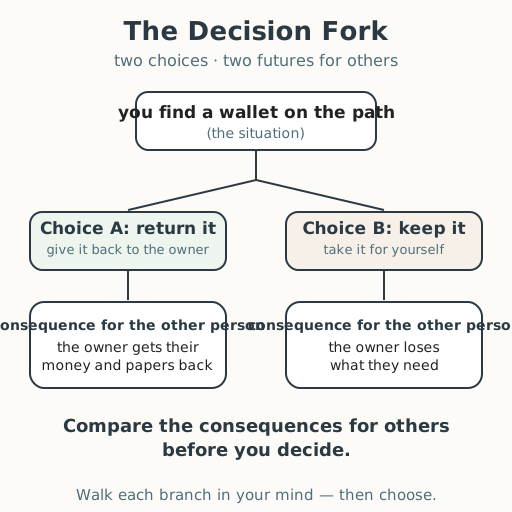
- Decision-fork poster · 1 A diagram with one situation at the top, two branches (Choice A and Choice B), and a consequences-for-others bubble under each branch
- Choice scenarios · 1 set per pair Situations with two possible choices, each with consequences for other people to compare (a found wallet, a borrowed tool, a hurtful rumor, a shared turn)
- Two-futures record page · 1 per learner A page with a fork to record two choices and their consequences for others before deciding
Low-tech / no-cost
- A chalk fork on the ground Draw a branching path in the dirt or on paper; stand at the split and talk through each branch's consequences for others before stepping one way
- Spoken scenarios Tell a situation aloud and invite learners to name two choices and their consequences for others; no paper needed
Enriched / lab & device
- A class decision wall · 1 A shared display where learners post their two-futures forks and read each other's comparisons
- A simple slides or whiteboard tool · 1 per group To build and present a decision fork digitally, making the branches and consequences easy to share
Works in different contexts
- large-group Build one decision fork together on the board, then have pairs complete a scenario and share one branch each
- multi-age Younger learners name the two choices; older learners add the consequences-for-others for each branch
- self-directed A learner works a written scenario alone, fills the two-futures page, and writes which choice they would make and why
- level-grouped Learners ready to extend compare three choices, or weigh which consequence matters more and defend the call
- outdoor-only Use a real branch in the ground as the fork; walk each path while naming consequences for others, then step down the chosen path
Lesson 2 — Two Choices, Two Futures
Summary
Learners practice comparing two possible choices and their consequences for others before deciding. They meet a simple tool — the decision fork — analyze a worked example, then work through choice scenarios in pairs and record their own two-futures comparison.
Objectives
- Compare two possible choices and their consequences for others before deciding. (D09.S1.05.02)
Connection
You find a wallet on the path. Choice A: return it. Choice B: keep it. Before you decide, you can look down each road and ask: what happens to the other person? The owner gets their money and papers back — or loses what they need. Comparing the consequences for others, not just for yourself, is how careful decisions are made — at a market stall, on a shared trail, or anywhere your choice touches someone else.
Materials
- Decision-fork poster
- Choice scenarios
- Two-futures record page
Preparation
- Print or draw the decision-fork poster (one situation, two branches, consequences for others under each).
- Copy choice scenarios for each pair and a two-futures record page for each learner.
- Prepare one spoken scenario for the opening if going low-tech.
Facilitator note
This lesson is written to the learner (“you”). The skill to land is comparing two
choices by their consequences for others before deciding — a reasoning routine, so
model it as a worked example before independent practice (Kirschner, Sweller & Clark,
2006). Keep the emphasis on consequences for others, not just self-interest; that
egalitarian move — who else is affected? — is the heart of the standard. Do not mark
any learner’s genuine choice as “wrong”; instead ask whether they considered the
consequences for others before deciding. Distinguish evidence from values: what the
consequences are is something we can observe and compare; which consequence matters
most is a value judgment. Hold it open. See docs/facilitation.md.
Procedure
- Gather (5 min). Last time you saw that values shape choices. Today you practice the next step: before you decide, compare two choices by what they do to other people.
- Meet the decision fork (10 min). Look at the poster. A situation sits at the top. Two branches split down from it — Choice A and Choice B. Under each branch, a bubble names the consequences for others. That fork is a thinking tool: you walk each branch in your mind before you pick one.
- Worked example (10 min). Build one together. Situation: “Sam borrowed Maya’s tool and broke it.” Choice A: tell Maya and offer to fix it. Choice B: hide it and say nothing. Walk each branch: what happens for Maya in each? For the friendship? Then decide together, and say why. Notice: you compared consequences for another person before deciding.
- Practice with a partner (10 min). Take a scenario. Draw or say the fork: two choices, and under each, the consequences for others. Then decide together and explain your choice in one sentence: “We chose ___ because for the other person it means ___.”
- Your own fork (10 min). On your page, write a real or invented situation, draw two branches, and fill in the consequences for others under each. Then mark the choice you would make and why.
Differentiation
- Support: Provide a pre-drawn fork with one branch filled in; the learner completes the second branch and the consequences-for-others bubbles.
- Extension: Add a third choice to the fork, or weigh which consequence matters most and defend that judgment.
Assessment
- Formative (observation): Can the learner name two choices and describe a consequence for another person for each, before deciding?
- Peer check: Partners check each other’s fork: “Did you name a consequence for someone else, not only for yourself?”
Home connection
Next time a choice at home affects someone else, stop and name two options and one consequence for the other person for each — then decide.
Resources
- Responsible decision-making (identifying and comparing consequences) is a CASEL core competency: https://casel.org/fundamentals-of-sel/
- On modeling a reasoning routine before independent practice: Kirschner, Sweller & Clark (2006), https://doi.org/10.1207/s15326985ep4102_1