Lesson 08 — Working Together for the Common Good
Learners **plan and carry out a small collective action for the common good** — a cleanup, a kindness campaign, or a small act of shared care — and **reflect** on what made it work. They follow a plan-do-reflect cycle, assign roles, act together, and record what they learned.
Objectives
Objectives
- D09.S3.05.02 Plan and carry out a small collective action for the common good, such as a cleanup or kindness campaign, and reflect on what made it work.
Essential question
How do we plan and carry out a small collective action for the common good?
Key vocabulary
Materials
Standard materials
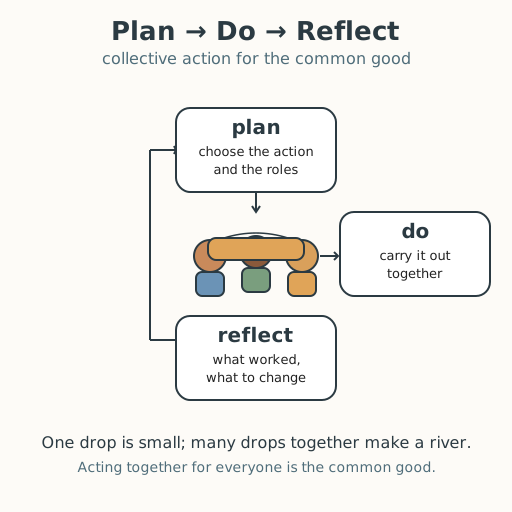
- Plan-do-reflect poster · 1 A three-step cycle — plan, do, reflect — with one sentence under each step and a reminder that the goal is the common good
- Collective-action plan page · 1 per team A page to record the team's chosen action, its goal for the common good, roles, and steps
- Reflection page · 1 per learner A page to reflect after the action: what worked, what surprised us, and what we would change next time
Low-tech / no-cost
- A real small task Choose a real no-cost action — tidying a shared space, a kindness-notes round, gathering litter, helping a younger group — with roles assigned by voice, sign, picture cards, or pointing
- A spoken reflection circle After the action, sit in a circle and each say, sign, write, or draw one thing that worked and one thing to change; no paper needed
Enriched / lab & device
- A shared planning board or slides · 1 A digital or large shared board to post the plan, roles, and steps so the whole team can see and adjust it
- A photo or video record · 1 per team A camera or device to record the action and the reflection, building a small class record of the common good
Works in different contexts
- large-group Plan one shared action as a class, split into teams with clear roles, carry it out, then reflect with one sentence per team
- multi-age Older learners plan and assign roles; younger learners carry out a step and report back what worked
- self-directed A learner chooses a small solo action for the common good, plans it on the page, does it, and completes the reflection
- level-grouped Learners ready to extend choose a slightly larger action and plan a 'what could go wrong and how we will handle it' step
- outdoor-only Choose an outdoor action — clearing a path, watering shared plants, a litter walk — plan it aloud, do it, and reflect in a circle
Lesson 8 — Working Together for the Common Good
Summary
Learners plan and carry out a small collective action for the common good — a cleanup, a kindness campaign, or another small act of shared care — and reflect on what made it work. They follow a plan-do-reflect cycle, assign roles, act together, and record what they learned, producing the unit’s collective-action plan and reflection.
Objectives
- Plan and carry out a small collective action for the common good, and reflect on what made it work. (D09.S3.05.02)
Connection
A littered path no single person wants to clean alone. Ten people, ten minutes — done. Collective action is people working together on something that helps everyone — the common good. One person’s small act is a drop; many drops together are a river. Today you will plan one, do one, and think about what made it work.
Materials
- Plan-do-reflect poster
- Collective-action plan page
- Reflection page
Preparation
- Print or draw the plan-do-reflect poster.
- Copy a plan page for each team and a reflection page for each learner.
- Prepare one or two ready, no-cost action options (a space tidy, a kindness round, a litter walk, helping a younger group) so teams can choose quickly.
Facilitator note
This lesson is written to the learner (“you”). The skill to land is the plan-do-reflect
cycle applied to a real, small, doable collective action for the common good. Keep the
action genuinely small and completable within the session or one short follow-up window —
the reflection matters as much as the deed. This is a skill (planning, dividing roles,
following through), so model one worked plan briefly before teams plan their own
(Kirschner, Sweller & Clark, 2006). The common good framing is a value of this
curriculum (that acting for everyone’s benefit is worth doing) — name it as a value, not
a fact. Make reflection honest and non-judging: what worked and what we would change
are information, never blame. Carry the technology & environment lens honestly: people
organize and communicate to act together in different ways — face to face, on a shared
board, or through digital tools — and each way shapes who can take part and how far the
action reaches; the shared environment is itself part of the common good (a tidied space,
watered plants, a cleared path). Name tools as helpers of people, never replacements for
them. See docs/facilitation.md.
Procedure
- Gather (5 min). You have learned how decisions get made. Today you make something good happen — together. Try to recall: what is one thing a group can do that helps everyone, not just one person? (Pause.)
- Meet the cycle (10 min). Look at the poster. Plan — choose a small action and decide who does what. Do — carry it out together. Reflect — ask what worked and what you would change. The goal is the common good: something that helps everyone, not just the doer. People organize to act in different ways — talking in a circle, writing on a shared board, or using digital tools to reach more people — and the common good often includes our shared environment: a tidied space, watered plants, a cleared path.
- Worked example (5 min). Build a tiny plan together: action — tidy the shared reading corner. Roles — one person gathers books, one dusts, one checks the floor. Steps — gather, sort, sweep, return. Watch how a plan turns a big job into small parts.
- Plan and do (20 min). In your team, choose your small action for the common good. Fill your plan page: the action, the goal, the roles, the steps. Then carry it out. Work together; if a step changes, adjust the plan — that is part of doing.
- Reflect (5 min). Sit together and fill your reflection page: What worked? What surprised us? What would we change next time? Say, sign, write, or draw one thing to share with the group.
Differentiation
- Support: Offer a pre-planned action with roles already listed; the learner does one step and completes a simple two-line reflection.
- Extension: Add a “what could go wrong and how we will handle it” step to the plan before acting.
- Seated & non-speaking participation: Choose a seated, no-walking action (a kindness-notes round, a thank-you poster, a picture story read to a younger group) and assign seated, non-verbal roles such as scribe, illustrator, sorter, or greeter (wave or hold up a card). A learner may plan and reflect entirely by writing, drawing, or pointing to picture cards — no speech or standing is required to take part.
Assessment
- Summative (performance/portfolio): Did the team plan an action for the common good, carry it out, and reflect — naming at least one thing that worked and one thing to change? The plan page and reflection page are kept as artifacts.
- Self-check: The learner asks, “Did our action help everyone, not just us? Did I do my part? Can I name what worked and what I would change?”
Home connection
With someone at home, do one small thing for the shared space or neighborhood — then talk about what worked and what you would change.
Resources
- Cooperative learning and collective action have a strong research base (Slavin, Cooperative Learning, 1995). The “common good” framing is a value held by this curriculum, not a scientific claim.
- On modeling planning/roles before independent practice: Kirschner, Sweller & Clark (2006), https://doi.org/10.1207/s15326985ep4102_1