Lesson 09 — Helping Two Peers Solve a Conflict
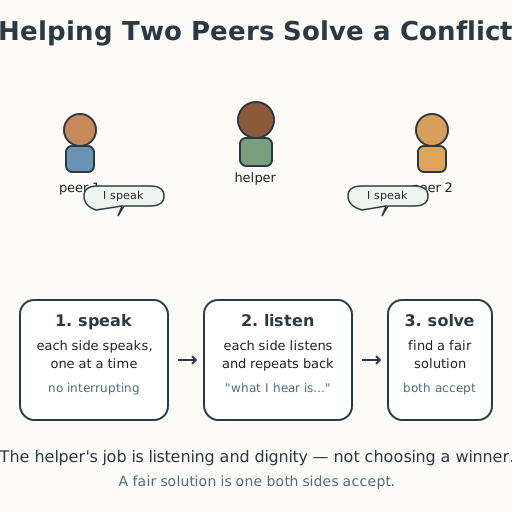
Learners practice **helping two peers solve a simple conflict** by having **each side listen** and **find a fair solution**. They learn a short mediation routine — each side speaks one at a time, each listens and repeats back, name the needs, then find a fair solution both accept — and role-play it in trios.
Objectives
Objectives
- D09.S4.05.01 Help two peers solve a simple conflict by having each side listen and find a fair solution.
Essential question
How do I help two peers solve a conflict by having each side listen and find a fair solution?
Key vocabulary
Materials
Standard materials
- Mediation-steps poster · 1 A poster with the steps — each side speaks one at a time, each side listens and repeats back, name the needs, brainstorm fair solutions, choose one both accept
- Conflict role-play cards · 1 set per trio Simple two-person conflicts (both want the last turn, both want the same spot, a borrowed item) for trios to role-play with one helper
- Mediation record page · 1 per trio A page to record each side's need and the fair solution the trio reached
Low-tech / no-cost
- A spoken worked example Act out a mediation aloud with two volunteers while the group names each step; no cards needed
- A talking object Pass a stone or stick so only the person holding it speaks; the other side listens and repeats back before the object moves on
- Picture/word need cards Simple cards (a turn, the pencil, the spot, 'I need to be heard') so a side can point to a need instead of speaking; works with the talking object for non-speaking learners
Enriched / lab & device
- A short film or scripted scene of mediation · 1 A brief video or read-aloud showing a peer helper guiding two sides through the steps, to analyze as a group
- A class peace-corner with the steps posted · 1 A quiet corner where learners can use the mediation steps themselves, with the poster and a talking object ready
Works in different contexts
- large-group Model one full mediation with volunteers, then have trios role-play and share the fair solution they reached
- multi-age Older learners act as the helper; younger learners play the two sides and practice speaking and repeating back
- self-directed A learner reads the steps, writes how they would help two peers through a given scenario, and records each side's need and a fair solution
- level-grouped Learners ready to extend try a harder scenario where both sides' needs are partly right, and find a solution that honors both
- outdoor-only Use the talking object outdoors; two learners sit as the sides, one stands as the helper, and they walk the steps aloud
Lesson 9 — Helping Two Peers Solve a Conflict
Summary
Learners practice helping two peers solve a simple conflict by having each side listen and find a fair solution. They learn a short mediation routine — each side speaks one at a time, each listens and repeats back, name the needs, then find a fair solution both accept — and role-play it in trios, producing a mediation record.
Objectives
- Help two peers solve a simple conflict by having each side listen and find a fair solution. (D09.S4.05.01)
Connection
Two friends both want the last turn, or the same spot, or the one borrowed pencil. Both are upset, and neither is listening. A helper can change everything: not by choosing a winner, but by helping each side speak, and each side listen, until they find a fair solution they both accept. That is what you will practice today — in the classroom, the yard, or anywhere people disagree.
Materials
- Mediation-steps poster
- Conflict role-play cards
- Mediation record page
Preparation
- Print or draw the mediation-steps poster.
- Copy role-play cards for each trio and a record page per trio.
- Arrange trios (two sides + one helper); prepare a talking object if going low-tech.
Facilitator note
This lesson is written to the learner (“you”). The skill to land is a short peer
mediation routine: (1) each side speaks, one at a time; (2) the other side listens and
repeats back what they heard; (3) name each side’s need; (4) brainstorm fair
solutions; (5) choose one both accept. This is a skill, so model the full routine
once as a worked example before trios try it (Kirschner, Sweller & Clark, 2006). Keep
it non-shaming: a conflict is not a moral failure, and no child is “the bad one.”
The helper’s job is dignity and listening, never judgment. Emphasize that the fair
solution must be accepted by both sides — not imposed. Draw a clear safety boundary:
if anyone is hurt, scared, threatened, or unsafe — or the conflict feels too big — the
helper’s first move is to bring in a trusted adult; a peer helper never resolves a
serious conflict alone. See docs/facilitation.md.
Procedure
- Gather (5 min). You have practiced comparing choices and seeing fairness. Now a skill for real life: when two people disagree, you can help them solve it without anyone winning or losing. Try to recall: what does it mean to really listen? (Pause.)
- Meet the steps (10 min). Look at the poster. The helper has five moves: each side speaks, one at a time (no interrupting); each side listens and repeats back what the other said; name the needs (“you need a turn; you need the pencil too”); brainstorm fair solutions (two or three ideas); choose one both accept.
- Worked example (10 min). Watch and help. Two volunteers are the sides (“I had the ball first!” / “I never get a turn!”); you are the helper. Walk each step slowly, and let the class name what to say next. End with a fair solution both agree to.
- Role-play in trios (15 min). Take a role-play card. One of you is the helper; two are the sides. Run the steps. The helper keeps it calm and fair; the sides practice speaking and repeating back. If the first solution doesn’t work, brainstorm again. Remember: if anyone is hurt, scared, threatened, or unsafe — or the conflict feels too big — the helper’s first move is to bring in a trusted adult. A peer helper never resolves a serious conflict alone.
- Record and close (5 min). On your page, write each side’s need and the fair solution you reached. Then say one thing you noticed: what helped the two sides actually listen to each other?
Differentiation
- Support: Provide a card with the steps printed as a checklist and a sentence starter for repeating back (“What I hear you saying is ___”).
- Extension: Try a harder scenario where both sides’ needs are partly right, and find a solution that honors both rather than splitting the difference.
- Non-speaking & seated participation: Role-play is done seated, so no walking or standing is required. A learner may express a need by pointing to a picture/word card, writing on the mediation record page, or gesturing; the helper then reads back or points to what each side showed. Repeating back can be done by pointing to the need card or writing, so fluent speech is never required to take a side or act as helper.
Assessment
- Formative (performance/observation): In role-play, does the helper ensure each side speaks and listens (repeats back), and guide the pair to a fair solution both accept?
- Self-check: The learner asks, “Did I help both sides speak? Did I help them listen? Was the solution fair to both, and did both accept it?”
Home connection
Next time you see two people disagreeing at home or nearby, you can help each side speak and listen — and find a solution both accept. Remember the safety line: if anyone is hurt, scared, threatened, or unsafe, or the disagreement feels too big, the first step is to bring in a trusted adult rather than handle it alone.
Resources
- Restorative practice frames responding to conflict by listening and repairing rather than only punishing: International Institute for Restorative Practices, https://www.iirp.edu/
- On modeling a routine before independent practice: Kirschner, Sweller & Clark (2006), https://doi.org/10.1207/s15326985ep4102_1